Портрет на Вилем Де Кунинг

100-те най-известни картини на Вилем Де Кунинг, всяка от които е уникална

Обновено Ноември 2026 · класирано според нашия индекс на популярност (търсения, посещения и поръчки за всяко произведение) · 117 творби на Вилем Де Кунинг в нашия каталог

Накратко

Жена I (1952) е картината на Вилем Де Кунинг, която привлича най-много погледи. След това погледът се насочва към Парк Розенберг, 1957, частна колекция и Разкопка (1950). Сред 117 произведения на Вилем Де Кунинг в нашия каталог, тези 100 са най-известните – всяко от тях е уникален оригинал, представен с годината на създаване, музея и причината за неговата вечност.

1904 – 1997, Ротердам Абстрактен експресионизъм Най-много творби: Art Institute of Chicago

Топ 10 картини на Вилем Де Кунинг, през погледа на галерията

1
Жена I (1952) на Вилем Де Кунинг

Жена I

1952 · Масло върху платно

Създадена между 1950 и 1952 година, тази емблематична творба заема централно място в прочутата серия “Жена” на Вилем де Кунинг. Повече от просто портрет, тя е висцерално изследване на женската форма – и по-широко, сурово изображение на следвоенната обществена тревожност, раздробената идентичност и първичните емоции. Де Кунинг не се стреми да представи идеална красота, а да улови вътрешния хаос и сложността на човешкото съществуване.

2
Парк Розенберг, 1957, частна колекция на Вилем Де Кунинг

Парк Розенберг, 1957, частна колекция

Масло върху платно

Картината Парк Розенберг, създадена през 1957 г., представлява визуално изследване на цвета и формата чрез съзнателно намаляване на сложността. Централният сюжет се състои от бледосиня платно, върху което са наложени смели ивълнати участъци жълта боя. Краищата на това платно изглеждат разкъсани или разкъсани, което допринася за една композиция, която се усеща донякъде хаотична и абстрактна. На заден план се вижда фигура човек, макар специфичните му черти да остават неразличими.

3
Разкопка (1950) на Вилем Де Кунинг

Разкопка

1950 · Масло върху платно · Art Institute of Chicago, Чикаго

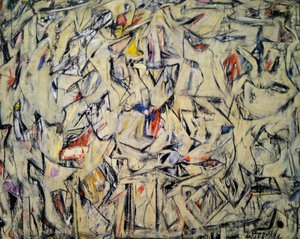
Уилъм де Кунинг, геният на 1950 г. с творбата си *Excavation*, не просто създава картина; тя е разкопаване – висцерално извличане на форма и чувство. Намираща се в Артистичния институт в Чикаго, тази монументална работа е ключов момент в еволюцията на абстрактното изкуство, бележейки решителна промяна от традиционното представяне и потапяйки се в дълбините на вътрешния свят на художника. По-скоро отколкото просто абстрактна композиция, *Excavation* сякаш е свидетелство за първичен…

4
Портал към реката (1960) на Вилем Де Кунинг

Портал към реката

1960 · Акрил върху платно

For those seeking to experience the power and dynamism of Willem de Kooning’s “Door to the River” firsthand, high-quality reproductions are available through AllPaintingsStore.com and AllPaintingsStore.com. Further exploration of de Kooning’s oeuvre, including his seminal work “Interchange,” can be found on Wikipedia: Wikipedia.

5
Стил Лифт (1945) на Вилем Де Кунинг

Стил Лифт

1945 · Масло върху платно

Възкресение на Емоцията и Формата: „Сцена от Живота“ на Вилем де Кунинг „Сцена от Живота“ (1945) е емблематична творба на Вилем де Кунинг и същински пример за абстрактен експресионизъм – движение, което презира реалистичната живопис в полза на спонтанни движения и емоционална резонанс. Картината е създадена през 1945 г., в разгара на опустошителните последствия от Втората световна война и носи дълбоко послание за търсенето на вътрешна истина и експеримента с…

6
Жени пеещи II (1966) на Вилем Де Кунинг

Жени пеещи II

1966 · Масло върху платно

Женски Хор II – Символ Емоционална Сила и Абстрактна Красота Женски Хор II от Уилем де Кунинг е произведение на изкуството, което пленява окото със своите ярки цветове и динамична композиция. Картината е създадена през 1966 г., когато художникът е в разцвета си на творческия си период и е част от движението Абстрактен експресионизъм – една от най-значимите художествени тенденции на XX век. Изпълнена с енергия и страст, тя предава…

7
Ешвил (1948) на Вилем Де Кунинг

Ешвил

1948 · Акрил върху платно

„Ешвил“ на Willem de Kooning не е просто изображение на лице; това е въплъщение на психологически раздразнителност и вътрешен хаос. Написан през 1948 г., в разцвета на неговия период на Абстрактен експресионизъм, портретът улавя момент на интензивна конфронтация със собственото „аз“ – визуално представяне на вътрешната борба и неразрешените тревоги. Картината служи за отличен пример за стилистичните белези на това направление: спонтанен жест, фрагментирана форма и съзнателно отказване от представителната…

8
Marilyn Monroe (1954) на Вилем Де Кунинг

Marilyn Monroe

1954 · Масло върху платно

Created in 1954, Willem de Kooning's *Marilyn Monroe* is not a conventional portrait of the iconic actress. Instead, it’s a visceral and emotionally charged interpretation that reflects the artist’s engagement with popular culture and his signature Abstract Expressionist style. This painting offers a fascinating glimpse into De Kooning’s approach to figuration and his ability to convey complex emotions through abstract means.

9
Посещението, галерия Tate (1966) на Вилем Де Кунинг

Посещението, галерия Tate

1966 · Акрил върху платно

Картината „Посещението“ на Вилем Де Кунинг, придобита от галерия Tate през 1969 г., се издига като крайъгълен камък на Абстрактния експресионизъм — движение, което необратимо промени пейзажа на следвоенното изкуство. Тази монументална маслена живопис надхвърля обикновеното репрезентативно представяне; тя олицетворява дълбоко изследване на емоцията и физичността, улавяйки момент, замръзнал във времето, но изпълнен с динамика.

10
Women singing ii tate gallery (1966) на Вилем Де Кунинг

Women singing ii tate gallery

1966 · Oil On Paper

Three figures emerge from a thicket of paint, their mouths open in a shared, wordless note. The canvas holds a moment caught from a television broadcast, where pop singers once flickered in the glow of 1966. One woman leans toward the left, her face caught in a sudden expression, while another turns her gaze away, lost in the rhythm. A third figure stands near the edge, part of a crowded,…

Знаменитите картини на Вилем Де Кунинг, номера от 11 до 100

11Zurich (1947) на Вилем Де КунингZurich1947 12Abstraction (1950) на Вилем Де КунингAbstraction1950 13The Acrobat (1942) на Вилем Де КунингThe Acrobat1942 · Музеят „Мунк“ 14Clam Diggers (1963) на Вилем Де КунингClam Diggers1963 15Seated Woman (1940) на Вилем Де КунингSeated Woman1940 16The Visit (1967) на Вилем Де КунингThe Visit1967 17Woman and Bicycle (1952) на Вилем Де КунингWoman and Bicycle1952 18Gotham News (1955) на Вилем Де КунингGotham News1955 19Suburb in havana (1958) на Вилем Де КунингSuburb in havana1958 20Untitled (10) (1950) на Вилем Де КунингUntitled (10)1950 21Неопределено (21) на Вилем Де КунингНеопределено (21) 22Seated woman 2,1940, private на Вилем Де КунингSeated woman 2,1940, private 23Saturday Night (1956) на Вилем Де КунингSaturday Night1956 24Woman V, 1952-53 (oil ^ charcoal on canvas) (1953) на Вилем Де КунингWoman V, 1952-53 (oil ^ charcoal on canvas)1953 25Картина (1948) на Вилем Де КунингКартина1948 26Two Women in the Country (1954) на Вилем Де КунингTwo Women in the Country1954 27Litho 2 (Waves 2) (1960) на Вилем Де КунингLitho 2 (Waves 2)1960 28Composition на Вилем Де КунингComposition 29Sphinx (1964) на Вилем Де КунингSphinx1964 30Seated Man (1939) на Вилем Де КунингSeated Man1939 31Woman with a Green and Beige Background на Вилем Де КунингWoman with a Green and Beige Background 32Untitled (1950) на Вилем Де КунингUntitled1950 · Art Institute of Chicago 33Untitled (1950) на Вилем Де КунингUntitled1950 34Untitled (1949) на Вилем Де КунингUntitled1949 35Zot (1949) на Вилем Де КунингZot1949 36Woman (1950) на Вилем Де КунингWoman1950 37Untitled III (1981) на Вилем Де КунингUntitled III1981 38Woman (1949) на Вилем Де КунингWoman1949 39Two Standing Women (1963) на Вилем Де КунингTwo Standing Women1963 40Легенда и Факт (1940) на Вилем Де КунингЛегенда и Факт1940 41Pink Lady (1965) на Вилем Де КунингPink Lady1965 42Two Standing Men (1938) на Вилем Де КунингTwo Standing Men1938 43Seated figure (male classical) (1939) на Вилем Де КунингSeated figure (male classical)1939 44Night (1948) на Вилем Де КунингNight1948 45Standing Man (1942) на Вилем Де КунингStanding Man1942 46Woman, Sag Harbor (1964) на Вилем Де КунингWoman, Sag Harbor1964 47Untitled (17) (1965) на Вилем Де КунингUntitled (17)1965 48Asheville (1948) на Вилем Де КунингAsheville1948 · The Phillips Collection 49Woman Verso Untitled (1948) на Вилем Де КунингWoman Verso Untitled1948 50Special Delivery (1946) на Вилем Де КунингSpecial Delivery1946 51Queen of Hearts (1946) на Вилем Де КунингQueen of Hearts1946 52White Nude (1967) на Вилем Де КунингWhite Nude1967 53Untitled (1964) на Вилем Де КунингUntitled1964 54Woman with a Hat (1966) на Вилем Де КунингWoman with a Hat1966 55Special Delivery (1946) на Вилем Де КунингSpecial Delivery1946 56Secretary (1948) на Вилем Де КунингSecretary1948 57Дърво в Неапол на Вилем Де КунингДърво в Неапол 58Summer couch (detail) mid (1900) на Вилем Де КунингSummer couch (detail) mid1900 59With Love (1971) на Вилем Де КунингWith Love1971 60Painting,1950, private на Вилем Де КунингPainting,1950, private 61Untitled (11) (1958) на Вилем Де КунингUntitled (11)1958 62Two trees on Mary Street . . . Amen! (1975) на Вилем Де КунингTwo trees on Mary Street . . . Amen!1975 63Brooding Woman (1965) на Вилем Де КунингBrooding Woman1965 64Woman Red Hair, Large Mouth, Large Foot (1965) на Вилем Де КунингWoman Red Hair, Large Mouth, Large Foot1965 65Meg (1955) на Вилем Де КунингMeg1955 · Даласски музей на изкуствата 66Figure and Landscape No. 2 (1951) на Вилем Де КунингFigure and Landscape No. 21951 67Landscape at Stanton Street (1971) на Вилем Де КунингLandscape at Stanton Street1971 68Reclining Man (John F. Kennedy) (1963) на Вилем Де КунингReclining Man (John F. Kennedy)1963 69Фирън Айленд (1946) на Вилем Де КунингФирън Айленд1946 70Untitled (1962) на Вилем Де КунингUntitled1962 71Untitled (23) (1968) на Вилем Де КунингUntitled (23)1968 72Untitled (verso: Untitled) (1959) на Вилем Де КунингUntitled (verso: Untitled)1959 73Жената (1964) на Вилем Де КунингЖената1964 74Excavation,1950, art institute of chicago на Вилем Де КунингExcavation,1950, art institute of chicago 75Woman i (detail),1950-52, moma ny на Вилем Де КунингWoman i (detail),1950-52, moma ny 76The Marshes (1971) на Вилем Де КунингThe Marshes1971 77Untitled (woman) (1971) на Вилем Де КунингUntitled (woman)1971 78Untitled (19) (1967) на Вилем Де КунингUntitled (19)1967 79Неопределено -2 от Четырёх литографий (1986) на Вилем Де КунингНеопределено -2 от Четырёх литографий1986 80Untitled (14) (1964) на Вилем Де КунингUntitled (14)1964 81Merritt Parkway (1959) на Вилем Де КунингMerritt Parkway1959 82Two Figures (1964) на Вилем Де КунингTwo Figures1964 83The Glazier (1940) на Вилем Де КунингThe Glazier1940 84Detour (1958) на Вилем Де КунингDetour1958 · Баварски държавни списъци с произведения на изкуството 85Queen of Hearts (1943) на Вилем Де КунингQueen of Hearts1943 86Untitled XIII (1985) на Вилем Де КунингUntitled XIII1985 · Cleveland Museum of Art 87Two Woman IV (1952) на Вилем Де КунингTwo Woman IV1952 88Devil at the Keyboard (1976) на Вилем Де КунингDevil at the Keyboard1976 89The Wave на Вилем Де КунингThe Wave 90Неозаглавен I (1981) на Вилем Де КунингНеозаглавен I1981 91Untitled XII (1983) на Вилем Де КунингUntitled XII1983 92Whose Name Was Writ in Water (1975) на Вилем Де КунингWhose Name Was Writ in Water1975 93The Wave (1943) на Вилем Де КунингThe Wave1943 · Smithsonian American Art Museum 94Two Standing Men (1938) на Вилем Де КунингTwo Standing Men1938 · Метрополитън Музей на изкуствата 95Lily Pond (1959) на Вилем Де КунингLily Pond1959 · Toledo Museum of Art 96Woman VIII (1961) на Вилем Де КунингWoman VIII1961 · Smithsonian American Art Museum 97Woman (1965) на Вилем Де КунингWoman1965 98Woman in the Pool (1968) на Вилем Де КунингWoman in the Pool1968 · Phoenix Art Museum 99Woman (1964) на Вилем Де КунингWoman1964 100Woman (1964) на Вилем Де КунингWoman1964

Знаменитите картини на Вилем Де Кунинг, период по период

Темите, които привличат погледа на Вилем Де Кунинг

Четирите найчесто срещани теми в тези оригинални творби, всяка с най-добрия си пример.

Музеите, в които се съхраняват оригиналите на Вилем Де Кунинг

8 музея, които притежават най-голям брой от картините на тази страница.

Музеи Град Творения на Вилем Де Кунинг Картини от този списък
Art Institute of Chicago, ЧикагоArt Institute of Chicago Чикаго 3 Разкопка, Untitled
Smithsonian American Art Museum, Вашингтон, окръг КолумбияSmithsonian American Art Museum Вашингтон, окръг Колумбия 2 The Wave, Woman VIII
Музеят „Мунк“, ОслоМузеят „Мунк“ Осло 1 The Acrobat
The Phillips Collection, Вашингтон, окръг КолумбияThe Phillips Collection Вашингтон, окръг Колумбия 1 Asheville
Даласски музей на изкуствата, ДъласДаласски музей на изкуствата Дълас 1 Meg
Баварски държавни списъци с произведения на изкуството, МюнхенБаварски държавни списъци с произведения на изкуството Мюнхен 1 Detour
Cleveland Museum of Art, КливландCleveland Museum of Art Кливланд 1 Untitled XIII
Метрополитън Музей на изкуствата, Ню ЙоркМетрополитън Музей на изкуствата Ню Йорк 1 Two Standing Men

Вилем Де Кунинг през десетилетията: един уникален оригинал за всяко

Произведения по десетилетия

Изберете десетилетие, за да видите оригиналната творба, която го определя.

Картини на Вилем Де Кунинг: въпроси към галерията

Кое е най-известното произведение на Вилем Де Кунинг?Разкрийте отговора

Жена I (1952). Следващите са Парк Розенберг, 1957, частна колекция и Разкопка (1950).

На каква възраст Вилем Де Кунинг създава Жена I?Разкрийте отговора

48 години: Жена I е от 1952 г., а Вилем Де Кунинг е роден/а в 1904.

Кои са десетте най-известни картини на Вилем Де Кунинг?Разкрийте отговора

Жена I, Парк Розенберг, 1957, частна колекция, Разкопка, Портал към реката, Стил Лифт, Жени пеещи II, Ешвил, Marilyn Monroe, Посещението, галерия Tate и Women singing ii tate gallery. Класацията по-горе показва годината и музея за всяко от тях.

Колко са известните творби на Вилем Де Кунинг?Разкрийте отговора

В нашия каталог са представени 117 произведения на Вилем Де Кунинг, датирани от 1938 до 1986.

Къде могат да се видят най-известните оригинали на Вилем Де Кунинг?Разкрийте отговора

Предимно в Art Institute of Chicago (Чикаго), Smithsonian American Art Museum (Вашингтон, окръг Колумбия) и Музеят „Мунк“ (Осло). В горната таблица с музеи са изброени всички тях.

През кой период Вилем Де Кунинг създава най-известните си картини?Разкрийте отговора

В 1960s: 29 от 100 произведенията на тази страница са създадени тогава, като Портал към реката са сред тях.

Коя е най-ранната и коя е най-късната известна картина на Вилем Де Кунинг?Разкрийте отговора

На тази страница най-старата е Two Standing Men (1938), а най-новата е Неопределено -2 от Четырёх литографий (1986).

Какви теми предпочиташе Вилем Де Кунинг?Разкрийте отговора

Woman (16), Emotional intensity (15) и American art (14), разпределени в 100 произведения на тази страница.

С какви материали най-често е живописувал Вилем Де Кунинг?Разкрийте отговора

Oil On Canvas, за 36 от 100 произведения на тази страница.

Към кое художествено направление принадлежи творчеството на Вилем Де Кунинг?Разкрийте отговора

Абстрактен експресионизъм, судейки по оригиналите на тази страница.

Какви оригинални творби на Вилем Де Кунинг мога да видя в Art Institute of Chicago?Разкрийте отговора

Разкопка и Untitled: Art Institute of Chicago, Чикаго притежава 2 от произведенията на тази страница.

Вилем Де Кунинг: портрет на художника

The Life of Willem de Kooning

Rotterdam, 1904. The air in the Netherlands carries the weight of a family in transition. Willem de Kooning enters the world on April 24, born to Leendert de Kooning and Cornelia Nobel. His early years are defined by a familial split, a divorce that leaves a sense of restless searching in its wake. This internal displacement follows him across the Atlantic. In 1926, he arrives in America not as a traveler, but as a stowaway on a British freighter, landing at Newport News, Virginia. He is an outsider looking for a foothold in a new landscape.

The grit of New York City becomes his reality. He navigates the urban sprawl through manual labor, working as a house painter and a carpenter to sustain his vision. This period of survival is not a detour; it is the foundation. He absorbs the pulse of the city, moving from the physical toil of construction to the intense, gestural demands of the canvas. His existence becomes a continuous negotiation between the structured world of his training and the chaotic energy of the New York School.

He remains a central figure in the Abstract Expressionist movement, a presence that persists through decades of stylistic evolution. He moves from the depiction of urban scenes toward a more visceral, fragmented language of form. This trajectory continues until his death on March 19, 1997, at the age of 92. He leaves behind a body of work that reflects a lifelong struggle to articulate the human psyche through paint.

Early Life and Artistic Training

Rotterdam, 1916. The classroom is abandoned. At twelve years old, Willem de Kooning leaves formal schooling behind to enter the world of commercial art. He begins an apprenticeship with a firm of commercial artists, learning the technical mechanics of the trade. The focus is on precision and the practical application of pigment. It is a period of disciplined labor, building a foundation of craftsmanship that remains present even as his later work moves toward abstraction.

The evenings belong to the Academie van Beeldende Kunsten en Technische Wetenschappen. From his teenage years until 1924, he attends these classes in Rotterdam, balancing the demands of work with the study of formal art. He is honing his ability to see, to map form, and to understand the structure of the visual world. By the time he leaves the academy, he is no longer just an apprentice. He is a portrait painter, capturing the likenesses of his subjects with a growing sense of technical command. This period of focused training provides the essential tools for the radical shifts that await him across the Atlantic.

Arrival and Life in New York

The Atlantic crossing is a gamble of shadows. In 1926, de Kooning arrives in the United States not as a passenger, but as a stowaway on the British freighter Shelley. The ship docks at Newport News, Virginia, on August 15, 1926. From there, the momentum shifts toward the grit of New York City. The city provides a landscape of labor and survival. He navigates the urban environment by working as a house painter, a carpenter, and a commercial artist. These manual trades keep him tethered to the physical reality of the city while he pursues his vision.

By 1934, the struggle for recognition takes a more organized form. He joins the Artists Union, a move that places him within the collective energy of the New York art scene. The work is demanding. He moves between the precision of commercial art and the heavy, physical labor of his various jobs. This period is defined by a relentless, daily grind in the city that will eventually become his home. He is an outsider working from within the machinery of New York life.

Key Works and Major Series

The early years of the 1930s find him working through the tension between representation and the emerging abstract impulse. Around 1938, he produces Two Standing Men, a work that captures a sense of the figure before the total dismantling of form takes hold. This period of experimentation leads toward a radical shift in the early 1950s. Between 1950 and 1953, he produces the Woman series, a sequence of paintings that confront the viewer with fragmented, visceral depictions of the female form. These works do not seek to idealize; instead, they use aggressive brushwork to explore the complexities of human emotion and sexuality.

Within this intense period, Woman I emerges, created between 1950 and 1952. The canvas is a site of struggle, where the figure is caught in a web of thick impasto and jarring color. This focus on the human figure eventually gives way to a different kind of spatial tension. By 1955, he completes Interchange. This work marks a departure from the figurative intensity of the previous years, moving toward an expansive, abstract urban landscape. The transition is visible in the way he handles space and color, shifting from the carnal focus of the Woman series to the more architectonic, gestural compositions of the mid-century.

Technique and Artistic Style

The canvas becomes an arena of physical struggle. De Kooning attacks the surface with aggressive brushwork, building up layers of thick impasto that create a heavy, tactile topography. He does not merely apply paint; he manipulates it, often employing a wet-on-wet technique aided by the addition of salad oil to the pigment. This method allows for a fluid, unpredictable interaction between colors, where edges blur and new textures emerge from the constant movement of the brush. His marks are rarely controlled or static. Instead, they are gestural, leaving behind calligraphic black images that slash through the composition with sudden, decisive energy.

He refuses the comfort of a single category. While many of his contemporaries move toward pure abstraction, de Kooning maintains a restless tension between the recognizable and the chaotic. He frequently merges abstraction and figuration, pulling elements of the human form into a fractured, non-linear space. A face might emerge from a tangle of strokes only to be dismantled by the next layer of paint. This refusal to settle on a definitive shape creates a sense of constant becoming. The work exists in a state of perpetual revision, where the act of painting is as much about the struggle to find a form as it is about the form itself.

Influences and Artistic Circles

The shift from representation toward abstraction happens in the company of others. In New York, de Kooning finds a mentor in Arshile Gorky. The relationship is profound; Gorky is the master who pushes him toward experimentation and the dismantling of traditional forms. This connection provides the bridge between de Kooning's early urban landscapes and the visceral abstraction that defines his later years. He moves through a landscape of ideas, absorbing the influence of Stuart Davis and John Graham, whose presence helps steer his vocabulary away from literal depiction.

The visual language he develops is a collision of disparate forces. He draws from the structural lessons of Cubism and the psychological depth of Surrealism. The influence of Picasso is felt in his approach to form, while the work of Franz Kline introduces a new dimension to his practice. From Kline, he adopts a more calligraphic approach, utilizing black and white enamel compositions and gestural marks that replace violent brushstrokes. This evolution marks a departure from his earlier, more heavy-handed methods.

He becomes a central figure within the New York School. This group of artists, including figures like Jackson Pollock and Lee Krasner, redefines the creative epicenter of the art world. They reject the sterile formalism of previous movements, opting instead for a space where the canvas becomes an arena for spontaneous, emotional truth. Within this circle, de Kooning’s work oscillates between the figurative and the abstract, never fully settling into one or the other.

Marriage and Personal Life

The year 1943 marks a shift in the domestic landscape of his life when he marries Elaine Fried. Their union is a complex entanglement of mutual artistic support and personal struggle. They share studio spaces, navigating the high-pressure environment of the New York art scene together. The marriage is characterized by an open relationship and a shared commitment to their respective careers, yet it is also shadowed by the heavy presence of alcoholism. This tension defines their years together, a period of intense creative output and private instability.

In 1956, the family structure expands with the birth of his daughter, Lisa de Kooning. However, the internal fractures in the marriage deepen. By 1957, the couple is separated. The distance between them persists for nearly two decades, a long hiatus in their shared history. The separation remains a constant, even as their professional lives continue to intersect within the same artistic circles. The rift eventually closes in 1976 when he and Elaine reunite.

Legacy and Global Impact

The shift in the center of the art world moves from the traditional salons of Paris to the experimental frontiers of America. De Kooning is at the heart of this transition. As a central figure in the Abstract Expressionist movement, he helps establish New York City as a global center for art. His presence in the New York School helps redefine the visual language of the mid-20th century, moving away from the sterile formalism of previous decades toward a more visceral, gestural approach to the canvas.

His influence reaches far beyond the immediate post-war era. He is considered one of the most important American artists of the 20th century, a status cemented by his ability to bridge the gap between abstraction and figuration. His work continues to provoke debate and inspire awe through its refusal to conform to established norms. The tension between chaos and order remains present in his canvases, challenging viewers to confront the raw, untamed essence of his subjects.