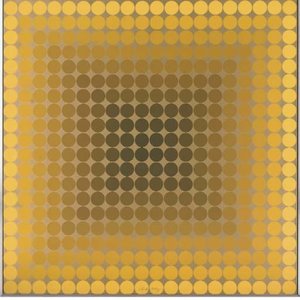
Портрет на Виктор Вазарели

100-те най-известни картини на Виктор Вазарели, селекция от галерията

Обновено Ноември 2026 · класирано според нашия индекс на популярност (търсения, посещения и поръчки за всяко произведение) · 776 творби на Виктор Вазарели в нашия каталог

Накратко

От всички оригинални произведения, оставени от Виктор Вазарели, най-известната е Bivega. След тях непосредствено следват Quadrature и ORION-MC. Нашият каталог съдържа 776 произведения на Виктор Вазарели; галерията е съхранила 100-те най-обожавани от света, всяко от тях представен с неговата дата, неговия музей и неговата история.

1906 – 1997, Печ Optical art Най-много творби: Bechtler Museum of Modern Art

Топ 10-те картини на Виктор Вазарели: изборът на галерията

2
Quadrature на Виктор Вазарели

Quadrature

Acrylic On Canvas

Victor Vasarely's *Quadrature* isn't merely a painting; it’s an invitation – an invitation to question the very nature of visual reality. Created by a visionary who anticipated the digital age, this work embodies the core tenets of Op Art, a movement that sought to manipulate perception through carefully constructed geometric forms and vibrant color fields. Painted in 1960s, *Quadrature* showcases Vasarely’s mastery of optical illusion, transforming two dynamic spheres into…

3
ORION-MC на Виктор Вазарели

ORION-MC

Acrylic On Canvas

Victor Vasarely's ORION-MC is not merely a painting; it’s an invitation to experience the world through a radically altered lens. This captivating work, rendered in a vibrant palette of red, yellow, green, blue, purple, orange, and black, exemplifies the core tenets of Op Art – Optical Art – pioneered by Vasarely himself. Born Károly Vaszary in 1906 in Pécs, Croatia, his artistic trajectory began with an unexpected detour into medicine…

4
Zebras (white on black) на Виктор Вазарели

Zebras (white on black)

Oil

The artwork titled Zebras (white on black) was created by the artist Victor Vasarely. This piece features two zebras positioned against a black background. The composition includes smaller figures of animals in the background, such as two birds and three additional zebras, which contribute to the depth of the image. The visual structure utilizes geometric shapes and patterns to form the figures.

5
Вега-Ва-3 (1968) на Виктор Вазарели

Вега-Ва-3

1968 · Дигитална живопис

Вега-Ва-3: Симфония на Геометрия и Оптични Илюзии Виктор Варели е един от най-значимите творци на Оп Арт – художествен стил, който революционизира изкуството през 60-те години на миналия век. Произведението „Вега-Ва-3“ е емблематичен пример за този подход и продължава да пленява зрителите със своята елегантна простота и дълбоко въздействие върху сетивата. Картината представлява кръг, изпълнен с малки кръгове – геометрична абстракция, която изглежда като съчетание на математическа точност и визуално…

6
Kaglo II (1986) на Виктор Вазарели

Kaglo II

1986 · Print · Inter-American Development Bank, Washington, D.C.

To stand before Victor Vasarely’s Kaglo II is to enter a realm where the boundaries between the static and the kinetic dissolve into a rhythmic dance of light and color. Created in 1986, this masterful print serves as a profound testament to the enduring power of geometric abstraction. At first glance, the eye is drawn to a central, commanding red sphere, which acts as the sun within a private cosmos.…

7
Vega 1 на Виктор Вазарели

Vega 1

Acrylic On Canvas

Victor Vasarely’s *Vega 1* isn't merely a painting; it’s an invitation. An invitation to step outside the confines of traditional representation and into a world governed by perception itself. Born in 1906 in Pécs, Croatia – then part of Austria-Hungary – Vasarely’s artistic trajectory was initially rooted in medicine before he decisively embraced the burgeoning field of visual abstraction. This pivotal shift, fueled by his studies at the Podolini-Volkmann Academy…

8
NB 22 Caope на Виктор Вазарели

NB 22 Caope

Acrylic On Canvas · Bechtler Museum of Modern Art, Шарлот

Victor Vasarely’s “NB 22 Caope” is more than just an abstract painting; it's a meticulously crafted portal into the heart of Op Art, a movement that sought to redefine our perception of reality. This striking work, dominated by a precisely arranged grid of black and white circles, exemplifies Vasarely’s pioneering approach to visual illusion – a technique he developed with mathematical rigor and an almost obsessive attention to detail. The…

9
Yon на Виктор Вазарели

Yon

Acrylic On Canvas

To stand before a work by Victor Vasarely is not merely to observe paint on canvas; it is to engage in a sophisticated dialogue with perception itself. This piece, characterized by its vibrant, almost pulsating geometric network, draws the viewer into a mesmerizing optical labyrinth. It speaks directly to the intellectual curiosity of the modern collector and the design sensibility of those who appreciate art as an architectural element. The…

10
Harmas (1966) на Виктор Вазарели

Harmas

1966 · Tapestry

To stand before Harmas is to step directly into the mind of its creator, Victor Vasarely. This piece is not merely an arrangement of color and pattern; it is a vibrant intellectual puzzle, a visual meditation on structure itself. The eye is immediately drawn into the intricate dance between the bold red checks and the myriad small circles that populate the background. It possesses the undeniable energy characteristic of Op…

Изборът на Виктор Вазарели продължава, от 11 до 100

Знаменитите картини на Виктор Вазарели, период по период

Op Art Period

1964 · 6 произведения в този списък

Op Art

1966 · 29 произведения в този списък

Op-Art Period

3 произведения в този списък

Modern

3 произведения в този списък

Темите, които привличат погледа на Виктор Вазарели

Четирите найчесто срещани теми в тези оригинални творби, всяка с най-добрия си пример.

Музеите, в които се съхраняват оригиналите на Виктор Вазарели

3 музея, които притежават най-голям брой от картините на тази страница.

Музеи Град Творения на Виктор Вазарели Картини от този списък
Bechtler Museum of Modern Art, ШарлотBechtler Museum of Modern Art Шарлот 4 NB 22 Caope, SIR-RIS, Tridem K
Inter-American Development Bank, Washington, D.C.Inter-American Development Bank Washington, D.C. 2 Kaglo II
Музей на изкуствата в Билбао, БилбаоМузей на изкуствата в Билбао Билбао 1 Pal-Ket

Виктор Вазарели десетилетие по десетилетие: оригиналът, който дефинира всяко от тях

Произведения по десетилетия

Изберете десетилетие, за да видите оригиналната творба, която го определя.

Въпроси на колекционерите относно картините на Виктор Вазарели

С кое произведение е най-известен Виктор Вазарели?Разкрийте отговора

Bivega. Следващите са Quadrature и ORION-MC.

Кои са десетте най-известни картини на Виктор Вазарели?Разкрийте отговора

Bivega, Quadrature, ORION-MC, Zebras (white on black), Вега-Ва-3, Kaglo II, Vega 1, NB 22 Caope, Yon и Harmas. Класацията по-горе показва годината и музея за всяко от тях.

Колко картини е оставил Виктор Вазарели?Разкрийте отговора

В нашия каталог са представени 776 произведения на Виктор Вазарели, датирани от 1938 до 1986.

В кои музеи са изложени шедьоврите на Виктор Вазарели?Разкрийте отговора

Предимно в Bechtler Museum of Modern Art (Шарлот), Inter-American Development Bank (Washington, D.C.) и Музей на изкуствата в Билбао (Билбао). В горната таблица с музеи са изброени всички тях.

В кои години Виктор Вазарели е създал най-известните си произведения?Разкрийте отговора

В 1960s: 10 от 100 произведенията на тази страница са създадени тогава, като Вега-Ва-3 са сред тях.

Кои са първата и последната известни оригинални творби на Виктор Вазарели?Разкрийте отговора

На тази страница най-старата е Zebras (1938), а най-новата е Kaglo II (1986).

Кои теми избира най-често Виктор Вазарели?Разкрийте отговора

Visual perception (35), Geometric abstraction (30) и Color field (29), разпределени в 100 произведения на тази страница.

Коя техника използва най-често Виктор Вазарели?Разкрийте отговора

Acrylic On Canvas, за 41 от 100 произведения на тази страница.

Към коهoто художествено направление принадлежи Виктор Вазарели?Разкрийте отговора

Optical art, судейки по оригиналите на тази страница.

Кои произведения на Виктор Вазарели се съхраняват в Bechtler Museum of Modern Art?Разкрийте отговора

NB 22 Caope, SIR-RIS и Tridem K: Bechtler Museum of Modern Art, Шарлот притежава 3 от произведенията на тази страница.

Виктор Вазарели: живот и творчество

The Early Life and Training of Victor Vasarely

Born Károly Vaszary on 9 April 1906 in Pécs, Hungary, the man who would become known as Victor Vasarely began his path in a different field entirely. In 1925, he moved into the halls of Eötvös Loránd University in Budapest to study medicine. The logic of the human body and science occupied his time for two years, but the pull of visual expression eventually took precedence. By 1927, he left his medical studies behind to pursue the study of traditional academic painting at the Podolini-Volkmann Academy.

His training continued as he moved into Sándor Bortnyik’s műhely. This workshop was a place where the principles of the Bauhaus movement took root, focusing on the intersection of functional design and geometric abstraction. Here, the focus shifted toward the structural and the systematic. The lessons learned in these studios provided the foundation for his later investigations into how shapes and colors interact with the eye.

The Development of a Unique Visual Language

Between 1929 and 1944, Vasarely focused on graphic work. He spent these years experimenting with how light and shadow interact with simple forms. His early graphic period produced pieces like Chess Board (1935) and Girl-power (1934). He also worked on Zebras in 1937. These works show a growing interest in how a viewer perceives a flat surface. He moved away from traditional painting toward a more structured, graphic approach.

From 1944 to 1947, his direction shifted. He moved through several styles, including cubistic, futuristic, expressionistic, symbolistic, and surrealistic approaches. He eventually moved past these experiments, looking for a more precise way to organize space. This search for a new logic led him to publish his Yellow Manifest. His work became less about individual expression and more about the mechanics of sight. This systematic method eventually established him as a leader of the Op art movement.

Technique and the Mastery of Optical Illusion

Vasarely’s approach relies on a systematic use of geometry to trigger a physical response in the viewer. He did not rely on traditional light sources or classical chiaroscuro to create form. Instead, he used a sophisticated interplay of high-contrast pigments to simulate depth and movement. By manipulating color density, he could trick the eye into perceiving recession and protrusion on a flat plane. This method turns a static surface into a space that seems to swell or recede.

His method, which he referred to as visual kinetics or plastique cinétique, involves a precise arrangement of shapes. He utilized textural effects, perspective, shadow, and light to build these illusions. The work often relies on the way the eye interprets rhythmic, internal radiance rather than external illumination. Through the use of grids and mathematical principles, he created sensations of visual vibration and swirling effects. The result is a sense of movement that exists entirely within the viewer's perception.

The precision of his technique is evident in how he handles color and line to create architectural depth. In works like Torony-Nagy, the intersection of crisp white lines with deep blues and emerald greens creates a rhythmic optical vibration. These elements work together to produce a sensation of pulsing light. He used these tools to move beyond simple representation, focusing instead on the mechanics of how we see.

Key Works and Achievements

In 1937, the creation of Zebra marked a shift toward what many consider the earliest examples of Op Art. This work moved away from traditional representation, focusing instead on the way the eye interprets simple forms. By the 1960s, his experiments with rhythm and light reached a peak in the 1969 work Torony-Nagy. This piece uses four stylized towers and a high-contrast palette of blues, greens, and oranges to create a sense of internal radiance. The composition relies on intersecting white lines and color density to make the flat surface appear to pulse and recede.

His interest in movement extended into three-dimensional space and everyday objects. He designed Georges Pompidou, a large kinematic object, which integrated his visual theories into a physical, moving form. This interest in the practical application of his geometry also led to a collaboration with Rosenthal Studio Linie. This partnership resulted in the Suomi tableware series, a 500-piece run that brought his geometric patterns into the domestic sphere.

The Establishment of the Fondation Vasarely

In 1966, Victor Vasarely began the process of establishing the Fondation Vasarely. This project was built upon his specific ideas regarding the concept of "art for all" and his vision for a "city of tomorrow." He wanted to create a space that moved beyond the traditional gallery experience to reflect these principles. The physical construction of the building began in 1973.

The foundation was officially inaugurated on 14 February 1976 in Aix-en-Provence, France. The site was designed to house his works and promote his theories on how art and urban design might interact. The architecture of the space itself was part of this vision, with the building's layout intended to support the way his geometric forms were meant to be experienced by the public.

The Lasting Legacy and Global Recognition

The reach of his visual language extended far beyond the walls of a gallery. His patterns and geometric structures found their way into the textures of everyday life, influencing the lines of fashion, the layouts of interior design, and the logic of graphic design. Even the early development of computer graphics carries the imprint of his systematic approach to form and perception. His ideas were not confined to the canvas; they moved into the functional world of objects and the digital structures that followed.

In 1982, his work traveled into space when serigraphs were included aboard the French-Soviet spacecraft Salyut 7. This moment highlighted a connection between his mathematical precision and the broader human endeavor of exploration. He remained a central figure in modern art history until his death in Paris, France, on 15 March 1997.

Where to See the Works Today

Tracing the physical presence of his work requires traveling across several locations in France and Hungary. In Aix-en-Provence, France, the Fondation Vasarely holds a significant portion of his output. This museum was established by the artist himself to promote his ideas regarding art for all. The space is organized into seven hexagonal cells, each measuring 14 metres across and 11 metres high, designed to house forty-two large-scale works that are 6 by 8 metres in size.

His presence in Hungary is also felt through dedicated spaces. The Vasarely Museum is located in Pécs, the city of his birth. There is also a Vasarely Museum situated in the Zichy Palace in Óbuda, Budapest. These locations allow for a direct encounter with the geometric forms and optical effects that defined his practice. In France, another site for his work is the Vasarely Museum at the Saint-Firmin Palace in Gordes.

Beyond these specific museums, his influence is found in various institutional collections. Some of his pieces are held by the Bilbao Fine Arts Museum, while others are part of the collections at the Inter-American Development Bank in Washington, D.C., and the Bechtler Museum of Modern Art in Charlotte. These scattered locations ensure his visual experiments remain accessible to different audiences.