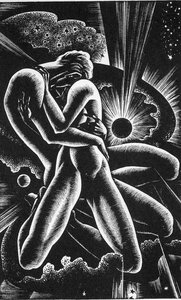
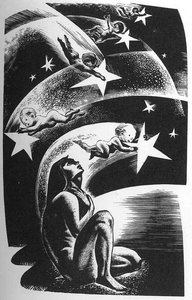
Портрет на Линд Уорд

48-те най-известни картини на Линд Уорд, селекция от галерията

Обновено Октомври 2026 · класирано според нашия индекс на популярност (търсения, посещения и поръчки за всяко произведение) · 48 творби на Линд Уорд в нашия каталог

Накратко

От всички оригинални произведения, оставени от Линд Уорд, най-известната е God's Man (1929). След тях непосредствено следват Beowulf wrestles with Grendel (1933) и Wild Pilgrimage (1932). Нашият каталог съдържа 48 произведения на Линд Уорд; галерията е съхранила 48-те най-обожавани от света, всяко от тях представен с неговата дата, неговия музей и неговата история.

1905 – 1985, Чикаго Expressionism

Топ 10-те картини на Линд Уорд: изборът на галерията

Изборът на Линд Уорд продължава, от 11 до 48

Темите, които привличат погледа на Линд Уорд

Четирите найчесто срещани теми в тези оригинални творби, всяка с най-добрия си пример.

Линд Уорд десетилетие по десетилетие: оригиналът, който дефинира всяко от тях

Произведения по десетилетия

Изберете десетилетие, за да видите оригиналната творба, която го определя.

Въпроси на колекционерите относно картините на Линд Уорд

С кое произведение е най-известен Линд Уорд?Разкрийте отговора

God's Man (1929). Следващите са Beowulf wrestles with Grendel (1933) и Wild Pilgrimage (1932).

На каква възраст е бил Линд Уорд, когато е създадена God's Man?Разкрийте отговора

24 години: God's Man е от 1929 г., а Линд Уорд е роден/а в 1905.

Кои са десетте най-известни картини на Линд Уорд?Разкрийте отговора

God's Man, Beowulf wrestles with Grendel, Wild Pilgrimage, Prelude to a Million Years, Prelude to a Million Years, Alec Waugh's ''Most Women...'', Prelude to a Million Years (12), Prelude to a Million Years (10), Alec Waugh's ''Hot Countries'' и Wild Pilgrimage. Класацията по-горе показва годината и музея за всяко от тях.

Колко картини е оставил Линд Уорд?Разкрийте отговора

В нашия каталог са представени 48 произведения на Линд Уорд, датирани от 1929 до 1969.

В кои години Линд Уорд е създал най-известните си произведения?Разкрийте отговора

В 1930s: 27 от 48 произведенията на тази страница са създадени тогава, като Beowulf wrestles with Grendel са сред тях.

Кои са първата и последната известни оригинални творби на Линд Уорд?Разкрийте отговора

На тази страница най-старата е God's Man (1929), а най-новата е Day of the Hawk (1969).

Кои теми избира най-често Линд Уорд?Разкрийте отговора

Symbols (20), Characters (13) и Nudes (12), разпределени в 48 произведения на тази страница.

Към коهoто художествено направление принадлежи Линд Уорд?Разкрийте отговора

Expressionism, судейки по оригиналите на тази страница.

Линд Уорд: живот и творчество

Lynd Ward: Pioneer of Wordless Novels & Master Wood Engraver

Lynd Kendall Ward (June 26, 1905 – June 28, 1985) was an American artist and novelist, known for his series of wordless novels using woodcuts, and his illustrations for juvenile and adult books. His wordless novels have influenced the development of the graphic novel. Although strongly associated with his wood engravings, he also worked in watercolor, oil, brush and ink, lithography and mezzotint. Ward was a son of Methodist minister, political organizer and radical social activist Harry F. Ward—the first chairman of the American Civil Liberties Union on its founding in 1920. This wasn’t a childhood of privilege, but one enriched by books, particularly those lavishly illustrated, igniting an early passion for narrative through imagery. Summers spent immersed in the Canadian wilderness further nurtured this sensibility, fostering a profound appreciation for nature which frequently found expression in the evocative landscapes and symbolic elements within his art. Ward's formal training at Teachers College, Columbia University, culminated in graduation in 1926 and marriage to May Yonge McNeer—a partnership that would prove creatively fertile, yielding some of the most beloved children’s books of their era. A pivotal journey to Europe followed, where he honed his skills in wood engraving at the National Academy of Graphic Arts in Leipzig, Germany, under the tutelage of Hans Alexander Mueller.

Early Life and Influences

Ward was born on June 26, 1905, in Chicago, Illinois—a city undergoing rapid industrialization and grappling with social tensions. His father, Harry F. Ward, instilled within him a deep commitment to progressive ideals through his involvement in the ACLU and his advocacy for civil liberties—values that would profoundly shape Ward’s artistic vision. Recognizing early on that he wished to pursue art as a vocation, Ward obtained an advanced degree in fine arts at Columbia Teachers' College in New York. This formative experience exposed him to influential artists and movements of the time, notably Frans Masereel’s *The Sun*, which inspired his groundbreaking approach to storytelling—the creation of wordless novels. The influence of Masereel’s pioneering work demonstrated Ward’s willingness to challenge conventional narrative structures and explore the expressive potential of visual imagery alone. His childhood was marked by exposure to literature, particularly books adorned with striking illustrations—a crucial element in cultivating his own fascination for conveying narratives through images.

The Birth of Wordless Narrative: Wood Engraving as Medium

Ward’s artistic breakthrough arrived during his time in Leipzig, Germany, where he studied wood engraving at the National Academy of Graphic Arts under Hans Alexander Mueller. This technique—characterized by meticulous detail and tonal gradation achieved through incising lines into wood blocks—became Ward's signature medium and would define his distinctive style for decades to come. Mueller’s guidance instilled in Ward a mastery of printmaking that extended beyond mere technical proficiency; it fostered an understanding of how visual elements could communicate complex ideas and emotions with unparalleled directness. The decision to embrace wordless narrative wasn’t simply stylistic—it represented a deliberate rejection of traditional storytelling conventions, prioritizing the power of imagery to transcend linguistic barriers and engage audiences on a visceral level. This bold choice cemented Ward's place as one of the pioneers of the graphic novel format—a genre that continues to thrive today.

Notable Achievements: Wordless Novels and Illustrations

Ward’s artistic legacy rests primarily upon his series of wordless novels—*God’s Man*, *Madman’s Drum*, *Wild Pilgrimage*, *Prelude to a Million Years*, *Song Without Words*, and *Vertigo*. These works stand as seminal achievements in American art literature, demonstrating Ward's ability to craft compelling narratives entirely through visual representations. Each novel explores profound themes—social injustice, spiritual yearning, existential contemplation—with remarkable subtlety and nuance—themes that resonate powerfully with readers across generations. Furthermore, Ward’s prolific illustrations for juvenile and adult books garnered him widespread acclaim and cemented his reputation as a storyteller who could captivate audiences of all ages. His collaborations with celebrated authors produced enduring classics, including Oscar Wilde’s *The Ballad of Reading Gaol*, showcasing Ward's talent for transforming literary texts into visually arresting experiences. The Caldecott Medal awarded to *The Biggest Bear*—a testament to his artistic vision and storytelling prowess—underscores the significance of his contribution to children’s literature.

Legacy and Enduring Influence

Lynd Ward’s unwavering commitment to social commentary through his art solidified his position as a socially conscious artist whose works reflected the anxieties and aspirations of his time. He was an active member of several prestigious artistic organizations, including the Society of Illustrators, the Society of American Graphic Arts, and the National Academy of Design—demonstrating his dedication to fostering dialogue and promoting artistic excellence. Ward’s enduring influence extends beyond his technical mastery—his pioneering approach to storytelling continues to inspire artists and writers today—a testament to an artist who dared to tell stories without words, leaving behind a legacy that celebrates the transformative power of visual narrative.