Портрет на Ludwig Passini

16-те най-известни картини на Ludwig Passini, селекция от галерията

Обновено Ноември 2026 · класирано според нашия индекс на популярност (търсения, посещения и поръчки за всяко произведение) · 16 творби на Ludwig Passini в нашия каталог

Накратко

От всички оригинални произведения, оставени от Ludwig Passini, най-известната е The young Comtessa with an ermine scarf on New Year's Eve (1847). След тях непосредствено следват Emperor Joseph II Riding (1850) и Princess Rospigliosi and Baroness Baude (1863). Нашият каталог съдържа 16 произведения на Ludwig Passini; галерията е съхранила 16-те най-обожавани от света, всяко от тях представен с неговата дата, неговия музей и неговата история.

1832 – 1903, Vienna Academicism Най-много творби: Национална галерия на изкуствата

Топ 10-те картини на Ludwig Passini: изборът на галерията

1
The young Comtessa with an ermine scarf on New Year's Eve (1847) на Ludwig Passini

The young Comtessa with an ermine scarf on New Year's Eve

1847 · Watercolor

In "The young Comtessa with an ermine scarf on New Year's Eve" by Ludwig Passini, we are presented with an intimate bust-length portrait of a young woman. The subject is positioned facing forward, occupying most of the frame in a way that demands a quiet, direct encounter. While she is centered vertically, there is a subtle, intentional off-centering horizontally that lends a naturalism to her pose. She looks directly at…

2
Emperor Joseph II Riding (1850) на Ludwig Passini

Emperor Joseph II Riding

1850 · Oil On Panel

In the artwork Emperor Joseph II Riding by Ludwig Passini, the composition is centered on the figure of the Emperor mounted upon a white horse. The subject is positioned in profile, facing toward the left side of the frame. This central figure is set against a landscape composed of earthy tones, specifically browns, greens, and ochres. The stark white of the horse provides a high-contrast element against the dark, formal…

7
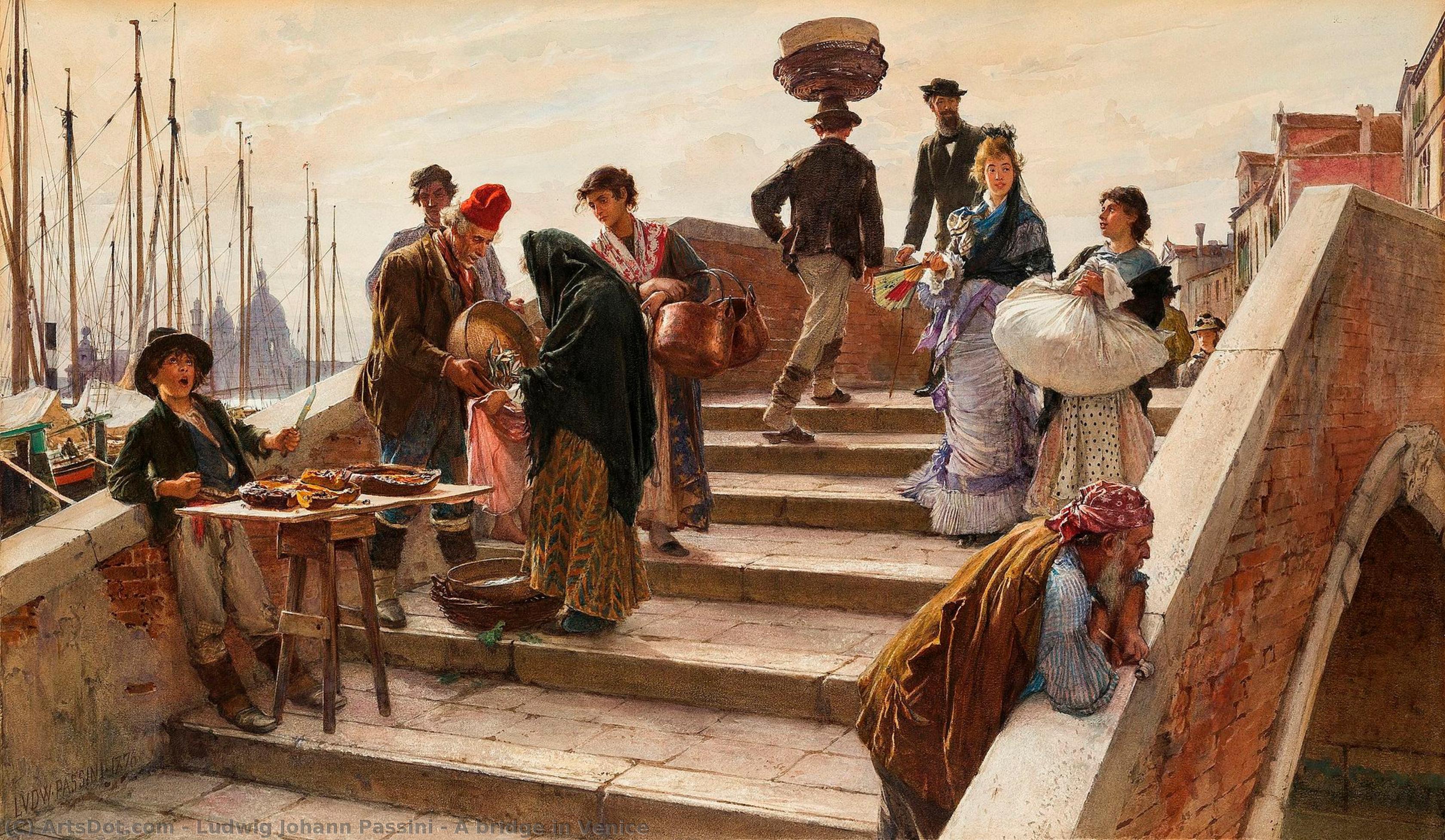
A bridge in Venice (1876) на Ludwig Passini

A bridge in Venice

1876

Ludwig Johann Passini’s “A Bridge in Venice,” painted in 1876, offers a captivating snapshot of daily life within the iconic Italian city. This horizontal canvas transports viewers to a bustling scene on one of Venice’s famed bridges, capturing a moment brimming with activity and character. More than just a depiction of architecture, it's a window into the vibrant social fabric of 19th-century Venetian society.

9
Monks Buying Fish before the Portal of the Madonna della Misericordia (1855) на Ludwig Passini

Monks Buying Fish before the Portal of the Madonna della Misericordia

1855 · Acrylic On Canvas · Национална галерия на изкуствата, Уокшънтън

Ludwig Johann Passini's “Monks Buying Fish before the Portal of the Madonna della Misericordia,” painted in 1855, isn’t merely a depiction of a marketplace scene; it’s a carefully constructed tableau brimming with quiet spirituality and the everyday rhythms of Venetian life. The painting transports us to a sun-drenched corner of the city, where the mundane act of purchasing fish becomes imbued with a profound sense of reverence. Passini, a master…

Изборът на Ludwig Passini продължава, от 11 до 16

Темите, които привличат погледа на Ludwig Passini

Четирите найчесто срещани теми в тези оригинални творби, всяка с най-добрия си пример.

Музеите, в които се съхраняват оригиналите на Ludwig Passini

Музеят, който притежава най-голям брой от картините на тази страница.

Музеи Град Творения на Ludwig Passini Картини от този списък
Национална галерия на изкуствата, УокшънтънНационална галерия на изкуствата Уокшънтън 1 Monks Buying Fish before the Portal of the Madonna della Misericordia

Ludwig Passini десетилетие по десетилетие: оригиналът, който дефинира всяко от тях

Произведения по десетилетия

Изберете десетилетие, за да видите оригиналната творба, която го определя.

Въпроси на колекционерите относно картините на Ludwig Passini

С кое произведение е най-известен Ludwig Passini?Разкрийте отговора

The young Comtessa with an ermine scarf on New Year's Eve (1847). Следващите са Emperor Joseph II Riding (1850) и Princess Rospigliosi and Baroness Baude (1863).

На каква възраст е бил Ludwig Passini, когато е създадена The young Comtessa with an ermine scarf on New Year's Eve?Разкрийте отговора

15 години: The young Comtessa with an ermine scarf on New Year's Eve е от 1847 г., а Ludwig Passini е роден/а в 1832.

Кои са десетте най-известни картини на Ludwig Passini?Разкрийте отговора

The young Comtessa with an ermine scarf on New Year's Eve, Emperor Joseph II Riding, Princess Rospigliosi and Baroness Baude, A shared confidence, On the Riva Dei Schiavoni a procession in Venice, Figures on a Venetian canal, A bridge in Venice, The Basilica of San Marco in Venice, Monks Buying Fish before the Portal of the Madonna della Misericordia и Young Venetian woman at the fountain. Класацията по-горе показва годината и музея за всяко от тях.

Колко картини е оставил Ludwig Passini?Разкрийте отговора

В нашия каталог са представени 16 произведения на Ludwig Passini, датирани от 1847 до 1893.

В кои музеи са изложени шедьоврите на Ludwig Passini?Разкрийте отговора

Предимно в Национална галерия на изкуствата (Уокшънтън). В горната таблица с музеи са изброени всички тях.

В кои години Ludwig Passini е създал най-известните си произведения?Разкрийте отговора

В 1870s: 3 от 16 произведенията на тази страница са създадени тогава, като A shared confidence са сред тях.

Кои са първата и последната известни оригинални творби на Ludwig Passini?Разкрийте отговора

На тази страница най-старата е The young Comtessa with an ermine scarf on New Year's Eve (1847), а най-новата е Figures on a Venetian canal (1893).

Кои теми избира най-често Ludwig Passini?Разкрийте отговора

19th century society (2), Historical figures (2) и Architecture (2), разпределени в 16 произведения на тази страница.

Коя техника използва най-често Ludwig Passini?Разкрийте отговора

Oil On Canvas, за 2 от 16 произведения на тази страница.

Към коهoто художествено направление принадлежи Ludwig Passini?Разкрийте отговора

Academicism, судейки по оригиналите на тази страница.

Ludwig Passini: живот и творчество

The Venetian Soul: The Life and Art of Ludwig Johann Passini

In the golden light of the nineteenth century, few artists captured the rhythmic pulse of Mediterranean life with as much tenderness and precision as Ludwig Johann Passini. Born in Vienna on July 9, 1832, Passini was a man of dual heritage, an Austrian by birth whose artistic soul became irrevocably entwined with the canals and cobblestones of Italy. His journey began under the watchful eye of his father, Johann Nepomuk Passini, a skilled engraver who provided the young artist with a foundational mastery of line and visual craftsmanship. This early exposure to the meticulous world of printmaking would later manifest in the exquisite detail and narrative clarity that define his most celebrated works.

The trajectory of Passini’s life was shaped by movement and cosmopolitan discovery. Following his family's relocation to Trieste in 1850, he was exposed to a melting pot of cultures that would broaden his artistic horizons far beyond the borders of his native Austria. His formal training at the prestigious Vienna Academy of Art brought him into the orbit of masters such as Joseph von Führich and Leopold Kupelwieser, where he refined a classical sensibility. Yet, it was the encouragement of Führich that propelled him toward Leipzig and eventually to the heart of Italy, setting the stage for a career defined by the pursuit of light, atmosphere, and the human condition.

A Mastery of Genre and the Venetian Spirit

Passini’s artistic evolution is a testament to his ability to adapt his technique to the spirit of his surroundings. During his years in Rome between 1853 and 1870, his work took on a profound narrative quality. He focused intensely on the human figure, placing characters within rich architectural settings and interior spaces that whispered stories of daily existence. It was during this period that he mastered the art of the genre scene—paintings that do not merely depict a moment, but breathe life into the social fabric of the era.

< p>However, it was his permanent move to Venice in 1873 that unlocked his most enduring creative period. Settling for three decades in the magnificent Palazzo Vendramin Calergi, Passini became a cornerstone of an illustrious artist colony. Alongside contemporaries such as Henry Woods and August von Pettenkofen, he participated in a vibrant intellectual exchange that pushed the boundaries of realism. His Venetian oeuvre is a breathtaking collection of watercolors and oils that serve as a visual chronicle of the city. Whether capturing the bustling activity on a bridge or the quiet, spiritual reverence of monks purchasing fish near a cathedral portal, Passini possessed a rare ability to find the extraordinary within the ordinary.

Technique, Legacy, and Artistic Significance

The brilliance of Passini’s work lies in his seamless blend of realism and poetic atmosphere. His technique was characterized by a meticulous attention to detail—the texture of sun-drenched brickwork, the subtle shimmer of water, and the intricate folds of period clothing—all rendered with a sensitivity that avoids the coldness of mere documentation. In his watercolors, he achieved a luminous quality that captured the fleeting effects of light, while his oil paintings, such as the evocative A Bridge in Venice, utilized masterful composition to draw the viewer into the heart of the scene.

Beyond his technical prowess, Passini’s historical significance rests in his role as a bridge between classical tradition and the burgeoning interest in modern, everyday life. He did not seek the grandiosity of historical epics; instead, he sought the truth in a child's play or a merchant's trade. His legacy is preserved in the way he immortalized a vanishing way of life, providing future generations with a window into the vibrant, social tapestry of 19th-century Italy. Today, his works remain cherished for their ability to evoke nostalgia and a profound sense of human connection, ensuring that the name Ludwig Johann Passini remains synonymous with the timeless beauty of the Venetian spirit.