Портрет на Франц Клайн

48-те най-известни картини на Франц Клайн, всяка от които е уникална

Обновено Октомври 2026 · класирано според нашия индекс на популярност (търсения, посещения и поръчки за всяко произведение) · 53 творби на Франц Клайн в нашия каталог

Накратко

Mahoning (1956) е картината на Франц Клайн, която привлича най-много погледи; оригиналът се намира в Уитни Музей на американското изкуство, Ню Йорк. След това погледът се насочва към Черен, Бял и Сив (1959) и Untitled (1959). Сред 53 произведения на Франц Клайн в нашия каталог, тези 48 са най-известните – всяко от тях е уникален оригинал, представен с годината на създаване, музея и причината за неговата вечност.

1910 – 1962, Уиксь-Бар Abstract expressionism Най-много творби: Smithsonian American Art Museum

Топ 10 картини на Франц Клайн, през погледа на галерията

1
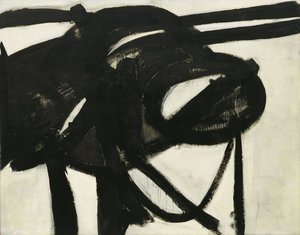
Mahoning (1956) на Франц Клайн

Mahoning

In the pantheon of Abstract Expressionism, few works command the room with such visceral authority as Franz Kline’s “Mahoning,” completed in 1956. To stand before this monumental canvas is to witness a profound dialogue between presence and absence, a struggle captured in the rhythmic collision of black enamel and stark white space. This is not merely a painting; it is an event. As a cornerstone of the New York School,…

2
Черен, Бял и Сив (1959) на Франц Клайн

Черен, Бял и Сив

1959 · Масло върху платно · Метрополитън Музей на изкуствата, Ню Йорк

Франк Клайн и „Черно, Бяло и Сиво“ – Символ на Енергия и Контрол „Черно, Бяло и Сиво“ е произведение на Франк Клайн, американски художник от началото на XX век, който остава изключително значим за движението Абстрактен експресионизъм. Роден през 1910 г., Клайн преминава през трудни години – самоубийството на баща му още като дете оказва дълбоко влияние върху неговата чувствителност, което по-късно се изразява в контрастните цветове и динамични линии…

3
Untitled (1959) на Франц Клайн

Untitled

1959 · Oil · Smithsonian American Art Museum, Вашингтон, окръг Колумбия

The canvas titled Untitled emerges from the hands of Franz Kline, a presence that commands the space it occupies. Created in 1959, this work exists as a significant expression of the Abstract Expressionism movement. It carries the weight of a specific moment in time, capturing a sense of raw, unmediated energy that defines the era. The piece arrives not as a window into a landscape, but as a direct encounter…

5
Zinc Yellow (1959) на Франц Клайн

Zinc Yellow

1959 · Oil On Canvas · Chrysler Museum of Art, Норфолк

In the pantheon of Abstract Expressionism, few works command the immediate, visceral attention of a room quite like Franz Kline’s Zinc Yellow. Completed in 1959, this monumental canvas serves as a breathtaking masterclass in reductive abstraction, where the boundaries between color and form dissolve into a singular, energetic event. At first glance, the viewer is met with an expansive, luminous field of yellow that seems to vibrate against the stark,…

6
Неопределено (1956) на Франц Клайн

Неопределено

1956 · Акрил върху платно

Фрагмент от Света: Размишления върху Абстрактния Екпресионизъм и Произведенията на Фанц Клайн Фанц Клайн е фигура, която продължава да пленява със своята сила и дълбочина на чувствата – художник, чиито творби изразяват същността на човешката преживяване по начин, който е както директен, така и загадъчен. Роден във ВилиБарре, Пенсилвания през 1910 г., животът му беше белязан от ранни трудности – самоубийството на баща му едва седемгодишен оказа дълбоко влияние върху…

7
Untitled (1959) на Франц Клайн

Untitled

1959 · Black and White Photography · Метрополитън Музей на изкуствата, Ню Йорк

This monochromatic photograph, dated 1959, captures a candid scene within a dense, wooded environment. The upper two-thirds of the frame are occupied by a heavy canopy of trees and foliage, creating a sense of enclosure through layered, organic lines. Natural daylight filters through the leaves, producing sharp highlights on certain surfaces while casting deep, dark shadows across the background. In the midground, several figures are positioned within a clearing. To…

Знаменитите картини на Франц Клайн, номера от 11 до 48

Темите, които привличат погледа на Франц Клайн

Четирите найчесто срещани теми в тези оригинални творби, всяка с най-добрия си пример.

Музеите, в които се съхраняват оригиналите на Франц Клайн

8 музея, които притежават най-голям брой от картините на тази страница.

Музеи Град Творения на Франц Клайн Картини от този списък
Smithsonian American Art Museum, Вашингтон, окръг КолумбияSmithsonian American Art Museum Вашингтон, окръг Колумбия 3 Untitled, Palmerton, Pa., Blueberry Eyes
Метрополитън Музей на изкуствата, Ню ЙоркМетрополитън Музей на изкуствата Ню Йорк 2 Черен, Бял и Сив, Untitled
Музей на изкуствата във Бостън, БостънМузей на изкуствата във Бостън Бостън 2 Black on Green, Red, and Yellow, Probst I
Уитни Музей на американското изкуство, Ню ЙоркУитни Музей на американското изкуство Ню Йорк 1 Mahoning
Albright-Knox Art Gallery, Ню ЙоркAlbright-Knox Art Gallery Ню Йорк 1 New York, N.Y.
Chrysler Museum of Art, НорфолкChrysler Museum of Art Норфолк 1 Zinc Yellow
Worcester Art Museum, УорстърWorcester Art Museum Уорстър 1 Untitled
Cleveland Museum of Art, КливландCleveland Museum of Art Кливланд 1 Accent Grave

Франц Клайн през десетилетията: един уникален оригинал за всяко

Произведения по десетилетия

Изберете десетилетие, за да видите оригиналната творба, която го определя.

Картини на Франц Клайн: въпроси към галерията

Кое е най-известното произведение на Франц Клайн?Разкрийте отговора

Mahoning (1956), Уитни Музей на американското изкуство, Ню Йорк. Следват Черен, Бял и Сив (1959) и Untitled (1959).

На каква възраст Франц Клайн създава Mahoning?Разкрийте отговора

46 години: Mahoning е от 1956 г., а Франц Клайн е роден/а в 1910.

Кои са десетте най-известни картини на Франц Клайн?Разкрийте отговора

Mahoning, Черен, Бял и Сив, Untitled, New York, N.Y., Zinc Yellow, Неопределено, Untitled, Study for "Flanders", Untitled и Frederick Blumenstein. Класацията по-горе показва годината и музея за всяко от тях.

Колко са известните творби на Франц Клайн?Разкрийте отговора

В нашия каталог са представени 53 произведения на Франц Клайн, датирани от 1938 до 1961.

Къде могат да се видят най-известните оригинали на Франц Клайн?Разкрийте отговора

Предимно в Smithsonian American Art Museum (Вашингтон, окръг Колумбия), Метрополитън Музей на изкуствата (Ню Йорк) и Музей на изкуствата във Бостън (Бостън). В горната таблица с музеи са изброени всички тях.

През кой период Франц Клайн създава най-известните си картини?Разкрийте отговора

В 1950s: 17 от 48 произведенията на тази страница са създадени тогава, като Mahoning са сред тях.

Коя е най-ранната и коя е най-късната известна картина на Франц Клайн?Разкрийте отговора

На тази страница най-старата е Circus Scene (1938), а най-новата е Study for "Flanders" (1961).

Какви теми предпочиташе Франц Клайн?Разкрийте отговора

Black and white (4), Geometric forms (4) и Black and white art (4), разпределени в 48 произведения на тази страница.

С какви материали най-често е живописувал Франц Клайн?Разкрийте отговора

Oil On Canvas, за 3 от 48 произведения на тази страница.

Към кое художествено направление принадлежи творчеството на Франц Клайн?Разкрийте отговора

Abstract expressionism, судейки по оригиналите на тази страница.

Какви оригинални творби на Франц Клайн мога да видя в Smithsonian American Art Museum?Разкрийте отговора

Untitled, Palmerton, Pa. и Blueberry Eyes: Smithsonian American Art Museum, Вашингтон, окръг Колумбия притежава 3 от произведенията на тази страница.

Франц Клайн: портрет на художника

Franz Kline (1910-1962): Pioneer of Abstract Expressionism

Franz Kline, a pivotal figure in the Abstract Expressionist movement, remains an artist whose work resonates with raw power and emotional depth. Born in Wilkes-Barre, Pennsylvania, in 1910, his life was marked by early hardship – the suicide of his father when he was just seven years old cast a long shadow, influencing a sensibility that would later find expression in the stark contrasts defining his art. This formative experience led to a nomadic youth and eventual enrollment at Girard College, Philadelphia, a boarding school for boys who had lost their fathers. It was here, amidst structured discipline, that Kline’s artistic inclinations began to surface, nurtured by traditional training in illustration and drafting. He continued his studies at Boston University and later honed his skills at the Heatherley School of Fine Art in London, immersing himself in the works of the Old Masters – Rembrandt, Velázquez, El Greco, Goya, Dürer – and absorbing the nuances of Japanese prints. These early influences, though seemingly distant from his eventual abstract style, laid a foundation for his understanding of composition, light, and the expressive potential of line.

Early Life and Artistic Training

Kline’s childhood was profoundly shaped by tragedy; his father's untimely death instilled in him a sensitivity to loss and vulnerability that would permeate his artistic vision. Seeking refuge from this sorrow, he embarked on a restless journey across America, developing an independent spirit and honing his observational skills. Recognizing his burgeoning talent for drawing and painting, he enrolled at Girard College, where he received a rigorous education focused on technical proficiency—a crucial element in preparing him for the challenges of formal artistic training. Subsequent studies at Boston University solidified his grounding in Western art history, while his time at Heatherley School of Fine Art in London exposed him to the grandeur and stylistic diversity of European painting traditions. He particularly admired Rembrandt’s masterful use of chiaroscuro—the dramatic interplay of light and shadow—and Velázquez’s meticulous realism, recognizing their ability to convey profound emotion through subtle detail. Furthermore, his fascination with Japanese prints instilled in him an appreciation for simplicity, balance, and the expressive power of line – principles that would become central to his distinctive artistic style.

From Representation to Simplification: The Emergence of Abstract Expressionism

Kline’s initial artistic endeavors centered on figurative painting—landscapes, cityscapes, portraits, and murals—demonstrating a meticulous attention to detail and capturing the essence of observed subjects. However, by the late 1930s and early 40s, he began experimenting with stylistic reductions, foreshadowing his groundbreaking embrace of abstraction. His “Hot Jazz” mural series commissioned for Greenwich Village tavern showcased this inclination toward simplification, utilizing bold forms and expressive brushstrokes to convey a sense of dynamism and energy. This pivotal project marked a decisive step away from traditional representational techniques—a move that would ultimately propel him into the forefront of Abstract Expressionism. Simultaneously, Kline’s encounter with Willem de Kooning in 1948 proved transformative; De Kooning encouraged him to explore a radically different approach – projecting one of Kline’s sketches onto a wall using a Bell-Opticon projector—an act that dramatically enlarged and transformed the image, reducing it to its essential strokes. This experience fundamentally altered Kline's artistic perspective, prompting him to abandon illusionistic rendering in favor of pure gesture and line.

The Language of Black and White: Defining Kline’s Aesthetic

Kline’s mature style is instantly recognizable for its monochromatic palette—primarily black on white. This wasn’t merely a stylistic preference but a deliberate strategy rooted in profound artistic conviction. He believed that the absence of color heightened the expressive potential of line, allowing it to convey emotion and dynamism with unparalleled intensity. His brushstrokes were fluid, energetic, and applied with house-painting brushes on large canvases—a technique that immersed the viewer within his abstract world. Rejecting representationalism as a means of conveying meaning, Kline sought instead to capture the visceral experience of creation itself – mirroring the spontaneity and immediacy of Japanese calligraphy. He frequently titled his paintings after places from his childhood or industrial landscapes — “Lehighton,” “Mahoning” — offering subtle anchors to his personal history without dictating the interpretation of the abstract forms. These titles served as echoes rather than explanations, inviting viewers to engage with the work on their own terms and fostering contemplation about the relationship between art and memory.

Legacy and Influence: A Lasting Impact on Modern Art

Franz Kline’s contribution to Abstract Expressionism solidified his place among the most influential artists of the mid-century—a movement that revolutionized American painting and profoundly impacted subsequent artistic developments. He exhibited extensively at prestigious galleries like Egan Gallery and Sidney Janis Gallery, garnering critical acclaim for his uncompromising vision and masterful execution. His participation in the Venice Biennale in 1960 earned him the Italian Ministry of Public Instruction Prize – a testament to his recognition as a leading figure within the international art community. Kline continued to teach at Black Mountain College and Pratt Institute, nurturing the artistic aspirations of younger generations and disseminating his distinctive aesthetic principles. Tragically, Kline’s life was cut short by rheumatic heart disease in 1962—a debilitating illness that ultimately claimed his vitality—leaving behind a legacy of enduring artistic significance. His unwavering commitment to gestural abstraction continues to inspire artists today, demonstrating the power of simplicity and expressive line to communicate profound emotion and intellectual contemplation. Kline’s paintings stand as monuments to an artist who dared to confront darkness with light, control with chaos, and ultimately achieved a sublime synthesis of form and feeling—a testament to a life forged in contrast and expressed through the indelible language of black and white.