


1


Обновено Ноември 2026 · класирано според нашия индекс на популярност (търсения, посещения и поръчки за всяко произведение) · 36 творби на Alan Davie в нашия каталог
Накратко
За галерията най-известната картина на Alan Davie е Woman Arranging Flowers (1945). Untitled Abstract и Self Portrait with Brushes (1937) допълват трио, което всяко око разпознава. От 36 произведения на Alan Davie в нашия каталог, галерията представя 36 най-известните по-долу – всяко от тях е оригинал с посочен година, музей и това, което го прави уникално.


 Joe's Magic Lantern1961
12
 Joe's Lucky Dip1961
13
 Keep Your Fingers Crossed1961
14
 Hopi Studies No.32, Opus 0.11731991 · University of Hertfordshire
15
 Hopi Studies No.30 (Big Blue) (Opus O.1171)1991
16
 Homage to an Earth Goddess No.61992
17
 Symbols in a Landscape1994 · The Pier Arts Centre
18
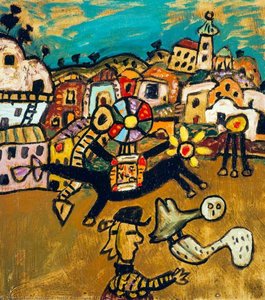 Village Witch (Opus O.1263)1994
19
 Magic Casket1997 · Национална галерия на съвременното изкуство в Единбург
20
 Celtic Landscape (Dreamscape)1996 · The Pier Arts Centre
21
 Magic Landscape (Opus O.1337)1996
22
 The Alchemist's Mirror No.1 (Opus 1357)1997
23
 Cosmic Signals I2000
24
 Cosmic Signals No.72000
25
 The Golden Palace1999
26
 Magician's Mirror No.22000 · The Mercer Art Gallery
27
 Serpent's Idea of a Horse2000
28
 The Magician's Mirror No.3 (Opus 1450)2000
29
 Without Devices2004 · Pembroke College Oxford Jcr Art Collection
30
 Around and Around in the PinkНационална галерия на Канада
31
 Kaleidoscope for a Parrot
32
 Prize for a Serpent
33
 Flowers on a TableThe Fleming Collection
34Prophet in a Tree, 1963Фицвилям Колеж
35
 Double MonumentRobinson College
36
 Hallucination with Monster and Cock
8 музея, които притежават най-голям брой от картините на тази страница.
| Музеи | Град | Творения на Alan Davie | Картини от този списък |
|---|---|---|---|
 The Pier Arts Centre |
Stromness | 2 | Symbols in a Landscape, Celtic Landscape (Dreamscape) |
 University of Hertfordshire |
North Hatley | 1 | Hopi Studies No.32, Opus 0.1173 |
 Национална галерия на съвременното изкуство в Единбург |
Единбург | 1 | Magic Casket |
 The Mercer Art Gallery |
Харогейт | 1 | Magician's Mirror No.2 |
 Pembroke College Oxford Jcr Art Collection |
Oxford | 1 | Without Devices |
 Национална галерия на Канада |
Отава | 1 | Around and Around in the Pink |
 The Fleming Collection |
London | 1 | Flowers on a Table |
 Фицвилям Колеж |
Кембридж | 1 | Prophet in a Tree, 1963 |
Изберете десетилетие, за да видите оригиналната творба, която го определя.


Woman Arranging Flowers (1945). Следващите са Untitled Abstract и Self Portrait with Brushes (1937).
25 години: Woman Arranging Flowers е от 1945 г., а Alan Davie е роден/а в 1920.
Woman Arranging Flowers, Untitled Abstract, Self Portrait with Brushes, The Saint, Entrance to a Paradise, Jingling Space, Ram Grip, Piggy Chain, Joy Bag No. 1 и Entrance For A Red Temple No. 4. Класацията по-горе показва годината и музея за всяко от тях.
В нашия каталог са представени 36 произведения на Alan Davie, датирани от 1937 до 2004.
Предимно в The Pier Arts Centre (Stromness), University of Hertfordshire (North Hatley) и Национална галерия на съвременното изкуство в Единбург (Единбург). В горната таблица с музеи са изброени всички тях.
В 1990s: 10 от 36 произведенията на тази страница са създадени тогава, като Hopi Studies No.32, Opus 0.1173 са сред тях.
На тази страница най-старата е Self Portrait with Brushes (1937), а най-новата е Without Devices (2004).
Abstract expressionism, судейки по оригиналите на тази страница.
Symbols in a Landscape и Celtic Landscape (Dreamscape): The Pier Arts Centre, Stromness притежава 2 от произведенията на тази страница.