A Life Shrouded in Mystery: Unraveling the Identity of Max Sinclair
The name Max Sinclair evokes a sense of romantic solitude, conjuring images of windswept coastlines and brooding landscapes. Yet, behind the evocative paintings signed simply “Max Sinclair” lies a fascinating enigma—an artist whose true identity remained largely obscured for decades. Recent scholarship suggests that "Max Sinclair" was, in fact, a pseudonym adopted by Heinrich Max Krause (1861-1931), a German painter who built a prolific career under multiple names, skillfully navigating the art market and personal anxieties of his time. Born in Biesdorf, Berlin, to Franz Emile Hermann Krause, himself a landscape artist, young Heinrich inherited both a lineage of artistic talent and a potential need for anonymity. The family’s relocation to Lancashire, England, in the 1870s proved pivotal, immersing him in the dramatic scenery of Wales and Scotland—motifs that would dominate his work throughout his life. While officially registered as Frederick Heinrich M. Krause upon marrying Mary Jane Mansell in 1885, he continued to paint under a variety of aliases including H. Max Krause, H.M. Krause, and M. Crouse, alongside the more familiar “Max Sinclair.” This practice wasn’t unusual for artists of the period, allowing them to explore different styles or cater to varying market demands without compromising their established reputation—or perhaps concealing their German origins during times of rising nationalistic sentiment.
The Welsh & Scottish Landscapes: A Signature Style
Sinclair's paintings are immediately recognizable by their atmospheric quality and a keen sensitivity to light and mood. He specialized in capturing the raw beauty of Britain’s shores, particularly the rugged coastlines and
rolling hills of Wales and Scotland. The majority of his works date from the early 1880s, depicting scenes often rendered in oil and watercolour with a loose, expressive brushstroke. While he never exhibited publicly under any of his names, the consistent dating and signing of his paintings provide valuable insight into his artistic development. His landscapes aren’t grand statements or meticulously detailed representations; instead, they are intimate studies of nature, imbued with a sense of
quiet contemplation. The palette is typically muted—grays, blues, and browns dominate—reflecting the often-overcast skies and dramatic weather conditions of the British Isles. He also produced marine scenes depicting bustling ports like London and Liverpool, showcasing his versatility and ability to capture both the tranquility of rural landscapes and the energy of
urban life.
Influences & Artistic Lineage: The Shadow of Franz Krause
Tracing Sinclair’s artistic influences reveals a strong connection to his father, Franz Emile Hermann Krause. The stylistic similarities between their works are undeniable—a shared love for
atmospheric perspective, a preference for naturalistic depictions, and a similar approach to capturing
light and shadow. It is believed that Max was the sole pupil of his Master Franz Krause, as noted in a Victorian newspaper cutting. Beyond his father’s direct influence, Sinclair's work resonates with the broader traditions of
19th-century British
landscape painting, particularly the
Barbizon school and the early works of the Impressionists. However, he developed a unique voice—a more introspective and emotionally charged approach that sets him apart from his contemporaries. The lack of formal training beyond his father’s tutelage may have contributed to this distinctive style, allowing him to forge his own path without adhering to strict academic conventions.
Rediscovery & Legacy: A Late Bloom in Recognition
For many years, Max Sinclair remained a relatively obscure figure, known primarily through the paintings that surfaced sporadically at auction and in antique shops. The recent identification of Heinrich Max Krause as the artist behind the pseudonym has sparked renewed interest in his work. Art historians are now re-evaluating his contribution to British
landscape painting, recognizing his skill in capturing atmosphere and emotion. While he may not have achieved widespread fame during his lifetime, Sinclair’s paintings continue to captivate viewers with their
quiet beauty and evocative power. His story serves as a reminder that artistic merit isn't always tied to recognition—and that sometimes, the most compelling works are those created by artists who deliberately chose to remain in the shadows.
Exploring the Work Today: A Collector’s Perspective
- Atmospheric Landscapes: Sinclair’s paintings offer a window into the soul of the British countryside—a world of brooding skies, windswept hills, and dramatic coastlines.
- Marine Paintings: His depictions of London and Liverpool docks provide a fascinating glimpse into Victorian-era maritime life.
- Signed & Dated Works: The consistent signing and dating of his paintings make them valuable for tracing his artistic development.
- Multiple Pseudonyms: Collectors are often intrigued by the mystery surrounding Sinclair’s identity and the use of various aliases.
- Emotional Resonance: His paintings evoke a sense of quiet contemplation and emotional depth, appealing to those who appreciate atmospheric art.


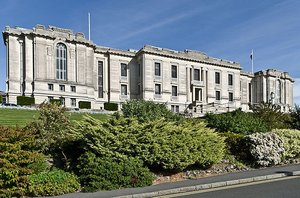 Llyfrgell Genedlaethol Cymru / The National Library of Wales


