Портрет на Магнус Енкел

100-те най-известни картини на Магнус Енкел, селекция от галерията

Обновено Ноември 2026 · класирано според нашия индекс на популярност (търсения, посещения и поръчки за всяко произведение) · 110 творби на Магнус Енкел в нашия каталог

Накратко

От всички оригинали, оставени от Магнус Енкел, най-известният е Naken gosse (1892), който се намира в колекцията на Villa Gyllenberg, Helsinki. След тях непосредствено следват Adam and Eve (1897) и Adam (Night) (1896). Нашият каталог съдържа 110 произведения на Магнус Енкел; галерията е съхранила 100-те най-обожавани от света, всяко от тях представен с неговата дата, неговия музей и неговата история.

1870 – 1925, Хамина Symbolism Най-много творби: Finnish National Gallery

Топ 10-те картини на Магнус Енкел: изборът на галерията

2
Adam and Eve (1897) на Магнус Енкел

Adam and Eve

1897 · Oil · Finnish National Gallery, Хелзинки

In this 1897 oil painting, two figures emerge from a dense, dark thicket. The composition focuses on the upper bodies of a man and a woman, positioned closely within a shallow, enclosed space. On the left, a woman with long, dark hair gazes downward, her expression heavy with melancholy. To her right, a man with short, light hair meets her gaze with a steady, contemplative look. The scene is set…

3
Adam (Night) (1896) на Магнус Енкел

Adam (Night)

1896 · Ink On Paper · Finnish National Gallery, Хелзинки

Created about 1896, Adam (Night) by Magnus Enckell presents a somber study of the human form. The subject is a muscular male torso and arms shown in profile. He is positioned against a dark, expansive background that creates a sense of isolation. The figure faces a large area of negative white space, emphasizing a state of solitude or quiet struggle.

4
Expulsion of Adam and Eve, after Masaccio (1898) на Магнус Енкел

Expulsion of Adam and Eve, after Masaccio

1898 · Oil · Finnish National Gallery, Хелзинки

In "Expulsion of Adam and Eve, after Masaccio" by Magnus Enckell, the biblical scene of the expulsion unfolds across a divided space. The composition separates the world into two distinct realms: a celestial realm above and a terrestrial realm below. In the upper register, a large, ethereal, reddish-pink winged figure descends through the air, appearing almost translucent as it hovers. This monumental presence watches over the figures below, casting a…

5
Listeners of Music (1897) на Магнус Енкел

Listeners of Music

1897 · Oil · Finnish National Gallery, Хелзинки

Listeners of Music is an oil painting by the Finnish symbolist painter Magnus Enckell. Created about 1897, the work emerged from a period when the artist was beginning to move away from the strictures of Naturalism. Enckell, who was born in Hamina, Finland in 1870, brought a specific, inward-looking sensibility to this canvas. The piece captures a crowd of people gathered in a dim space, their faces turned toward an…

6
The Concert (1898) на Магнус Енкел

The Concert

1898 · Oil · Finnish National Gallery, Хелзинки

In The Concert, Magnus Enckell constructs a dense, crowded indoor scene, likely a theater or concert hall. The composition utilizes a layered arrangement to establish spatial depth, placing several individuals in the foreground while a large group of figures fills the midground and background. This layering draws the viewer into the assembly, creating a sense of being part of the gathered crowd.

7
Portrait of Sculptor Madeleine Jouvray (1893) на Магнус Енкел

Portrait of Sculptor Madeleine Jouvray

1893 · Oil On Canvas · Finnish National Gallery, Хелзинки

The portrait presents a bust-length view of Madeleine Jouvray, positioned centrally against a textured, abstract background of brown tones. The subject is depicted from the torso upward, her gaze directed toward the viewer at eye level. Her dark hair and the voluminous folds of her black garment create organic shapes that dominate the lower and side portions of the frame. A muted color palette defines the work, relying heavily on…

8
Narcissus (1896) на Магнус Енкел

Narcissus

1896 · Oil · Joensuu Art Museum Onni, Joensuu

This oil painting, titled Narcissus, was created by the Finnish artist Magnus Enckell about 1896. It represents a significant moment in the artist's development, emerging from a period when his palette was characterized by a subdued and somber quality. Through this work, we encounter the early sensibilities of a painter who would eventually become a central figure in the Finnish Golden Age.

9
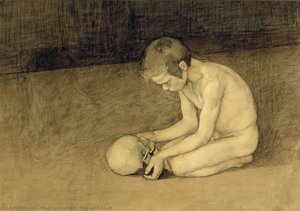
: Boy with Skull (1893) на Магнус Енкел

: Boy with Skull

1893 · Watercolor

In the quiet stillness of 1893, Magnus Enckell brings forth Boy with Skull, a work that captures a profound intersection of existence. The scene unfolds with a heavy, contemplative weight, centering on the presence of a young boy and a human skull. This encounter between the living and the remains of the departed creates a space where the boundaries of the human psyche feel thin and permeable.

10
Boats on the Shore (1902) на Магнус Енкел

Boats on the Shore

1902 · Watercolor · Finnish National Gallery, Хелзинки

The scene unfolds in Boats on the Shore, a work painted by Magnus Enckell around 1902. This piece emerges from a period of significant transition for the artist, as he moves away from the somber, muted tones of his earlier years toward a more luminous approach to color. The canvas captures a quiet moment of maritime life, where the stillness of the water meets the solid presence of wooden vessels…

Изборът на Магнус Енкел продължава, от 11 до 100

11Portrait of the Poet Otto Manninen (1903) на Магнус ЕнкелPortrait of the Poet Otto Manninen1903 · Finnish National Gallery 12Reading Room (1899) на Магнус ЕнкелReading Room1899 · Finnish National Gallery 13Elementary School (1899) на Магнус ЕнкелElementary School1899 · Finnish National Gallery 14Girl Straightening Her Hair (1902) на Магнус ЕнкелGirl Straightening Her Hair1902 · Finnish National Gallery 15Gethsemane (1902) на Магнус ЕнкелGethsemane1902 · Finnish National Gallery 16Portrait of Mrs E. Gadolin-Lagervall (1901) на Магнус ЕнкелPortrait of Mrs E. Gadolin-Lagervall1901 · Finnish National Gallery 17Portrait of Beda Stjernschantz (1902) на Магнус ЕнкелPortrait of Beda Stjernschantz1902 · Serlachius Manor 18Theatre Scene (Ida Aalberg as Maria Stuart) (1905) на Магнус ЕнкелTheatre Scene (Ida Aalberg as Maria Stuart)1905 · Finnish National Gallery 19Resurrection, Full Sketch of the Altarpiece of Tampere Cathedral (1906) на Магнус ЕнкелResurrection, Full Sketch of the Altarpiece of Tampere Cathedral1906 · Finnish National Gallery 20Girls on the Beach (1910) на Магнус ЕнкелGirls on the Beach1910 · Finnish National Gallery 21Resurrection, Copy of the Right Half of the Altarpiece in Tampere Cathedral (1907) на Магнус ЕнкелResurrection, Copy of the Right Half of the Altarpiece in Tampere Cathedral1907 · Finnish National Gallery 22Portrait of Edvard Richter (1908) на Магнус ЕнкелPortrait of Edvard Richter1908 · Finnish National Gallery 23Nude (1909) на Магнус ЕнкелNude1909 · Finnish National Gallery 24Portrait of Tyra Hasselblatt (1910) на Магнус ЕнкелPortrait of Tyra Hasselblatt1910 · HAM Helsinki Art Museum 25Resurrection (1906) на Магнус ЕнкелResurrection1906 26Pietà (1916) на Магнус ЕнкелPietà1916 · Finnish National Gallery 27Portrait of Mrs. Agda Vilén (1917) на Магнус ЕнкелPortrait of Mrs. Agda Vilén1917 · Finnish National Gallery 28Mrs. Esther Cederhvarf with Her Son (1916) на Магнус ЕнкелMrs. Esther Cederhvarf with Her Son1916 · Finnish National Gallery 29Portrait of A. W. Finch (1915) на Магнус ЕнкелPortrait of A. W. Finch1915 · Finnish National Gallery 30Lempi  (from Kuorsalo) (1914) на Магнус ЕнкелLempi (from Kuorsalo)1914 · Finnish National Gallery 31Awakening Faun (1914) на Магнус ЕнкелAwakening Faun1914 · Finnish National Gallery 32The Dying Adonis (1915) на Магнус ЕнкелThe Dying Adonis1915 · Villa Gyllenberg 33Reading Girl (1922) на Магнус ЕнкелReading Girl1922 · Finnish National Gallery 34At the Source (1921) на Магнус ЕнкелAt the Source1921 · Finnish National Gallery 35Self-Portrait (1918) на Магнус ЕнкелSelf-Portrait1918 · Finnish National Gallery 36By The Window (1919) на Магнус ЕнкелBy The Window1919 · Finnish National Gallery 37Portrait of Mrs. Lydia Keirkner (1922) на Магнус ЕнкелPortrait of Mrs. Lydia Keirkner1922 · Finnish National Gallery 38Diana and Endymion I (1921) на Магнус ЕнкелDiana and Endymion I1921 · Finnish National Gallery 39Sketch for Stained Glass Windows of Pori Church (1924) на Магнус ЕнкелSketch for Stained Glass Windows of Pori Church1924 · Finnish National Gallery 40Christus resurrexit, sketch for the stained glass of Pori church (1924) на Магнус ЕнкелChristus resurrexit, sketch for the stained glass of Pori church1924 · Finnish National Gallery 41Purgatory. Detail of a stained glass composition designed for Turun Tuomiokirkko (1923) на Магнус ЕнкелPurgatory. Detail of a stained glass composition designed for Turun Tuomiokirkko1923 · Finnish National Gallery 42Come to Me, sketch for a stained glass window in Pori Church (1924) на Магнус ЕнкелCome to Me, sketch for a stained glass window in Pori Church1924 · Finnish National Gallery 43Portrait of Miss Barbara Lagerborg (1925) на Магнус ЕнкелPortrait of Miss Barbara Lagerborg1925 · Finnish National Gallery 44Bird of Paradise, sketch (1925) на Магнус ЕнкелBird of Paradise, sketch1925 · Finnish National Gallery 45Head (1894) на Магнус ЕнкелHead1894 · Finnish National Gallery 46Angel, copy after Leonardo da Vinci's Virgin Annunciation painting, part (1895) на Магнус ЕнкелAngel, copy after Leonardo da Vinci's Virgin Annunciation painting, part1895 · Finnish National Gallery 47Boy with Skull (1893) на Магнус ЕнкелBoy with Skull1893 · Ateneum Art Museum 48Princess and Swineherd (1890) на Магнус ЕнкелPrincess and Swineherd1890 · Finnish National Gallery 49The Cult of Venus (1895) на Магнус ЕнкелThe Cult of Venus1895 · Finnish National Gallery 50Baltic Herring (1904) на Магнус ЕнкелBaltic Herring1904 · Finnish National Gallery 51Seaside View from the Naples Region (1905) на Магнус ЕнкелSeaside View from the Naples Region1905 · Finnish National Gallery 52Napolinlahti (1905) на Магнус ЕнкелNapolinlahti1905 · Finnish National Gallery 53From the Naples Region (1905) на Магнус ЕнкелFrom the Naples Region1905 · Finnish National Gallery 54Seaside Landscape from Suursaari Island (1905) на Магнус ЕнкелSeaside Landscape from Suursaari Island1905 · Finnish National Gallery 55View of Porvoo (1899) на Магнус ЕнкелView of Porvoo1899 · Finnish National Gallery 56Seaside Landscape (1905) на Магнус ЕнкелSeaside Landscape1905 · Finnish National Gallery 57Boy and Sail (1902) на Магнус ЕнкелBoy and Sail1902 · Finnish National Gallery 58Cliffs on the shore (1902) на Магнус ЕнкелCliffs on the shore1902 59Midsummer Day Service in Lohja Church (1899) на Магнус ЕнкелMidsummer Day Service in Lohja Church1899 · Finnish National Gallery 60Study на Магнус ЕнкелStudyFinnish National Gallery 61Fishermen on the Shore на Магнус ЕнкелFishermen on the ShoreFinnish National Gallery 62Watercolor Sketch of the Address of Suomen Taideyhdistys на Магнус ЕнкелWatercolor Sketch of the Address of Suomen TaideyhdistysFinnish National Gallery 63Copy of a Byzantine Icon на Магнус ЕнкелCopy of a Byzantine IconFinnish National Gallery 64Three Boys на Магнус ЕнкелThree BoysFinnish National Gallery 65Woman Seated на Магнус ЕнкелWoman SeatedFinnish National Gallery 66Portrait of a Young Girl на Магнус ЕнкелPortrait of a Young GirlFinnish National Gallery 67Lost in Thoughts на Магнус ЕнкелLost in ThoughtsFinnish National Gallery 68Salome (1906) на Магнус ЕнкелSalome1906 · Serlachius Manor 69Holstentor на Магнус ЕнкелHolstentor 70Autumn Landscape (1915) на Магнус ЕнкелAutumn Landscape1915 · Finnish National Gallery 71Shore of Seinäjoki (1912) на Магнус ЕнкелShore of Seinäjoki1912 · Finnish National Gallery 72Angler (1915) на Магнус ЕнкелAngler1915 · Finnish National Gallery 73The Park View from San Remo (1913) на Магнус ЕнкелThe Park View from San Remo1913 · Finnish National Gallery 74Still Life (1912) на Магнус ЕнкелStill Life1912 · Finnish National Gallery 75Sunny Rocky Shore, Porto Fino (1920) на Магнус ЕнкелSunny Rocky Shore, Porto Fino1920 · Finnish National Gallery 76View from Kaivopuisto (1919) на Магнус ЕнкелView from Kaivopuisto1919 · Finnish National Gallery 77Small Lake (1919) на Магнус ЕнкелSmall Lake1919 · Finnish National Gallery 78Interior View of the Finnish Opera (1919) на Магнус ЕнкелInterior View of the Finnish Opera1919 · Finnish National Gallery 79Birches in Vääksy (1919) на Магнус ЕнкелBirches in Vääksy1919 · Finnish National Gallery 80Still life with fruit (1922) на Магнус ЕнкелStill life with fruit1922 81Man and swan (1918) на Магнус ЕнкелMan and swan1918 · Serlachius Manor 82Christmas Tree in the Hall of Kilo Mansion (1919) на Магнус ЕнкелChristmas Tree in the Hall of Kilo Mansion1919 · Serlachius Manor 83Sketch for a Stained Glass Window for the Choir of Turun Tuomiokirkko (1923) на Магнус ЕнкелSketch for a Stained Glass Window for the Choir of Turun Tuomiokirkko1923 · Finnish National Gallery 84Paradise Bird, Study (1925) на Магнус ЕнкелParadise Bird, Study1925 · Finnish National Gallery 85Workhorse, Study на Магнус ЕнкелWorkhorse, StudyFinnish National Gallery 86Seashore Landscape на Магнус ЕнкелSeashore LandscapeFinnish National Gallery 87Workhorse, Study на Магнус ЕнкелWorkhorse, StudyFinnish National Gallery 88Boys на Магнус ЕнкелBoysFinnish National Gallery 89Seashore Landscape на Магнус ЕнкелSeashore LandscapeFinnish National Gallery 90Maritime Landscape на Магнус ЕнкелMaritime LandscapeFinnish National Gallery 91The Nude на Магнус ЕнкелThe NudeFinnish National Gallery 92Landscape на Магнус ЕнкелLandscapeFinnish National Gallery 93Landscape на Магнус ЕнкелLandscapeFinnish National Gallery 94River Landscape на Магнус ЕнкелRiver LandscapeFinnish National Gallery 95Landscape на Магнус ЕнкелLandscapeFinnish National Gallery 96Landscape на Магнус ЕнкелLandscapeFinnish National Gallery 97Landscape, Sketch на Магнус ЕнкелLandscape, SketchFinnish National Gallery 98Fantasia (1895) на Магнус ЕнкелFantasia1895 · Ateneum Art Museum 99The Variety Theatre in Paris (1912) на Магнус ЕнкелThe Variety Theatre in Paris1912 · Finnish National Gallery 100Mrs. Anni Lagerborg (1914) на Магнус ЕнкелMrs. Anni Lagerborg1914 · Finnish National Gallery

Знаменитите картини на Магнус Енкел, период по период

Темите, които привличат погледа на Магнус Енкел

Четирите найчесто срещани теми в тези оригинални творби, всяка с най-добрия си пример.

Музеите, в които се съхраняват оригиналите на Магнус Енкел

6 музея, които притежават най-голям брой от картините на тази страница.

Музеи Град Творения на Магнус Енкел Картини от този списък
Finnish National Gallery, ХелзинкиFinnish National Gallery Хелзинки 91 Adam and Eve, Adam (Night), Expulsion of Adam and Eve, after Masaccio
Serlachius Manor, Мънття-ВилппулаSerlachius Manor Мънття-Вилппула 4 Portrait of Beda Stjernschantz, Salome, Man and swan
Ateneum Art Museum, ХелзинкиAteneum Art Museum Хелзинки 4 Boy with Skull, Fantasia
Villa Gyllenberg, HelsinkiVilla Gyllenberg Helsinki 2 Naken gosse, The Dying Adonis
Joensuu Art Museum Onni, JoensuuJoensuu Art Museum Onni Joensuu 1 Narcissus
HAM Helsinki Art Museum, HelsinkiHAM Helsinki Art Museum Helsinki 1 Portrait of Tyra Hasselblatt

Магнус Енкел десетилетие по десетилетие: оригиналът, който дефинира всяко от тях

Произведения по десетилетия

Изберете десетилетие, за да видите оригиналната творба, която го определя.

Въпроси на колекционерите относно картините на Магнус Енкел

С кое произведение е най-известен Магнус Енкел?Разкрийте отговора

Naken gosse (1892), Villa Gyllenberg, Helsinki. Следват Adam and Eve (1897) и Adam (Night) (1896).

На каква възраст е бил Магнус Енкел, когато е създадена Naken gosse?Разкрийте отговора

22 години: Naken gosse е от 1892 г., а Магнус Енкел е роден/а в 1870.

Кои са десетте най-известни картини на Магнус Енкел?Разкрийте отговора

Naken gosse, Adam and Eve, Adam (Night), Expulsion of Adam and Eve, after Masaccio, Listeners of Music, The Concert, Portrait of Sculptor Madeleine Jouvray, Narcissus, : Boy with Skull и Boats on the Shore. Класацията по-горе показва годината и музея за всяко от тях.

Колко картини е оставил Магнус Енкел?Разкрийте отговора

В нашия каталог са представени 110 произведения на Магнус Енкел, датирани от 1890 до 1925.

В кои музеи са изложени шедьоврите на Магнус Енкел?Разкрийте отговора

Предимно в Finnish National Gallery (Хелзинки), Serlachius Manor (Мънття-Вилппула) и Ateneum Art Museum (Хелзинки). В горната таблица с музеи са изброени всички тях.

В кои години Магнус Енкел е създал най-известните си произведения?Разкрийте отговора

В 1910s: 24 от 100 произведенията на тази страница са създадени тогава, като Girls on the Beach са сред тях.

Кои са първата и последната известни оригинални творби на Магнус Енкел?Разкрийте отговора

На тази страница най-старата е Princess and Swineherd (1890), а най-новата е Portrait of Miss Barbara Lagerborg (1925).

Кои теми избира най-често Магнус Енкел?Разкрийте отговора

Woman (17), Man (15) и Figures (12), разпределени в 100 произведения на тази страница.

Коя техника използва най-често Магнус Енкел?Разкрийте отговора

Oil On Canvas, за 19 от 100 произведения на тази страница.

Към коهoто художествено направление принадлежи Магнус Енкел?Разкрийте отговора

Symbolism, судейки по оригиналите на тази страница.

Кои произведения на Магнус Енкел се съхраняват в Finnish National Gallery?Разкрийте отговора

Adam and Eve, Adam (Night) и Expulsion of Adam and Eve, after Masaccio: Finnish National Gallery, Хелзинки притежава 85 от произведенията на тази страница.

Магнус Енкел: живот и творчество

The Emergence of a Symbolist Vision

Born in the coastal town of Hamina in 1870, Knut Magnus Enckell was destined to become a cornerstone of the Finnish Golden Age. His early journey was one of profound transition, moving from the quiet landscapes of his youth toward the vibrant, intellectual currents of Paris. After initial studies in Helsinki under the guidance of Gunnar Berndtson, Enckell sought the rigorous training of the Académie Julian, where the influence of masters like Jules-Joseph Lefebvre and Jean-Joseph Benjamin-Constant began to shape his artistic eye. While his early education was rooted in the prevailing Naturalism of the era, a deeper, more introspective impulse soon began to stir within his work, pulling him away from mere representation toward the enigmatic and evocative realms of Symbolism.

A Transformation of Light and Color

The trajectory of Enckell’s career is marked by a remarkable aesthetic metamorphosis that mirrored the shifting tides of European modernism. In his formative years, his canvases were characterized by a subdued, almost somber palette that captured the melancholic depths of the human psyche. However, from 1902 onwards, a dramatic shift occurred; the shadows retreated to make way for an increasingly bright and luminous colorism. As a leading figure in the Septem group, Enckell embraced a new language of light, pushing the boundaries of Finnish art through bold, vibrant hues. This evolution was not merely technical but spiritual, as his use of radiant colors allowed him to explore themes that were previously shrouded in muted tones, bringing a newfound vitality to the Symbolist movement.

The Tapestry of Myth and Psyche

Enckell’s oeuvre is a captivating exploration of the unseen, where mythology, theatre, and the human soul converge upon the canvas. His works often feel like fever dreams or whispered legends, capturing moments of profound psychological tension and ethereal beauty. He possessed a unique ability to blend the tangible world with the subconscious, creating scenes that resonate with both mystery and grace. Among his most evocative contributions are:
Through these works, Enckell bridged the gap between reality and the ethereal, using the stage of his canvas to perform the silent dramas of the human experience.

A Lasting Legacy in Finnish Art

Beyond his technical mastery, Magnus Enckell remains a figure of immense historical significance. He was more than just a painter; he was a cultural influencer who helped redefine the identity of Finnish art on an international stage. His ability to oscillate between being a traditionalist and a radical reformer allowed him to leave an indelible mark on the landscape of early 20th-century European art. Today, his legacy is preserved in the great institutions of Finland, standing as a testament to a life spent chasing the light through the shadows of the human spirit.