Isaac Israëls: A Pioneer of Amsterdam Impressionism
Isaac Lazarus Israëls (1865 – 1934) stands as a cornerstone of Dutch Impressionist art, embodying the spirit of innovation and artistic exploration that defined the Hague School’s successor. Born in Amsterdam to Jozef Israëls, arguably the most celebrated painter of his time—a titan whose monumental depictions of Jewish life captivated audiences—and Aleida Schaap, Isaac inherited an artistic lineage steeped in tradition yet propelled forward by a fervent desire for stylistic modernity. From his earliest years, he demonstrated exceptional talent, selling “Bugle Practice” to Hendrik Willem Mesdag at just sixteen before it was completed, showcasing an uncanny ability to capture fleeting moments and luminous light—characteristics central to the Impressionist ethos.- Early Life & Artistic Training:
- The Hague School Influence:
- Amsterdam Impressionism: Capturing Everyday Life:
- Travels & Expanding Horizons:
- Legacy & Recognition:
Early Life & Artistic Training
Isaac’s formative years were marked by a profound engagement with the arts fostered by his father's unwavering dedication to realism and narrative painting. Jozef Israëls, deeply committed to portraying Jewish identity within the broader context of Dutch society, instilled in Isaac a meticulous attention to detail and an understanding of conveying emotion through subtle tonal shifts—skills that would prove invaluable throughout his artistic career. He pursued formal training at the Royal Academy of Art in The Hague alongside George Hendrik Breitner, forging a lifelong friendship that nurtured intellectual discourse and collaborative experimentation.This connection proved pivotal in shaping Israëls’s artistic sensibilities.The Hague School Influence
While Israëls swiftly distanced himself from the rigid conventions of academic painting—a deliberate rejection of the prevailing stylistic trends—the legacy of Jozef Israëls and the broader influence of the Hague School remained palpable. The Hague School’s emphasis on capturing atmospheric conditions and depicting landscapes with vibrant color palettes provided a crucial springboard for Israëls's artistic development.Breitner, similarly, championed expressive brushwork and bold compositional choices.Amsterdam Impressionism: Capturing Everyday Life
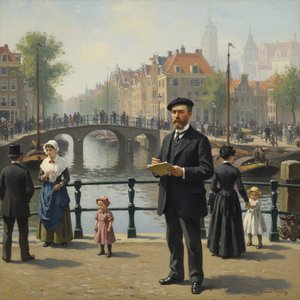
Israëls’s artistic vision centered on portraying the dynamism of Amsterdam—the bustling streets, lively cafes, and vibrant marketplaces that constituted the heart of Dutch urban life. Unlike many artists of his era who focused on grand historical narratives or mythological subjects, Israëls sought to distill the essence of human experience into evocative scenes rendered with loose brushstrokes and luminous color palettes.- Notable Works:
- The Role of Light & Color:
- Psychological Depth:
Travels & Expanding Horizons
Driven by an insatiable curiosity and a desire to broaden his artistic horizons, Israëls embarked on extensive journeys throughout Europe and Asia during the early 20th century.- India & The Dutch East Indies:
- Influence of Eastern Aesthetics:
Legacy & Recognition
Isaac Israëls’s contribution to Dutch Impressionist art is undeniable. His masterful depictions of everyday life, coupled with his innovative use of color and brushwork, cemented his place as one of the most influential painters of his generation.- Museum Collections:
- Olympic Medal Record:
- Critical Acclaim:
Въпроси и отговори
Как е разделена кариерата на Исаак Лазаров Израелс на периоди?
Кариерата на Исаак Лазаров Израелс се разгръща период по период на страницата Хронология: хоризонтална хронология от произведения, групирани в глави според различните етапи от кариерата му.
Къде мога да намеря статистика за творбите на Исаак Лазаров Израелс?
Страницата Статистика на Исаак Лазаров Израелс представя статистика, изчислена въз основа на произведенията на артиста, изброени в ето този уебсайт.
Къде и през коя година е роден/а Исаак Лазаров Израелс?
Исаак Лазаров Израелс е роден в Амстердам през 1865 г.