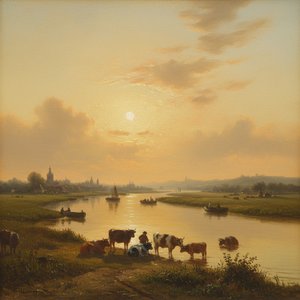
Hendrick Avercamp (1585 - 1634) – A Pioneer of Dutch Winter
Hendrick Avercamp, a name synonymous with the shimmering, frozen landscapes of the Dutch Golden Age, was born in Amsterdam on January 27, 1585. His life story is as intriguing as his art—a tale marked by both artistic innovation and personal circumstance. From an early age, it became apparent that Avercamp lived within a world experienced differently than most; he was mute, and likely deaf, earning him the affectionate yet defining moniker “de Stomme van Kampen” – the Mute of Kampen. This perceived limitation, however, did not stifle his artistic voice but perhaps sharpened his observational skills, allowing him to translate the nuances of the Dutch winter onto canvas with unparalleled clarity and charm. He initially studied in Amsterdam under Pieter Isaacsz, a portrait painter, and possibly also received guidance from David Vinckboons, whose influence can be seen in Avercamp’s early works. In 1608, he relocated to Kampen, where he would spend the majority of his life and establish himself as a unique and celebrated artist.
## Life – Silence Speaks Volumes
Avercamp’s existence was marked by profound physical challenges—he was mute and probably deaf—a circumstance that profoundly shaped his artistic perspective. Born in Amsterdam during a period of considerable climatic instability, coinciding with the Little Ice Age, Avercamp witnessed firsthand the dramatic impact of extreme winter conditions on daily life. This experience instilled within him an unwavering dedication to capturing the essence of these frozen landscapes with meticulous detail and breathtaking realism. His early training encompassed instruction from Pieter Isaacsz, a prominent portraitist of his time, fostering a foundational understanding of artistic technique and composition. Furthermore, he benefited from the mentorship of David Vinckboons, whose stylistic sensibilities contributed to Avercamp’s distinctive approach to landscape painting. Moving to Kampen in 1608 solidified his artistic home and provided him with an environment conducive to sustained creative endeavor.
## Artistic Style – Mastering Aerial Perspective and Watercolor Technique
Avercamp distinguished himself as one of the earliest dedicated landscape painters in 17th-century Holland, a field traditionally dominated by portraiture and history painting. Unlike many contemporaries who idealized their subjects or sought to convey grand narratives, Avercamp focused exclusively on winter scenes—a subject rarely explored with such consistent precision before him. His canvases are populated by figures engaged in activities ranging from skating and sledding to playing *kolf*, a form of golf played on ice—creating vibrant depictions of Dutch society amidst the austere beauty of the frozen season. Avercamp’s mastery lay in his ability to convey both the chill of winter and the warmth of communal enjoyment, achieved through masterful use of aerial perspective. This technique subtly shifts colors and details as viewed from higher elevations, creating a convincing illusion of depth and immersing the viewer within the icy expanse. Crucially, Avercamp employed watercolor washes over pen and ink drawings—a method that imparted delicate luminosity and textural richness to his paintings.
## Influences – Bruegel’s Legacy and Flemish Tradition
Avercamp's artistic sensibilities were undeniably shaped by the legacy of Pieter Bruegel the Elder, a Flemish master whose depictions of peasant life and winter landscapes served as an inspiration for Avercamp’s early compositions. Like Bruegel, Avercamp captured scenes brimming with numerous figures engaged in everyday activities—reflecting a shared commitment to portraying the realities of Dutch society with unflinching honesty. This stylistic influence is evident in Avercamp's penchant for depicting dynamic compositions filled with bustling crowds and intricate details—a characteristic that distinguishes him from many other landscape painters of his era. Moreover, Avercamp’s artistic training included exposure to prints after Bruegel, reinforcing the importance of Flemish tradition within his formative years.
## Notable Works – Winter Landscapes That Captivate Audiences Today
Avercamp's oeuvre comprises numerous iconic winter landscapes that continue to resonate with audiences today—most notably *Winter Landscape with Skaters*, which exemplifies Avercamp’s unparalleled skill in conveying both the chill of winter and the warmth of communal enjoyment. This painting, featuring a captivating array of figures engaged in skating activities, stands as a testament to Avercamp's meticulous observation and artistic virtuosity. Similarly, *Street in Delfi* offers a rare glimpse into urban life during the Dutch Golden Age—demonstrating Avercamp’s ability to depict townscapes with remarkable accuracy and detail. And *Enjoying the Ice near a Town*, showcases Avercamp’s masterful use of composition and color to capture the spirit of winter leisure—further cementing his reputation as one of Holland's foremost landscape painters. His paintings are housed in prominent collections, including the Rijksmuseum in Amsterdam and the Mauritshuis in The Hague—testaments to their enduring artistic significance.