Портрет на Дейвид Кокс

100-те най-известни картини на Дейвид Кокс, селекция от галерията

Обновено Ноември 2026 · класирано според нашия индекс на популярност (търсения, посещения и поръчки за всяко произведение) · 498 творби на Дейвид Кокс в нашия каталог

Накратко

От всички оригинални произведения, оставени от Дейвид Кокс, най-известната е Going to the Hayfield (1850). След тях непосредствено следват George IV Embarking for Scotland at Greenwich (1823) и Going to the Hayfield (1849). Нашият каталог съдържа 498 произведения на Дейвид Кокс; галерията е съхранила 100-те най-обожавани от света, всяко от тях представен с неговата дата, неговия музей и неговата история.

1783 – 1859, Бирмингам Romanticism Най-много творби: Бирмингамски музей и художествена галерия

Топ 10-те картини на Дейвид Кокс: изборът на галерията

1
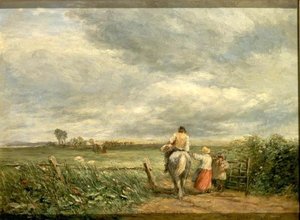
Going to the Hayfield (1850) на Дейвид Кокс

Going to the Hayfield

1850 · Watercolor

The scene unfolds in "Going to the Hayfield," a work created by the artist David Cox. In this 1849 composition, the quiet rhythms of rural life take center stage. Figures move through the landscape, their presence tied to the seasonal tasks of the countryside. The air feels heavy with the atmosphere of a specific afternoon, capturing a moment of simple, everyday activity within the English landscape.

2
George IV Embarking for Scotland at Greenwich (1823) на Дейвид Кокс

George IV Embarking for Scotland at Greenwich

1823 · Watercolor

The watercolor depicts a bustling maritime scene at Greenwich, centered on the ceremonial embarkation of George IV for Scotland. Numerous vessels occupy the water, some positioned near the shore and others further out. These boats carry various figures, and several are adorned with flags. On the banks, crowds of people gather to observe the event, some standing near the water's edge while others remain further back. A horse is visible…

3
Going to the Hayfield (1849) на Дейвид Кокс

Going to the Hayfield

David Cox's "Going to the Hayfield," painted in 1849, isn’t merely a landscape; it’s a carefully constructed distillation of Romantic sensibility and a profound connection to the English countryside. This evocative piece, now beautifully reproduced, transports us to a specific moment – a quiet afternoon as figures journey towards a hayfield bathed in the diffused light of an overcast sky. Cox, a pivotal figure bridging the gap between earlier landscape…

4
Rhyl Sands (1854) на Дейвид Кокс

Rhyl Sands

1854 · Oil On Canvas · Tate Gallery, Лондон

David Cox’s “Rhyl Sands,” painted in 1854, isn't merely a depiction of a beach; it’s a carefully constructed evocation of the Romantic spirit – a yearning for the sublime beauty and untamed power of nature. Cox, a pivotal figure within the Birmingham School of watercolourists, masterfully captures a fleeting moment along the Welsh coast, imbuing the scene with an atmosphere of both tranquility and dramatic intensity. The painting transports us…

5
Study of a Dog (1840) на Дейвид Кокс

Study of a Dog

1840 · Watercolor

In this intimate watercolor study, titled Study of a Dog, the viewer encounters a quiet moment of observation. The subject is a single dog, an animal captured in a state of repose. David Cox, a British artist who lived from 1783 to 1859, brings a sense of immediacy to this piece. The work emerges from the 1840s, a period when the artist's hand moved with increasing freedom. It belongs to…

6
The Skylark (1849) на Дейвид Кокс

The Skylark

In the vast tapestry of English landscape painting, few works capture the ephemeral beauty of the countryside with as much soul as David Cox’s The Skylark. Created in 1849, this masterpiece serves as a profound window into a serene, pastoral era, inviting the viewer to pause and breathe in the quietude of the rural landscape. The painting presents a sprawling field of grass that stretches toward a distant, hazy horizon,…

7
Storm off the Coast, Hastings (1813) на Дейвид Кокс

Storm off the Coast, Hastings

There is a certain gravity in how the sky meets the sea in this 1813 work. The composition draws the eye along a diagonal path, moving from the heavy, dark presence of the cliffs in the foreground toward a lighter, mist-filled horizon. It is a scene of movement and tension, where the elements of sea, sky, and stone are caught in a moment of profound unrest. The palette relies on…

9
Cornfield (1814) на Дейвид Кокс

Cornfield

1814 · Watercolor

The air feels heavy and damp, thick with the scent of wet earth and the promise of rain. In this hazy landscape, a vast cornfield stretches toward a soft, clouded horizon, its breadth emphasized by long, horizontal strokes of ochre and muted green. Figures move through the middle ground, their forms softened by the mist, tending to a cart pulled by horses. There is a rhythmic, slow quality to their…

10
Near the Pont d'Arcole, Paris (1829) на Дейвид Кокс

Near the Pont d'Arcole, Paris

1829 · Watercolor

The scene unfolds in the heart of a bustling Parisian street, captured in the work titled Near the Pont d'Arcole, Paris. This watercolor painting brings us into a moment of urban life, where the architecture of the city meets the movement of its people. The artist, David Cox, directs our gaze toward the structures and the atmosphere of the streets near the Pont d'Arcole.

Изборът на Дейвид Кокс продължава, от 11 до 100

11Pont Neuf from the Quai de l'Ecole, Paris (1829) на Дейвид КоксPont Neuf from the Quai de l'Ecole, Paris1829 12Place du Palais Royal, Paris (1829) на Дейвид КоксPlace du Palais Royal, Paris1829 · Бирмингамски музей и художествена галерия 13The Welsh Funeral (1848) на Дейвид КоксThe Welsh Funeral1848 · Бирмингамски музей и художествена галерия 14Untitled (AQTKGL) (1853) на Дейвид КоксUntitled (AQTKGL)1853 15The Cross Roads (1850) на Дейвид КоксThe Cross Roads1850 · Бирмингамски музей и художествена галерия 16Rhyl Sands (1854) на Дейвид КоксRhyl Sands1854 · Бирмингамски музей и художествена галерия 17Scene in a Lane (1858) на Дейвид КоксScene in a Lane1858 18Beach Scene Sunrise (1820) на Дейвид КоксBeach Scene Sunrise1820 · Yale Center for British Art 19Fishing off Hastings (1810) на Дейвид КоксFishing off Hastings1810 · Yale Center for British Art 20The Junction of the Severn and the Wye with Chepstow in the Distance (1830) на Дейвид КоксThe Junction of the Severn and the Wye with Chepstow in the Distance1830 · Yale Center for British Art 21The Wyndcliff, River Wye (1842) на Дейвид КоксThe Wyndcliff, River Wye1842 · Бирмингамски музей и художествена галерия 22German Der Strand von Rhyl (1854) на Дейвид КоксGerman Der Strand von Rhyl1854 · Manchester Art Gallery 23Left at a Girls' School (1812) на Дейвид КоксLeft at a Girls' School1812 · Бирмингамски музей и художествена галерия 24Lake Scene, North Wales (1811) на Дейвид КоксLake Scene, North Wales1811 · Бирмингамски музей и художествена галерия 25A View of Westminster Bridge, Looking West towards Lambeth Palace and Westminster Abbey (1811) на Дейвид КоксA View of Westminster Bridge, Looking West towards Lambeth Palace and Westminster Abbey1811 26In Windsor Park (1807) на Дейвид КоксIn Windsor Park1807 27Westminster from Lambeth (1813) на Дейвид КоксWestminster from Lambeth1813 28Sunset, Hastings: Beached Fishing Vessels (1811) на Дейвид КоксSunset, Hastings: Beached Fishing Vessels1811 29Gipsies on Dulwich Common (1808) на Дейвид КоксGipsies on Dulwich Common1808 · Бирмингамски музей и художествена галерия 30Pastoral Scene in Herefordshire (1820) на Дейвид КоксPastoral Scene in Herefordshire1820 31Lugg Meadows, near Hereford (1817) на Дейвид КоксLugg Meadows, near Hereford1817 32Tour d'Horloge, Rouen (1829) на Дейвид КоксTour d'Horloge, Rouen1829 33The Opening of the New London Bridge (1831) на Дейвид КоксThe Opening of the New London Bridge1831 34St. Mary's Church and the Shire Hall, Warwick (1828) на Дейвид КоксSt. Mary's Church and the Shire Hall, Warwick1828 35Place St. Barthélemy, Rouen (1829) на Дейвид КоксPlace St. Barthélemy, Rouen1829 36Carthage: Aeneas and Achates (1825) на Дейвид КоксCarthage: Aeneas and Achates1825 37Junction of the Severn and the Wye with a Rainbow (1827) на Дейвид КоксJunction of the Severn and the Wye with a Rainbow1827 38Dockyard - Building a Sloop (1823) на Дейвид КоксDockyard - Building a Sloop1823 39Still LIfe: Basket, Foxgloves, Clothes and Other Objects (1823) на Дейвид КоксStill LIfe: Basket, Foxgloves, Clothes and Other Objects1823 · Бирмингамски музей и художествена галерия 40A View of the Pavillon de Flore and the Tuileries from the Seine, Notre Dame, Paris (1829) на Дейвид КоксA View of the Pavillon de Flore and the Tuileries from the Seine, Notre Dame, Paris1829 41Hay on Wye (1824) на Дейвид КоксHay on Wye1824 42Porte St. Denis, Paris (1829) на Дейвид КоксPorte St. Denis, Paris1829 43Pirates' Isle (1826) на Дейвид КоксPirates' Isle1826 44Pavillon de Flore, Tuileries, Paris (1830) на Дейвид КоксPavillon de Flore, Tuileries, Paris1830 45St. Eustache, Paris (1829) на Дейвид КоксSt. Eustache, Paris1829 46Handsworth Old Church, Birmingham (1828) на Дейвид КоксHandsworth Old Church, Birmingham1828 47Ulverston Sands (1835) на Дейвид КоксUlverston Sands1835 · Бирмингамски музей и художествена галерия 48Crossing Lancaster Sands (1835) на Дейвид КоксCrossing Lancaster Sands1835 49Street in Beauvais (1832) на Дейвид КоксStreet in Beauvais1832 50The Pont des Arts with the Louvre and Tuileries from the Quai Conti (1838) на Дейвид КоксThe Pont des Arts with the Louvre and Tuileries from the Quai Conti1838 51The Long Gallery, Hardwick Hall, Derbyshire (1839) на Дейвид КоксThe Long Gallery, Hardwick Hall, Derbyshire1839 52The Poplar Avenue, after Hobbema (1835) на Дейвид КоксThe Poplar Avenue, after Hobbema1835 53The Long Gallery, Hardwick Hall, Derbyshire (1839) на Дейвид КоксThe Long Gallery, Hardwick Hall, Derbyshire1839 54Going Out Hawking (1838) на Дейвид КоксGoing Out Hawking1838 55Peace and War: Lympne Church and Castle (1838) на Дейвид КоксPeace and War: Lympne Church and Castle1838 · Бирмингамски музей и художествена галерия 56A Terrace, with Figures, Haddon Hall (1834) на Дейвид КоксA Terrace, with Figures, Haddon Hall1834 · Бирмингамски музей и художествена галерия 57Windermere during the Regatta (1832) на Дейвид КоксWindermere during the Regatta1832 58Rhaiadr Cwm, North Wales (1836) на Дейвид КоксRhaiadr Cwm, North Wales1836 59Pass of Llanberis, Caernarvonshire, Wales (1836) на Дейвид КоксPass of Llanberis, Caernarvonshire, Wales1836 60The Long Gallery, Hardwick Hall, Derbyshire (1839) на Дейвид КоксThe Long Gallery, Hardwick Hall, Derbyshire1839 · Chatsworth House 61Crossing Lancaster Sands (1840) на Дейвид КоксCrossing Lancaster Sands1840 62View near Bettws-y-Coed (1846) на Дейвид КоксView near Bettws-y-Coed1846 · Бирмингамски музей и художествена галерия 63On Lancaster Sands, Low Tide (1840) на Дейвид КоксOn Lancaster Sands, Low Tide1840 64Vale of Clwyd (1848) на Дейвид КоксVale of Clwyd1848 65Near Knaresborough (1844) на Дейвид КоксNear Knaresborough1844 66A Welsh Road (1846) на Дейвид КоксA Welsh Road1846 67The Vale of Dolwyddelan (1846) на Дейвид КоксThe Vale of Dolwyddelan1846 68A Country Track Leading to Harlech Castle (1842) на Дейвид КоксA Country Track Leading to Harlech Castle1842 69Carreg Cennan Castle (1844) на Дейвид КоксCarreg Cennan Castle1844 70Cottage Interior (1840) на Дейвид КоксCottage Interior1840 · Бирмингамски музей и художествена галерия 71Outskirts of a Wood, with Gypsies (1843) на Дейвид КоксOutskirts of a Wood, with Gypsies1843 72Vale of Clwyd (1846) на Дейвид КоксVale of Clwyd1846 73Going to the Hayfield (1853) на Дейвид КоксGoing to the Hayfield1853 · Yale Center for British Art 74On the Medway (1850) на Дейвид КоксOn the Medway1850 75Horses Drinking (1855) на Дейвид КоксHorses Drinking1855 76A Mountain Torrent (1850) на Дейвид КоксA Mountain Torrent1850 77Flying the Kite (1853) на Дейвид КоксFlying the Kite1853 78On Carrington Moss, Cheshire (1851) на Дейвид КоксOn Carrington Moss, Cheshire1851 79Mountain Heights, Cader Idris (1850) на Дейвид КоксMountain Heights, Cader Idris1850 80Penman Bach (1852) на Дейвид КоксPenman Bach1852 81The Night Train (1849) на Дейвид КоксThe Night Train1849 82Vale of Clwyd (1849) на Дейвид КоксVale of Clwyd1849 83The Challange (1853) на Дейвид КоксThe Challange1853 84Peat Gatherers (1850) на Дейвид КоксPeat Gatherers1850 85Kenilworth Castle (1857) на Дейвид КоксKenilworth Castle1857 · Бирмингамски музей и художествена галерия 86Darley Churchyard (1858) на Дейвид КоксDarley Churchyard1858 87On the Moors, near Bettws-y-Coed (1856) на Дейвид КоксOn the Moors, near Bettws-y-Coed1856 88Crossing the Moor (1858) на Дейвид КоксCrossing the Moor1858 89Stepping Stones, Bettws-y-Coed (1857) на Дейвид КоксStepping Stones, Bettws-y-Coed1857 90Clouds (1857) на Дейвид КоксClouds1857 91Moonlight Landscape (1850) на Дейвид КоксMoonlight Landscape1850 · Yale Center for British Art 92The Night Train (1849) на Дейвид КоксThe Night Train1849 · City Art Gallery 93Midday Rest на Дейвид КоксMidday Rest 94The Thames At Battersea на Дейвид КоксThe Thames At Battersea 95Returning Home на Дейвид КоксReturning Home 96Lancaster Sands 1 на Дейвид КоксLancaster Sands 1 97A Child With A Dog, Outside A Cottage на Дейвид КоксA Child With A Dog, Outside A Cottage 98The Jetty, Calais на Дейвид КоксThe Jetty, Calais 99Young Welsh Girl на Дейвид КоксYoung Welsh Girl 100In The Hayfield 1 на Дейвид КоксIn The Hayfield 1

Знаменитите картини на Дейвид Кокс, период по период

Late Medieval

1820 – 1858 · 3 произведения в този списък

Темите, които привличат погледа на Дейвид Кокс

Четирите найчесто срещани теми в тези оригинални творби, всяка с най-добрия си пример.

Музеите, в които се съхраняват оригиналите на Дейвид Кокс

6 музея, които притежават най-голям брой от картините на тази страница.

Музеи Град Творения на Дейвид Кокс Картини от този списък
Бирмингамски музей и художествена галерия, БирмингамБирмингамски музей и художествена галерия Бирмингам 54 Going to the Hayfield, The Skylark, Storm off the Coast, Hastings
Yale Center for British Art, Ню ХейвънYale Center for British Art Ню Хейвън 6 Beach Scene Sunrise, Fishing off Hastings, The Junction of the Severn and the Wye with Chepstow in the Distance
Tate Gallery, ЛондонTate Gallery Лондон 1 Rhyl Sands
Manchester Art Gallery, МанчестърManchester Art Gallery Манчестър 1 German Der Strand von Rhyl
Chatsworth House, БейкуелChatsworth House Бейкуел 1 The Long Gallery, Hardwick Hall, Derbyshire
City Art Gallery, БирмингамCity Art Gallery Бирмингам 1 The Night Train

Дейвид Кокс десетилетие по десетилетие: оригиналът, който дефинира всяко от тях

Произведения по десетилетия

Изберете десетилетие, за да видите оригиналната творба, която го определя.

Въпроси на колекционерите относно картините на Дейвид Кокс

С кое произведение е най-известен Дейвид Кокс?Разкрийте отговора

Going to the Hayfield (1850). Следващите са George IV Embarking for Scotland at Greenwich (1823) и Going to the Hayfield (1849).

На каква възраст е бил Дейвид Кокс, когато е създадена Going to the Hayfield?Разкрийте отговора

67 години: Going to the Hayfield е от 1850 г., а Дейвид Кокс е роден/а в 1783.

Кои са десетте най-известни картини на Дейвид Кокс?Разкрийте отговора

Going to the Hayfield, George IV Embarking for Scotland at Greenwich, Going to the Hayfield, Rhyl Sands, Study of a Dog, The Skylark, Storm off the Coast, Hastings, The Old Bridge at Bridgnorth, Shropshire, Cornfield и Near the Pont d'Arcole, Paris. Класацията по-горе показва годината и музея за всяко от тях.

Колко картини е оставил Дейвид Кокс?Разкрийте отговора

В нашия каталог са представени 498 произведения на Дейвид Кокс, датирани от 1807 до 1858.

В кои музеи са изложени шедьоврите на Дейвид Кокс?Разкрийте отговора

Предимно в Бирмингамски музей и художествена галерия (Бирмингам), Yale Center for British Art (Ню Хейвън) и Tate Gallery (Лондон). В горната таблица с музеи са изброени всички тях.

В кои години Дейвид Кокс е създал най-известните си произведения?Разкрийте отговора

В 1850s: 24 от 100 произведенията на тази страница са създадени тогава, като Going to the Hayfield са сред тях.

Кои са първата и последната известни оригинални творби на Дейвид Кокс?Разкрийте отговора

На тази страница най-старата е In Windsor Park (1807), а най-новата е Scene in a Lane (1858).

Кои теми избира най-често Дейвид Кокс?Разкрийте отговора

Landscape (13), Sky (10) и British countryside (8), разпределени в 100 произведения на тази страница.

Коя техника използва най-често Дейвид Кокс?Разкрийте отговора

Watercolor, за 13 от 100 произведения на тази страница.

Към коهoто художествено направление принадлежи Дейвид Кокс?Разкрийте отговора

Romanticism, судейки по оригиналите на тази страница.

Кои произведения на Дейвид Кокс се съхраняват в Бирмингамски музей и художествена галерия?Разкрийте отговора

Going to the Hayfield, The Skylark и Storm off the Coast, Hastings: Бирмингамски музей и художествена галерия, Бирмингам притежава 18 от произведенията на тази страница.

Дейвид Кокс: живот и творчество

Early Life and Artistic Beginnings

David Cox, a name now synonymous with the evocative beauty of British landscape painting, was born on April 29th, 1783, in Deritend – a bustling industrial suburb of Birmingham. His father, Joseph Cox, was a skilled blacksmith and whitesmith, supplying vital components to Birmingham’s renowned gun trade; a profession steeped in precision and craftsmanship. His mother, however, possessed a remarkable distinction: she hailed from a farming background but had received an unusually thorough education, imbuing David with both a practical understanding of the land and a sharp intellect. This unique combination shaped his future artistic vision. Initially, young David was destined to follow in his father’s footsteps, learning the trade of blacksmithing. However, a childhood illness – a broken leg – led to a period of convalescence during which he discovered a passion for art. He began by creating paper kites, meticulously coloring them with simple box sets, quickly progressing to copying engravings and adding delicate details. This early exploration was nurtured further through his apprenticeship under Albert Fielder, a respected Birmingham painter specializing in miniature portraits and decorative paintings applied to objects like snuffboxes – a craft demanding both technical skill and artistic flair. This formative period instilled in him the fundamentals of composition, color theory, and meticulous detail, laying the groundwork for his later success. Crucially, he spent time studying alongside fellow apprentices Charles Barber and William Radclyffe at Joseph Barber’s academy, absorbing techniques and developing a keen eye for observation.

A Journey into Watercolor and Welsh Inspiration

The year 1804 marked a pivotal shift in David Cox's career as he embarked on a new chapter by relocating to London. There, he married his landlord’s daughter, Mary Ragg – a union that provided him with stability and a home base while he continued to hone his artistic skills. A defining moment arrived in 1805 when he joined forces with Charles Barber for a sketching tour through Wales. This journey proved transformative, profoundly influencing his artistic style and establishing a lifelong fascination with the rugged beauty of the Welsh mountains and valleys. The dramatic light, the ever-changing weather, and the raw, untamed landscapes ignited within him a desire to capture the essence of nature’s power and vulnerability. These Welsh sketches became a cornerstone of his oeuvre, informing his later paintings with a distinctive atmospheric quality. Cox quickly established himself as an exhibitor at the Royal Academy from 1805 onwards, initially earning a living primarily through drawing lessons – a testament to his teaching abilities and his commitment to sharing his knowledge. Colonel Hon. H. Windsor became one of his earliest pupils in 1808, further solidifying Cox’s reputation as an accomplished instructor. His early works were characterized by detailed watercolor landscapes, often depicting rural scenes and architectural subjects with a remarkable level of precision. He skillfully rendered the textures of stone walls, the folds of fabric, and the intricacies of farm buildings, demonstrating a meticulous attention to detail that was both admired and imitated.

The Evolution of Style: From Precision to Atmosphere

Cox’s artistic style underwent a significant evolution over his career. Initially, he focused on creating highly detailed topographical representations – meticulously documenting the appearance of landscapes as they were observed. However, influenced by artists like Constable and the Dutch masters of the 17th century, he gradually shifted towards a more expressive and atmospheric approach. He began to prioritize capturing the *feeling* of a place rather than simply replicating its visual form. This transition is evident in his later oil paintings, which are distinguished by looser brushwork, vibrant colors, and an unparalleled ability to convey the effects of light and weather – particularly the shifting moods of the Welsh skies. His use of color became bolder and more emotive, reflecting a growing confidence in his artistic vision. Cox’s work is often described as “pre-Impressionist,” anticipating many of the techniques that would later characterize the Impressionist movement. His emphasis on capturing fleeting moments, his loose brushwork, and his focus on light and atmosphere foreshadowed the innovations of artists like Monet and Renoir. He was a master of suggesting rather than explicitly depicting, allowing the viewer’s imagination to complete the picture.

Major Achievements and Lasting Legacy

Throughout his career, David Cox produced over 300 oil paintings – a remarkable achievement that is now recognized as one of the greatest, yet least celebrated, accomplishments of any British painter. He continued to exhibit at the Royal Academy until his death in 1859, maintaining a consistent output and refining his artistic style. His work became increasingly popular during his lifetime, particularly in Wales, where he was admired for his depictions of the Welsh countryside. Cox’s legacy extends far beyond his individual paintings. He wrote several influential instructional books on watercolor painting – *A Series of Progressive Lessons* (1811) being one of the most successful – which helped to popularize the medium among amateur artists and establish him as a respected authority on technique. His dedication to teaching, combined with his artistic talent, cemented his place in the history of British art. David Cox died in Harborne, near Birmingham, on June 7th, 1859, leaving behind a rich body of work that continues to inspire admiration and is considered a cornerstone of British landscape painting.

Historical Significance

David Cox’s contribution to English landscape painting cannot be overstated. He was not merely a skilled artist; he was a pioneer who challenged the conventions of his time and pushed the boundaries of watercolor technique. His early embrace of Impressionistic principles – capturing fleeting moments, emphasizing light and atmosphere, and utilizing loose brushwork – positioned him as a crucial link between the Romantic era and the rise of modern art. Furthermore, his deep connection to Wales—documented through countless sketches and paintings—established a unique artistic voice rooted in the rugged beauty of that nation’s landscape. Cox's work serves as a testament to the power of observation, the importance of capturing emotion, and the enduring appeal of nature’s sublime grandeur.