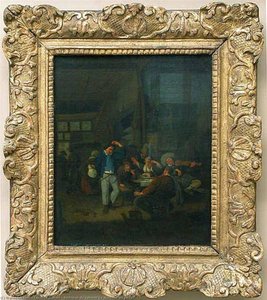
Портрет на Cornelis Dusart

Картини на Cornelis Dusart: 37-те най-известни, през погледа на галерията

Обновено Ноември 2026 · класирано според нашия индекс на популярност (търсения, посещения и поръчки за всяко произведение) · 40 творби на Cornelis Dusart в нашия каталог

Накратко

Според избора на галерията най-известната картина на Cornelis Dusart е Peasants in Front of an Inn (1681), чийто оригинал се намира в Kunsthistorisches Museum, Виена. Village inn (1690) и Country Inn with Hurdy-Gurdy Player (1681) допълват трио, което всяко око разпознава. От 40 произведения на Cornelis Dusart в нашия каталог, галерията представя 37 най-известните по-долу – всяко от тях е оригинал с посочен година, музей и това, което го прави уникално.

1660 – 1704, Haarlem Dutch golden age Най-много творби: Rijksmuseum

Топ 10 карти на Cornelis Dusart в галерията

1
Peasants in Front of an Inn (1681) от Cornelis Dusart

Peasants in Front of an Inn

1681 · Oil On Panel · Kunsthistorisches Museum, Виена

The air outside the inn feels heavy with the scent of damp earth and woodsmoke. Under the shade of a leafy canopy, a group of peasants gathers, their bodies leaning into the ease of a midday rest. There is a palpable sense of movement held in suspension; a man sits perched on a bench, perhaps listening to the low murmur of conversation or the distant sound of a traveler approaching.…

2
Village inn (1690) от Cornelis Dusart

Village inn

1690 · Oil On Panel · Rijksmuseum, Амстердам

In this 1690 oil on panel, we find ourselves drawn into the quiet, unhurried rhythm of a Dutch village inn. The scene is one of communal leisure, where the boundaries between public social life and private intimacy blur under the soft, natural light of a rural afternoon. In the foreground, a man and a woman sit together, their presence grounding the composition with a sense of lived experience. He holds…

3
Country Inn with Hurdy-Gurdy Player (1681) от Cornelis Dusart

Country Inn with Hurdy-Gurdy Player

1681 · Painting · Städel Museum, Франкфурт

A group of peasants gathers in the courtyard of a rustic, thatched-roof inn. The composition is crowded, with figures occupying the foreground and midground to create a sense of social activity. On the right, the heavy architecture of the building provides a structured frame, while foliage on the left balances the scene. The light originates from the upper left, casting soft shadows across the courtyard and highlighting the central figures.…

Картини на Cornelis Dusart, класирани от 11 до 37

Темите, които привличат погледа на Cornelis Dusart

Четирите найчесто срещани теми в тези оригинални творби, всяка с най-добрия си пример.

Музеите, в които се съхраняват оригиналите на Cornelis Dusart

8 музея, които притежават най-голям брой от картините на тази страница.

Музей Град Творения на Cornelis Dusart Картини от този списък
Rijksmuseum, АмстердамRijksmuseum Амстердам 6 Village inn, A Mother with her Children, Village fair
Statens Museum for Kunst, КопенхагенStatens Museum for Kunst Копенхаген 2 Bagpiper at an Inn, Peasants outside an Inn
Франс Халс Музей, ХейренФранс Халс Музей Хейрен 2 Drinking party, The Notary
Kunsthistorisches Museum, ВиенаKunsthistorisches Museum Виена 1 Peasants in Front of an Inn
Städel Museum, ФранкфуртStädel Museum Франкфурт 1 Country Inn with Hurdy-Gurdy Player
Fine Arts Museums of San Francisco, Сан ФранцискоFine Arts Museums of San Francisco Сан Франциско 1 Village Scene
Национален музей във Варшава, ВаршаваНационален музей във Варшава Варшава 1 Fish scraping
Национална галерия в Ирландия, Dublin CityНационална галерия в Ирландия Dublin City 1 A Merry-making

Cornelis Dusart, по една емблематична картина на десетилетие

Произведения по десетилетия

Изберете десетилетие, за да видите оригиналната творба, която го определя.

Картините на Cornelis Dusart: отговорите на галерията

Коя картина на Cornelis Dusart е най-известната от всички?Разкрийте отговора

Peasants in Front of an Inn (1681), Kunsthistorisches Museum, Виена. Следват Village inn (1690) и Country Inn with Hurdy-Gurdy Player (1681).

На каква възраст беше Cornelis Dusart, когато завърши Peasants in Front of an Inn?Разкрийте отговора

21 години: Peasants in Front of an Inn е от 1681 г., а Cornelis Dusart е роден/а в 1660.

Кои са 10-те най-добри картини на Cornelis Dusart?Разкрийте отговора

Peasants in Front of an Inn, Village inn, Country Inn with Hurdy-Gurdy Player, Village Scene, teasing the cat, Fish scraping, A Merry-making, A kermess, Bagpiper at an Inn и Peasants outside an Inn. Класацията по-горе показва годината и музея за всяко от тях.

Колко произведения е създал Cornelis Dusart?Разкрийте отговора

В нашия каталог са представени 40 произведения на Cornelis Dusart, датирани от 1679 до 1702.

Къде са изложени най-известните оригинали на Cornelis Dusart?Разкрийте отговора

Предимно в Rijksmuseum (Амстердам), Statens Museum for Kunst (Копенхаген) и Франс Халс Музей (Хейрен). В горната таблица с музеи са изброени всички тях.

Кога Cornelis Dusart създава най-известните си картини?Разкрийте отговора

В 1680s: 11 от 37 произведенията на тази страница са създадени тогава, като Peasants in Front of an Inn са сред тях.

Кои са най-ранните и най-късните известни творби на Cornelis Dusart?Разкрийте отговора

На тази страница най-старата е The Milk Seller (1679), а най-новата е Drinking party (1702).

Към кои сюжети Cornelis Dusart се връща най-често?Разкрийте отговора

Inn (3), Woman (3) и Men (3), разпределени в 37 произведения на тази страница.

С коя техника е работил най-често Cornelis Dusart?Разкрийте отговора

Oil On Panel, за 4 от 37 произведения на тази страница.

С кое художествено направление е свързан(а) Cornelis Dusart?Разкрийте отговора

Dutch golden age и Baroque, судейки по оригиналите на тази страница.

Кои оригинални творби на Cornelis Dusart притежава Rijksmuseum?Разкрийте отговора

Village inn, A Mother with her Children и Village fair: Rijksmuseum, Амстердам притежава 6 от произведенията на тази страница.

Cornelis Dusart: художникът

Cornelis Dusart: A Window into Dutch Everyday Life

Cornelis Dusart (1660-1704) stands as a fascinating figure within the Haarlem School of painting, offering viewers a glimpse into the vibrant tapestry of 17th-century Dutch society. Unlike many artists of his era focused on grand historical narratives or mythological subjects, Dusart dedicated himself to capturing the commonplace – itinerant peddlers haggling in bustling marketplaces and intimate scenes unfolding within taverns. This deliberate choice reveals a profound interest in portraying the realities of daily life, reflecting a humanist sensibility that was gaining momentum during the Golden Age. His artistic training began under the tutelage of Rembrandt Harmenszoon van Rijn, arguably the most influential painter of his time, cementing Dusart’s connection to the stylistic innovations emerging from Leiden and Amsterdam. Rembrandt's emphasis on dramatic lighting and psychological realism undoubtedly shaped Dusart’s approach, fostering a meticulous attention to detail that distinguishes his oeuvre. However, Dusart developed a unique style—characterized by soft brushstrokes and subtle tonal gradations—that subtly diverged from Rembrandt’s bolder palette. This distinctive technique allowed him to convey atmosphere and emotion with remarkable sensitivity. Dusart's prolific output spanned numerous commissions, primarily focusing on genre scenes. He skillfully rendered the textures of fabrics, the expressions of faces, and the nuances of light and shadow, creating images that feel remarkably authentic. Consider “The Street Seller,” a captivating depiction of a peddler engaging in trade—the artist’s meticulous observation captures not only the physical appearance of the scene but also the palpable energy of the marketplace. Similarly, "The Quack" portrays a physician examining a patient with quiet dignity and precision, highlighting Dusart's ability to convey psychological depth within seemingly simple compositions. Furthermore, Dusart’s work exemplifies the burgeoning fascination with realism that permeated Dutch art circles during his lifetime. He wasn’t merely documenting what he saw; he was striving to evoke feeling and understanding in the viewer. This ambition aligns perfectly with the broader cultural context of the period—a time marked by intellectual curiosity and a desire to represent human experience accurately. Dusart's contribution to Haarlem School painting is significant not only for its stylistic merits but also for its enduring portrayal of ordinary life, securing his place as an artist who captured the spirit of his era with remarkable artistry.
  • Notable Commissions: Dusart undertook numerous commissions for wealthy patrons and civic institutions, showcasing his versatility and artistic skill.
  • Influences: Rembrandt van Rijn’s masterful use of light and psychological realism profoundly impacted Dusart's artistic development.
  • Technique: Dusart employed soft brushstrokes and tonal gradations to create atmospheric paintings imbued with emotion and subtlety.

Major Achievements & Legacy

Dusart’s enduring legacy resides in his ability to distill the essence of everyday life into powerfully evocative images. His genre scenes continue to resonate with audiences today, offering insights into the social customs and psychological complexities of 17th-century Holland. While Dusart may not command the same level of fame as Rembrandt or Vermeer, his meticulous style and humanist vision solidify his position as a pivotal artist within the Haarlem School—a testament to the transformative power of observing and representing the human condition with unwavering dedication.