Портрет на Christopher Pearse Cranch

34-те най-известни картини на Christopher Pearse Cranch, всяка от които е уникална

Обновено Ноември 2026 · класирано според нашия индекс на популярност (търсения, посещения и поръчки за всяко произведение) · 34 творби на Christopher Pearse Cranch в нашия каталог

Накратко

River Running between Pastures (1850) е картината на Christopher Pearse Cranch, която привлича най-много погледи. След това погледът се насочва към Sunset Landscape и View on the Catskill River (1846). Сред 34 произведения на Christopher Pearse Cranch в нашия каталог, тези 34 са най-известните – всяко от тях е уникален оригинал, представен с годината на създаване, музея и причината за неговата вечност.

1813 – 1892, Columbia Hudson river school Най-много творби: New York Historical Society

Топ 10 картини на Christopher Pearse Cranch, през погледа на галерията

1
River Running between Pastures (1850) на Christopher Pearse Cranch

River Running between Pastures

1850 · Oil

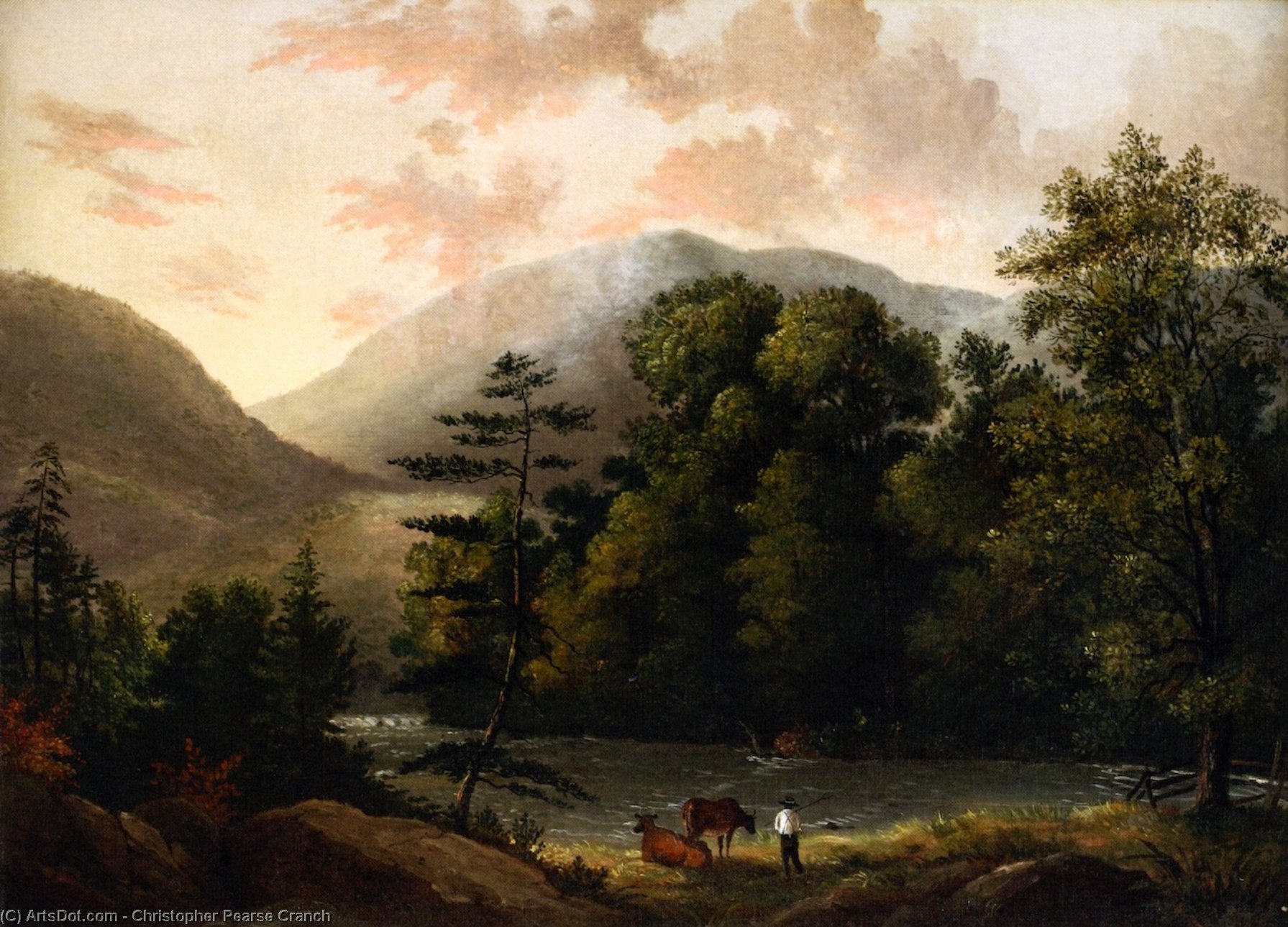
A river carves a path through a lush valley, flanked by dense, green foliage. In the distance, mountains rise against the horizon, framing a scene of quiet pastoral life. Along the riverbanks, cows graze peacefully, while horses move through the landscape. A solitary figure stands near the center, observing the movement of the water or tending to the livestock. The composition captures a moment of stillness within the natural world.

Знаменитите картини на Christopher Pearse Cranch, номера от 11 до 34

Темите, които привличат погледа на Christopher Pearse Cranch

Четирите найчесто срещани теми в тези оригинални творби, всяка с най-добрия си пример.

Музеите, в които се съхраняват оригиналите на Christopher Pearse Cranch

5 музея, които притежават най-голям брой от картините на тази страница.

Музеи Град Творения на Christopher Pearse Cranch Картини от този списък
New York Historical Society, Ню ЙоркNew York Historical Society Ню Йорк 2 View on the Catskill River, Landscape
Addison Gallery of American Art, MassachusettsAddison Gallery of American Art Massachusetts 1 Sunset Landscape
Fogg Art Museum, КеймбриджFogg Art Museum Кеймбридж 1 View on the Hudson
Национална галерия на изкуствата, УокшънтънНационална галерия на изкуствата Уокшънтън 1 Castle Gondolfo, Lake Albano, Italy
Музей на изкуствата във Бостън, БостънМузей на изкуствата във Бостън Бостън 1 San Pietro in Castello, Venice

Christopher Pearse Cranch през десетилетията: един уникален оригинал за всяко

Произведения по десетилетия

Изберете десетилетие, за да видите оригиналната творба, която го определя.

Картини на Christopher Pearse Cranch: въпроси към галерията

Кое е най-известното произведение на Christopher Pearse Cranch?Разкрийте отговора

River Running between Pastures (1850). Следващите са Sunset Landscape и View on the Catskill River (1846).

На каква възраст Christopher Pearse Cranch създава River Running between Pastures?Разкрийте отговора

37 години: River Running between Pastures е от 1850 г., а Christopher Pearse Cranch е роден/а в 1813.

Кои са десетте най-известни картини на Christopher Pearse Cranch?Разкрийте отговора

River Running between Pastures, Sunset Landscape, View on the Catskill River, Rome, Man with Two Cows, Landscape with Fishermen and Artist Sketching, Tivoli, East of Rome, Mountain Landscape, View on the Hudson и Landscape. Класацията по-горе показва годината и музея за всяко от тях.

Колко са известните творби на Christopher Pearse Cranch?Разкрийте отговора

В нашия каталог са представени 34 произведения на Christopher Pearse Cranch, датирани от 1844 до 1885.

Къде могат да се видят най-известните оригинали на Christopher Pearse Cranch?Разкрийте отговора

Предимно в New York Historical Society (Ню Йорк), Addison Gallery of American Art (Massachusetts) и Fogg Art Museum (Кеймбридж). В горната таблица с музеи са изброени всички тях.

През кой период Christopher Pearse Cranch създава най-известните си картини?Разкрийте отговора

В 1850s: 13 от 34 произведенията на тази страница са създадени тогава, като River Running between Pastures са сред тях.

Коя е най-ранната и коя е най-късната известна картина на Christopher Pearse Cranch?Разкрийте отговора

На тази страница най-старата е Man with Two Cows (1844), а най-новата е McIntyre Mountain (1885).

Какви теми предпочиташе Christopher Pearse Cranch?Разкрийте отговора

Landscape (13), Italy (10) и Sunset (4), разпределени в 34 произведения на тази страница.

Към кое художествено направление принадлежи творчеството на Christopher Pearse Cranch?Разкрийте отговора

Hudson river school, судейки по оригиналите на тази страница.

Какви оригинални творби на Christopher Pearse Cranch мога да видя в New York Historical Society?Разкрийте отговора

View on the Catskill River и Landscape: New York Historical Society, Ню Йорк притежава 2 от произведенията на тази страница.

Christopher Pearse Cranch: портрет на художника

The Transcendental Vision of Christopher Pearse Cranch

In the rich tapestry of nineteenth-century American culture, few figures embody the era's intellectual and aesthetic synthesis as gracefully as Christopher Pearse Cranch. Born in 1813 in Columbia, Maryland, into a distinguished legal family, Cranch was destined for a life where the boundaries between the spiritual and the material would perpetually blur. While his early path led him toward the pulpit and the rigorous study of theology at Harvard Divinity School, his soul remained deeply tethered to the visual world. This unique duality—the disciplined mind of a Unitarian minister paired with the observant eye of an artist—allowed him to approach the canvas not merely as a surface for depiction, but as a medium for profound philosophical inquiry.

Cranch’s creative identity was profoundly shaped by his proximity to the Transcendentalist movement. As a contemporary and participant in Ralph Waldo Emerson’s inner circle, he breathed the same intellectual air that celebrated the divinity found within nature. His involvement with Emerson’s transcendental club provided him with a conceptual framework that would forever inform his landscapes. To Cranch, a waterfall or a morning mist was not just a meteorological event; it was a manifestation of the sublime, a visible sign of the underlying spiritual unity of the universe. This connection to the Hudson River School ethos allowed his work to transcend mere topographical accuracy, reaching instead for an emotional and spiritual resonance that mirrored the era's optimism and reverence for the American wilderness.

A Multifaceted Legacy of Art and Letters

The brilliance of Cranch lay in his refusal to be confined to a single discipline. He was a true Renaissance man of the American nineteenth century, weaving together a legacy that spanned painting, poetry, and prose. His literary contributions were as diverse as they were impactful, ranging from the whimsical charm of his "Huggermugger Books"* for children to the sophisticated, contemplative verses found in publications like Emerson’s Dial. This versatility extended into the realm of visual satire, where his caricatures for Harper's Weekly demonstrated a keen wit and an ability to capture the social nuances of his time.

In his paintings, Cranch achieved a delicate balance between the grandiosity of the landscape tradition and a more intimate, impressionistic sensitivity. His works, such as "Landscape with Waterfall" and his evocative depictions of Venice, reveal an artist capable of capturing both the rugged majesty of the New World and the luminous, atmospheric light of the Old. Through his brush, one can trace the evolution of a man who sought to translate the intangible truths of his faith into the tangible beauty of color and form.

The historical significance of Christopher Pearse Cranch resides in his role as a bridge between eras and ideologies. He stood at the intersection of:

  • Theological Thought: Bringing the moral depth of Unitarianism to the visual arts.
  • Literary Innovation: Contributing to the development of American prose and poetry through both scholarly essays and imaginative children's tales.
  • Artistic Tradition: Enhancing the Hudson River School tradition with a uniquely transcendentalist perspective on the natural world.

Ultimately, Cranch’s life serves as a testament to the power of integrated thought. He did not see art and intellect as opposing forces, but as two halves of a single, harmonious pursuit of truth. His enduring contribution to American art remains a luminous example of how the observation of nature can become an act of profound spiritual devotion.