Меню
БЕЗПЛАТНА КОНСУЛТАЦИЯ ЗА ИЗКУСТВО

Бързи факти

  • Died: 2020
  • Art period: Modern
  • Also known as: cruzeiro seixas
  • Copyright status: Under copyright
  • Room fit: living room
  • Topics explored: surrealism
  • Works on APS: 9
  • Creative periods: mature period
  • Museums on APS:
    • Museu da Fundação Dionísio Pinheiro e Alice Cardoso Pinheiro
    • Rede Portuguesa de Arte Contemporânea a Norte
  • Разгърни скритите подробности
  • Top-ranked work: Conversation with a rose
  • Nationality: Portugal
  • Top 3 works:
    • Conversation with a rose
    • The night
    • Untitled
  • Born: 1920, Amadora, Portugal
  • Movements: surrealism
  • Vibe: mystical
  • Color intensity: balanced
  • Lifespan: 100 years

Тест за изкуство

Има само един верен отговор за всеки въпрос.

Въпрос 1:
Which artistic movement is most closely associated with Tamara de Lempicka, characterized by its geometric forms and opulent ornamentation?
Въпрос 2:
During the 1920s, Georgia O’Keeffe began to gain recognition for her paintings primarily depicting:
Въпрос 3:
What was a defining characteristic of the Surrealist movement during the 1920s, exemplified by artists like Salvador Dalí?
Въпрос 4:
Gertrude Stein’s salon in Paris was notable for:
Въпрос 5:
Which artist is credited with establishing one of the first independent female galleries in Paris, providing a platform for young avant-garde painters?

A Life Immersed in Surrealism: The World of Cruzeiro Seixas

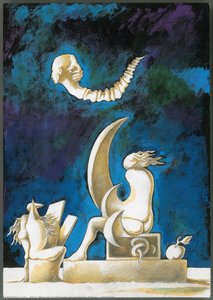
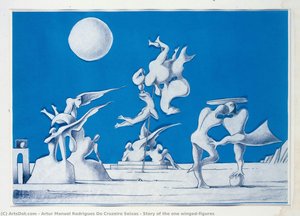
Artur Manuel Rodrigues do Cruzeiro Seixas, known simply as Cruzeiro Seixas, was a figure who resisted easy categorization—a “man who paints,” as he preferred to be called rather than a painter, and a profoundly influential Portuguese poet. Born in Amadora, Portugal, in 1920, and passing away in Lisbon in 2020 at the remarkable age of 99, Seixas’s long life was deeply interwoven with the evolution of surrealism, not merely as an artistic style but as a philosophical stance against convention and a passionate exploration of the subconscious. His work is characterized by dreamlike imagery, literary allusions, and a unique visual language that often evokes both unsettling mystery and playful delight.

Early Influences and the Lisbon Surrealist Group

Seixas’s artistic journey began in the fertile intellectual environment of António Arroio School, where he forged lasting friendships with key figures who would shape Portugal's cultural landscape: Mário Cesariny, Marcelino Vespeira, Júlio Pomar, and Fernando Azevedo. This circle became the nucleus of what would emerge as the Surrealist Group of Lisbon in the mid-1940s, born from a schism within the broader Portuguese surrealist movement. Initially drawn to neorealism, Seixas quickly gravitated towards the liberating principles of surrealism—a rejection of rational thought and an embrace of the irrational, the fantastical, and the power of free association. The 1949 exhibition of the group marked a pivotal moment, establishing their presence and challenging the prevailing artistic norms. This period was crucial in defining Seixas’s aesthetic trajectory, fostering his commitment to exploring the depths of human consciousness through visual expression.

A Journey Beyond Borders: Africa, Asia, and Poetic Beginnings

The 1950s saw Seixas embark on a transformative journey that would profoundly impact both his artistic vision and his poetic voice. Enlisting in the Merchant Navy, he traveled extensively throughout Africa, India, and Asia—experiences that broadened his horizons and infused his work with new perspectives and symbolic resonances. His time in Angola, beginning in 1951, proved particularly significant; he worked at the Luanda Museum while simultaneously developing his poetic production. This period marked the genesis of a powerful literary voice alongside his increasingly distinctive visual style. Early exhibitions during this time sparked considerable debate, demonstrating Seixas’s willingness to challenge expectations and provoke thought through unconventional imagery and object-based works.

Collaboration, Recognition, and a Unique Artistic Vision

Upon returning to Portugal in 1964, Seixas continued to push the boundaries of artistic expression. His collaboration with Natália Correia on the renowned “Anthology of Erotic and Satirical Portuguese Poetry” in 1966 showcased his ability to seamlessly blend visual art with literary themes. The late 1960s brought further recognition, including a scholarship from the Calouste Gulbenkian Foundation, which allowed him to dedicate himself fully to his artistic pursuits. Retrospective exhibitions and solo shows at galleries like Buchholz and Divulgação solidified his position within the Portuguese art world. Throughout his career, Seixas maintained a steadfast commitment to surrealism, engaging with international colleagues and contributing to magazines dedicated to the movement. His work is characterized by a “broken world” where dreamlike elements coexist with unsettling violence and a playful exploration of artistic history—a unique synthesis that defies easy categorization.

Legacy and Historical Significance

Cruzeiro Seixas’s enduring legacy lies in his unwavering dedication to surrealism as a means of exploring the complexities of human experience. He wasn't simply replicating a style; he was using it as a vehicle for profound introspection, literary engagement, and social commentary. His paintings, often imbued with symbolic figures and haunting imagery, invite viewers into a realm where logic is suspended and the subconscious takes center stage. The recognition bestowed upon him—including the rank of Grand Officer of the Ancient, Nobilíssimo and Enlightened Military Order of Santiago da Espada—underscores his significant contribution to Portuguese culture. He remained a vital force in the art world until his death, continuing to challenge conventions and inspire generations of artists with his unique vision and unwavering commitment to the power of imagination. His work stands as a testament to the enduring relevance of surrealism and its capacity to illuminate the hidden depths of the human psyche.