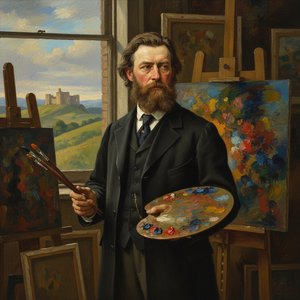
Introduction to Alexander Milne Calder
Alexander Milne Calder (MILL-nee) was a Scottish-American sculptor born in Aberdeen, Scotland, on August 23, 1846. He is best known for his monumental architectural sculpture of Philadelphia City Hall and as the father of renowned sculptor Alexander Stirling Calder, alongside whose grandson, Alexander ‘Sandy’ Calder, achieved considerable acclaim in the 20th century. His artistic journey began amidst the vibrant Arts and Crafts movement, nurtured by a formative education at the Royal Academy in Edinburgh and honed through studies with John Rhind. He subsequently established himself in London, immersing himself in the artistic milieu of his time and contributing to significant projects like the Albert Memorial. A pivotal moment arrived in 1868 when Calder emigrated to the United States and settled in Philadelphia, where he pursued further academic endeavors under the tutelage of Thomas Eakins at the Pennsylvania Academy of Fine Arts. This relocation marked the commencement of a prolific artistic career characterized by innovation and experimentation.Early Life and Education
Calder’s upbringing instilled within him a profound appreciation for craftsmanship and artistic expression. Born to Nanette Lederer Calder, a painter, and Alexander Stirling Calder, a sculptor—who himself was a celebrated artist—he inherited a legacy of creative endeavor. His father's mastery of stone carving profoundly influenced his formative years, shaping his understanding of sculptural technique. Calder attended the Royal Academy in Edinburgh and studied with John Rhind, absorbing artistic principles that would inform his subsequent work. He honed his skills at the South Kensington School and collaborated closely with Thomas Eakins at the Pennsylvania Academy of Fine Arts, immersing himself in a stimulating environment conducive to artistic development. His father contracted tuberculosis during Calder’s youth, necessitating a relocation to Oracle, Arizona, where he resided alongside his wife, Louisa, fostering a familial bond that would endure throughout his life. Calder's formative years were enriched by friendships with Riley, an elderly resident of the ranch who imparted invaluable knowledge about sculpting and artistic vision.Career Highlights
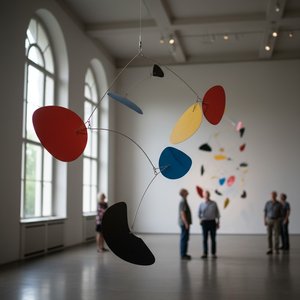
Calder’s professional trajectory commenced in 1872 when he accepted a commission from John McArthur Jr., to create sculptures adorning Philadelphia City Hall—a project that demanded meticulous planning and execution over two decades. This ambitious undertaking showcased Calder's dedication to craftmanship and his ability to translate conceptual ideas into tangible forms. Simultaneously, he undertook the prestigious role of artistic director for the Fairmount Park Art Association, crafting an equestrian statue honoring George Gordon Meade—a testament to his commitment to public art and historical commemoration. His groundbreaking contribution to kinetic art arrived in 1931 with the creation of his first mobile—a sculptural innovation that embraced chance and movement—inspired by Marcel Duchamp’s conceptual approach. Calder's work quickly gained recognition within the Parisian avant-garde, propelling him to prominence as one of America’s foremost contemporary sculptors. A landmark retrospective exhibition at the Museum of Modern Art in New York in 1953 solidified Calder’s artistic reputation and cemented his place among the titans of American art history. His monumental sculptures—including *Spirale* for UNESCO headquarters and *Flamingo* for Chicago's Federal Center Plaza—became enduring symbols of artistic ambition and innovation.Legacy
Alexander Milne Calder’s influence extended far beyond his own creations, shaping the artistic landscape of subsequent generations. His son, Alexander Stirling Calder, followed in his father’s footsteps as a sculptor, perpetuating the Calder family tradition of artistic excellence. Similarly, Alexander ‘Sandy’ Calder—Calder's grandson—became a celebrated artist himself, carrying forward the legacy of innovation and experimentation established by his forefathers. Calder’s enduring contribution to art history continues to inspire artists worldwide, ensuring that his vision remains relevant for years to come.Въпроси и отговори
От коя държава е Александър Калдер?
Александър Калдер е роден в САЩ.
Къде могат да бъдат намерени произведенията на Александър Калдер, групирани по ключови думи?
Работите на Александър Калдер могат да бъдат разгледани по ключови думи на страницата за произведения на Александър Калдер чрез По ключови думи. Всяка ключова дума групира съответните произведения на изкуството.
Мога ли да разгледам творбите на Александър Калдер по теми?
Атлас по теми на Александър Калдер е страница, която класифицира творбите на художника според техните сюжети.