A Pioneer of American Modernism: The Life and Art of Abraham Walkowitz
Abraham Walkowitz, a figure often overshadowed by the brighter lights of early 20th-century American art, nevertheless played a crucial role in shaping its trajectory. Born in Tyumen, Russia, in 1878, his life was marked by displacement and ultimately led him to become one of the first true pioneers of American Modernism – an artist who absorbed European influences while forging a uniquely American voice. His journey began with humble beginnings, but blossomed into a career defined by dynamic portraits, evocative cityscapes, and a profound engagement with the spirit of his time.
- Early Life & Immigration: Walkowitz’s childhood was shaped by upheaval; he emigrated to the United States with his mother and sisters in 1889, seeking refuge from the political turmoil of Russia. This early experience instilled within him a sensitivity to movement, change, and perhaps even a deep-seated yearning for belonging – themes that would later permeate his art. He began his artistic training in New York City, initially at the Cooper Union and then the Educational Alliance, laying the groundwork for his future explorations.
- Formal Training & Parisian Influence: Recognizing his potential, Walkowitz pursued further studies in Paris, enrolling at the Académie Julian under Jean-Paul Laurens. This immersion in European artistic traditions proved transformative, exposing him to the burgeoning currents of Impressionism and Post-Impressionism. However, he wasn’t merely a passive recipient of these influences; he actively sought to synthesize them with his own developing sensibilities.
The Crucible of Modernity: Influences and Artistic Development
Walkowitz's artistic journey truly took shape during his association with Alfred Stieglitz and the 291 Gallery in New York City. This wasn’t simply a professional connection; it was an immersion into a vibrant community of artists – Arthur Dove, Marsden Hartley, and John Marin among them – who were challenging conventional notions of art and pushing the boundaries of representation. The 291 Gallery became his crucible, fostering experimentation and encouraging him to break free from traditional constraints. A particularly significant moment occurred during the 1907 memorial exhibition dedicated to Paul Cézanne in Paris. This encounter profoundly influenced Walkowitz’s approach to abstraction, solidifying his commitment to exploring form and structure beyond mere imitation of reality. He absorbed the spirit of European modernism – the emphasis on subjective experience, flattened perspectives, and bold simplification – but crucially, he resisted becoming a mere imitator. Instead, he sought to synthesize these influences with his own unique vision, forging an authentically American voice within the burgeoning modernist movement.
- The Isadora Duncan Connection: A defining aspect of Walkowitz’s artistic development was his fascination with Isadora Duncan, the revolutionary dancer whose dynamic movements captivated him. Over five thousand drawings depicting Duncan – a monumental undertaking – reveal not just her physical form but also her spirit of liberation and artistic innovation. These weren't simply portraits; they were explorations of her essence, capturing the energy and dynamism of her performances.
- Early Cityscapes: Simultaneously, Walkowitz began to develop his distinctive style of cityscapes, characterized by a hazy, atmospheric quality that captured the mood and energy of New York. Works like “New York Skyline” (1913) demonstrate his mastery of linear perspective and his ability to convey the dynamism of urban life through subtle color and light.
Capturing Essence: Key Works and Artistic Style
Walkowitz’s artistic output was remarkably diverse, encompassing cityscapes, still lifes, and, most notably, his extensive portraits of Isadora Duncan. The
Isadora Duncan Drawings stand as a monumental achievement – not simply representations of the dancer's physical form but explorations of her very essence, her spirit of liberation and artistic innovation. These works are characterized by their fluid lines, dynamic compositions, and evocative use of charcoal and watercolor. His
New York Skyline (1913), a hazy watercolor depiction of the city, showcases his mastery of linear perspective and atmospheric depth, while hinting at the energy and dynamism of urban life. Later works, such as
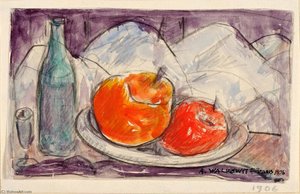
Metropolis, No. 1 (1919), reveal a darker, more Expressionistic sensibility, reflecting themes of destruction and loss in its dramatic charcoal rendering. Throughout his career, Walkowitz’s style evolved from representational depictions to increasingly abstract forms, yet he always retained a distinctive American character – a blend of European influences filtered through his own unique vision. His still lifes demonstrate a similar exploration of form and color, pushing the boundaries of traditional genre painting towards modernist abstraction.
A Lasting Legacy: Historical Significance
Abraham Walkowitz played an indispensable role in shaping the landscape of early American Modernism. He served as a crucial bridge between the avant-garde ideas emanating from Europe and the emerging artistic identity taking root in America. His involvement with Alfred Stieglitz’s 291 Gallery was instrumental in establishing a platform for modern art, introducing European artists to an American audience, and fostering a community of like-minded innovators. The watershed moment of the Armory Show in 1913 – where Walkowitz exhibited alongside other groundbreaking artists – marked a turning point in the acceptance of modern art within the United States. Beyond his contributions to the broader modernist movement, Walkowitz’s extensive drawings of Isadora Duncan provide invaluable insights into both her artistic practice and his own evolving style. Critics like Oscar Bluemner recognized his unique ability to absorb modernist influences without sacrificing originality, highlighting his contribution to a distinctly American form of modern art – one that was bold, innovative, and deeply personal. Walkowitz’s legacy continues to inspire artists today, reminding us of the power of artistic vision and the importance of forging one's own path in the pursuit of creative expression.