Beyond Spontaneity: The Transition from Impressionism to Neo-Impressionism
 Georges Seurat: Pointillism, Perception & the Scientific Foundations of Modern Art
The Genesis of Pointillism: From Impressionism to Scientific Inquiry The late 19th century was a period of profound upheaval, not just in the socio-political landscape but also within the artistic realm. The established norms of academic painting wer...
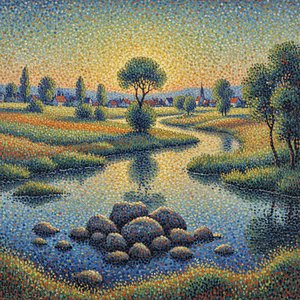
To understand the emergence of Neo-Impressionism, one must first look at the shimmering, ephemeral world of its predecessor. In the late 19th century, the Impressionists had already begun to dismantle the rigid hierarchies of academic painting, replacing somber studio tones with a vibrant, subjective celebration of light and movement. Artists like Monet and Renoir sought to capture the fleeting moment—the way a sunbeam dances upon water or how a passing cloud alters the hue of a cathedral. Yet, for a new generation of thinkers emerging in the late 1880s, this beautiful spontaneity felt dangerously close to chaos. There was a perceived lack of underlying structure, an almost arbitrary application of pigment that lacked a cohesive, intellectual foundation.
Enter the Neo-Impressionist circle, led by the visionary Georges Seurat. While they shared the Impressionists' profound fascination with light and modern life, these artists sought to elevate the movement from mere observation to a systematic science. They did not wish to simply witness the transient effects of nature; they desired to decode them. This was not a rejection of the Impressionist spirit, but rather an evolution—a transition from the subjective "impression" to an objective, measured understanding of how light and color interact within the human eye. It was a movement born of a desire for permanence and precision amidst a rapidly industrializing world.
The Physics of Vision: Chromoluminarism and Optical Mixing
 The Science of Light: How Seurat and Signac Revolutionized Color with Pointillism
The Genesis of Neo-Impressionism: Moving Beyond Spontaneity Georges Seurat: Pointillism, Perception & the Scientific Foundations of Modern Art The Genesis of Pointillism: From Impressionism to Scientific Inquiry The late 19th century was a period of ...
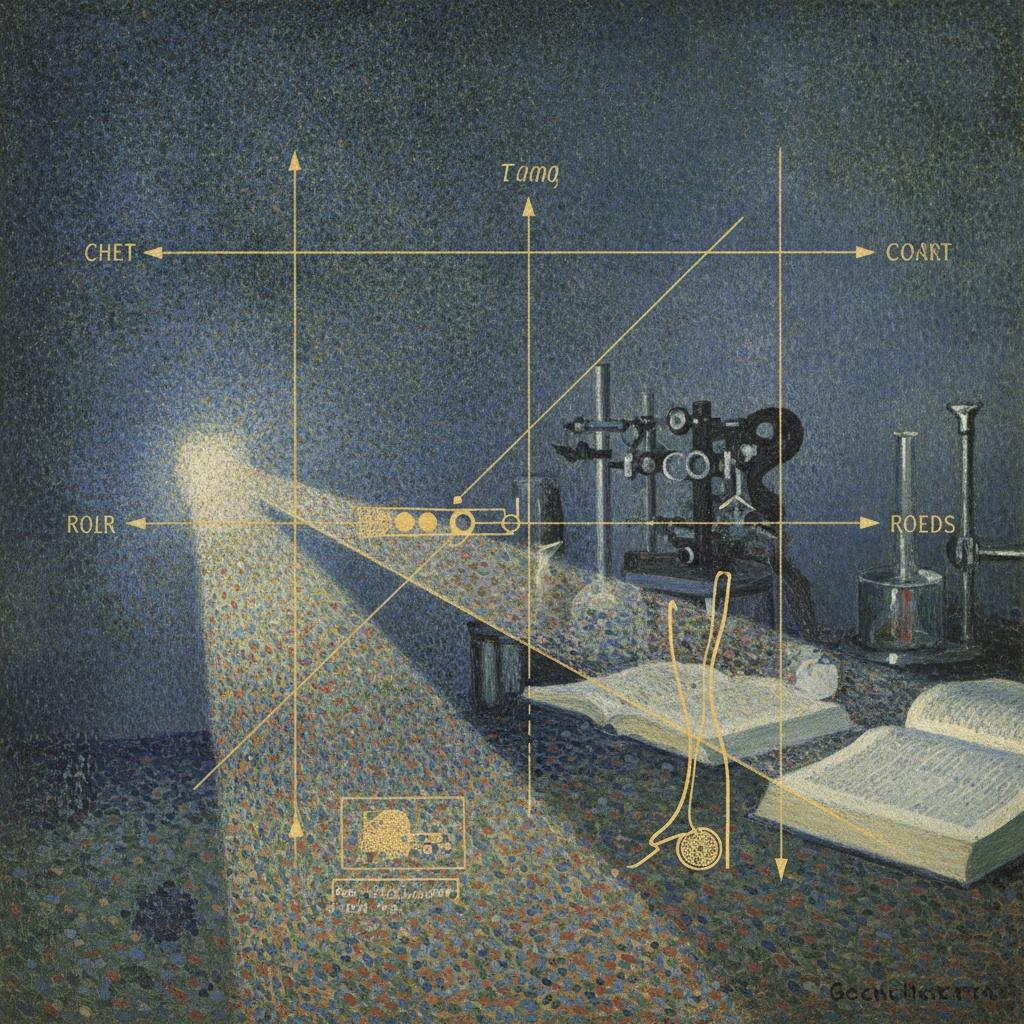
At the heart of this revolution lay a profound fascination with the burgeoning field of optics. The Neo-Impressionists were not merely painters; they were investigators of the mechanics of sight. They immersed themselves in the contemporary scientific treatises of figures such as Michel Eugène Chevreul, whose work on the law of simultaneous contrast, and Ogden Rood, who explored the complexities of color theory. These scientists had demonstrated a radical truth: that colors do not exist in isolation but are constantly influenced by their neighbors.
This realization led to the development of chromoluminarism, a term Seurat used to describe his method of applying color. The core principle was mélange optique, or optical mixture. Rather than the traditional practice of mixing pigments on a palette—a process that inevitably dulls the intensity and "muddies" the hue—the Neo-Impressionists placed tiny, unblended dabs of pure, primary colors directly onto the canvas. They believed that when these separate elements were viewed from a distance, the human eye would perform the mixing itself. This technique aimed to achieve a greater luminosity and a pulsating, shimmering light that physical pigment mixing could never replicate, effectively turning the viewer's retina into an active participant in the creation of the artwork.
Divisionism vs. Pointillism: Decoding the Technical Nuances
--- title: Neo-impressionism | Tate url: https://www.tate.org.uk/art/art-terms/n/neo-impressionism hostname: tate.org.uk description: Tate glossary definition for neo-impressionism: The name given to the post-impressionist work of Georges Seurat, Pau...
In popular art history discourse, the terms "Pointillism" and "Divisionism" are often used interchangeably, yet for the true connoisseur, a subtle but vital distinction exists. The term Pointillism refers specifically to the physical application of paint—the use of minute, precise dots or points of color. It is the visible technique that defines the texture of the canvas, creating a rhythmic, almost mathematical surface. While evocative and widely recognized, even the artist Paul Signac eventually distanced himself from this term, perhaps finding it too reductive for the complexity of their intent.
Divisionism, on the other hand, refers to the theoretical and structural foundation of the work: the separation of colors into their component parts. It is the intellectual application of color theory, where the artist "divides" light into its constituent spectrum to be reconstituted by the spectator. If Pointillism is the how—the physical dotting of the canvas—then Divisionism is the why—the scientific logic of separating pigments to achieve maximum brilliance. Together, these two concepts allowed artists to create works that felt both structurally sound and vibrantly alive, bridging the gap between rigorous science and poetic expression.
The Masters of Light: Georges Seurat, Paul Signac, and the Scientific Method
 Georges Seurat's Masterpieces: 25 Paintings That Defined Pointillism | OriginalUniqueArt
Introduction To embark on a journey through the top 25 artworks of Georges Seurat is to enter a world meticulously constructed from light, color, and an almost scientific devotion to perception. These paintings aren’t simply images; they are visual p...
The movement found its most profound expression in the brief but intensely focused career of Georges Seurat. His masterpiece, A Sunday on La Grande Jatte, stands as the definitive monument to this era. In this monumental work, Seurat meticulously constructed a scene of Parisian leisure not through sweeping brushstrokes, but through an almost obsessive devotion to light and form. Every figure, every shadow, and every reflection was a carefully considered note in a visual symphony, demonstrating his ability to use scientific precision to evoke deep, atmospheric emotion.
Following Seurat, Paul Signac emerged as the movement's great communicator and theorist. While Seurat provided the foundational rigor, Signac’s later works embraced a more expressive, almost lyrical use of the Divisionist technique. His canvases often featured larger, more mosaic-like strokes that emphasized the rhythmic flow of color across the landscape. Alongside figures like Camille and Lucien Pissarro, these artists transformed the canvas into a laboratory of light, proving that art could be both an intellectual pursuit and a deeply sensory experience.
The Enduring Legacy: How Neo-Impressionism Shaped Modern Perception
 Georges Seurat
A Pioneer of Luminous Precision: The Life and Art of Georges Seurat Georges Pierre Seurat, born in Paris on December 2, 1859, emerged as a pivotal figure in the transition from Impressionism to modern art. His brief but intensely focused career revol...
The impact of Neo-Impressionism extends far beyond the late 19th century. By introducing a systematic approach to color and form, Seurat and his contemporaries provided a crucial bridge between the observational world of Impressionism and the abstract explorations of 20th-century modern art. Their emphasis on the autonomy of the brushstroke and the construction of an image through discrete elements paved the way for everything from Fauvism to the geometric precision of Cubism.
Today, we continue to be captivated by the luminous precision of these works. They remind us that vision is not a passive act of receiving images, but an active process of interpretation and reconstruction. To stand before a Neo-Impressionist masterpiece is to experience the magic of science meeting soul. For those seeking to bring this extraordinary sense of light into their own lives, OriginalUniqueArt.com offers exquisite, hand-painted oil reproductions of these canonical masterpieces. Our master artists, trained in the finest academic traditions, meticulously recreate the texture and optical depth of works like Seurat's, ensuring that the shimmering brilliance of the Neo-Impressionist era can be preserved and cherished within your own collection for generations to come.