Introduction
To step into the world of Geometric Abstraction is to leave behind the chaotic noise of the recognizable world and enter a realm of pure, rhythmic order. Imagine walking through a gallery where the air feels still, and every line, circle, and square carries the weight of a profound, silent language. This movement did not seek to mimic the curve of a petal or the shadow of a face; instead, it sought the fundamental architecture of reality itself. It is an exploration of balance, tension, and the mathematical heartbeat that underlies our existence.
Emerging in the early 20th century amidst a period of radical global transformation, Geometric Abstraction rose from the ashes of tradition. As the industrial age accelerated and the boundaries of science and physics expanded, artists felt a pressing need to move beyond mere representation. They looked toward the precision of the machine, the clarity of Euclidean geometry, and the spiritual resonance of primary colors to create a new visual vocabulary. From the structured rigor of Suprematism in Russia to the vibrant, balanced planes of De Stijl in the Netherlands, this movement redefined the canvas as a space for structural truth rather than narrative storytelling.
These masterpieces remain deeply meaningful today because they speak to our universal desire for clarity and harmony. In an era often defined by visual fragmentation, the clean intersections and bold, unyielding shapes of these works offer a sense of permanence and stability. They remind us that beauty can be found in the most disciplined forms and that complexity can emerge from simplicity.
As we guide you through this curated selection, prepare to encounter works that do more than just occupy space—they command it. We have identified ten pivotal masterpieces that serve as the pillars of this movement, each a testament to the power of shape, color, and line to evoke the infinite. Each piece in this list represents a moment where art broke free from the object to touch the essence of form.
Geometric Horizon: A Monumental Mosaic of Solar Light and Earthbound Shadows - Charles Delorme
 Geometric Horizon: A Monumental Mosaic of Solar Light and Earthbound Shadows - Charles Delorme
To stand before Geometric Horizon: A Monumental Mosaic of Solar Light and Earthbound Shadows is to witness a profound moment of cosmic stillness. Charles Delorme captures that universal, breathless pause between night and day, where the heavy, earthbound ochre blocks meet a sudden, radiant burst of cadmium orange. This masterpiece earns its place among the top 10 defining works of the Geometric Abstraction movement through its masterful use of structural tension; it transforms a rigid, pixelated mosaic into a breathing, meditative landscape of light and shadow.
The piece achieves a rare equilibrium, balancing the disciplined precision of rectilinear forms with an almost spiritual warmth. It does not merely depict a sunrise; it reconstructs the very sensation of light breaking through darkness. At OriginalUniqueArt.com, we ensure this emotional depth is preserved for your space. Through our professional hand-painted oil reproductions, our artists translate Delorme’s digital precision into tactile, textured masterpieces on 100% cotton canvas, allowing the vibrant luminosity and heavy, architectural shadows to become a permanent, physical presence in your collection.
Dance - Fernand Léger
 Dance - Fernand Léger
Imagine stepping into a space where the air vibrates with an unseen rhythm, a pulse that mirrors the heartbeat of a bustling metropolis. Fernand Léger’s 1942 masterpiece, Dance , evokes this exact sensation, pulling the viewer into a kaleidoscopic whirlwind of primary blues, striking reds, and vibrant yellows. Created during the profound uncertainty of World War II, this work serves as a defiant celebration of life, using the language of geometric abstraction to find stability within chaos.
As a cornerstone of the movement, Dance earns its place among the top masterpieces by seamlessly merging Constructivist aesthetics with organic vitality. Léger utilizes flattened planes and machine-like precision—circles, squares, and bold cylinders—to reimagine the human form through the lens of the industrial age. This rhythmic interplay of shape and color does more than decorate; it injects a sense of resilient energy into any environment. For the modern professional or collector, integrating such a dynamic composition into a corporate or residential space offers a timeless way to foster inspiration and strength through the power of structured movement.
The accordion - Fernand Léger
 The accordion - Fernand Léger
To witness the pulse of the machine age is to encounter the rhythmic, mechanical heartbeat captured in The Accordion by Fernand Léger . Created in 1926, this masterpiece stands as a definitive pillar of the Geometric Abstraction movement, translating the industrial energy of post-war Europe into a vibrant visual symphony. Léger moves away from traditional representation, instead utilizing bold, architectural planes and a high-contrast palette of luminous reds, sun-drenched yellows, and assertive black accents to command the viewer's attention.
The composition functions through a brilliant display of Constructivism , where the accordion is reimagined as a series of intersecting cylinders and geometric forms. The artist’s unique ability to blend rigid, structural shapes with a sense of organic vitality—often referred to as 'Tubism'—creates a captivating visual friction. As smaller, fragmented echoes of the instrument dance across the periphery, the canvas achieves a state of infinite movement. This work remains essential because it proves how geometric precision can evoke profound human emotion, offering a sophisticated, dynamic focal point that continues to transform modern architectural spaces with its timeless, industrial soul.
Study for the - Fernand Léger
 Study for the - Fernand Léger
In Study for Breakfast , Fernand Léger invites the viewer into a rhythmic, pulsating world where the boundaries between objects and atmosphere dissolve. One cannot help but feel drawn into the vibrant energy of the scene, where the meticulous application of color creates a sense of profound, kinetic life. As a cornerstone of the Top 10 Masterpieces That Defined the Geometric Abstraction Art Movement , this work captures a unique psychological depth; it is not merely a depiction of a morning ritual, but an exploration of how fragmented forms and primary tones can evoke the underlying order of our existence.
The painting’s use of Pointillism—applying tiny, distinct dots of pigment—creates a shimmering optical experience that mirrors the dynamism of the modern age. This technique allows light to dance across the canvas, offering a sensory journey that oscillates between structured geometry and fluid emotion. Integrating such a powerful piece into your collection can transform a personal sanctuary into a space for profound reflection. The balanced composition and rhythmic vitality provide a calming yet stimulating focal point, perfect for creating an environment of sophisticated, modern serenity.
Still Life - Paul Klee
 Still Life - Paul Klee
In Paul Klee’s 1927 masterpiece, Still Life , the play of light does not merely illuminate objects; it orchestrates a rhythmic dance across a stage of geometric forms. Klee utilizes a sophisticated interplay of light and shadow, where soft, diffused glows meet sharp, hatched textures to create a sense of structural depth. This command of illumination—treating light as a tactile element rather than a mere external force—is precisely what secured this work's place among the top 10 masterpieces that defined the geometric abstraction art movement . By manipulating tonal shifts across primary colors, Klee transforms a collection of simple items into a profound musical composition of sight.
For the modern collector, a faithful reproduction of this work offers more than just decoration; it brings an architectural dimension to any space. The way the light seems to emerge from within the canvas adds a layer of luxury and intellectual depth to contemporary walls, making it an ideal centerpiece for those seeking to integrate the historical weight of the Bauhaus era into professional or residential interiors.
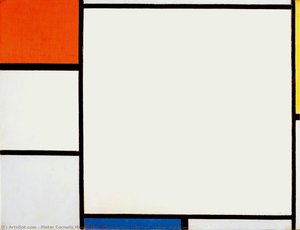
Composition with red, yellow and blue - Piet Mondrian
 Composition with red, yellow and blue - Piet Mondrian
Acquiring Composition with red, yellow and blue by Piet Mondrian is more than a decorative choice; it is an investment in the very foundation of modern visual legacy. As a cornerstone of the Geometric Abstraction movement, this 1927 masterpiece represents the pinnacle of the De Stijl movement’s pursuit of universal harmony. Its market significance is unparalleled, with its rigorous use of primary colors and orthogonal black lines serving as a blueprint for much of 20th-century design. The painting functions through a sophisticated tension of weight and void, where the vibrant red square anchors the composition against the airy, white intervals.
For the discerning decorator or procurement manager, this work offers an unmatched aesthetic authority. Whether rendered as a large-scale museum-quality oil reproduction or a precise fine art print, the piece brings a structured, intellectual energy to high-end corporate spaces and luxury hospitality interiors. Its clean, mathematical precision provides a timeless focal point that complements modern architectural minimalism, ensuring that even a high-quality reproduction commands the same prestige and status as the original icon.
Nude on a Red Background - Fernand Léger
 Nude on a Red Background - Fernand Léger
In Fernand Léger’s 1927 masterpiece, "Nude on a Red Background," we encounter a profound moment of quiet vulnerability set against a landscape of striking intensity. As a cornerstone of the Geometric Abstraction movement, this work does not merely present a figure; it offers a mirror to the soul. The solitary woman, her hands delicately obscuring her face, creates a rhythmic tension between organic human emotion and the structured, tubular forms characteristic of Léger’s Machine Age aesthetic.
The technical brilliance lies in the chromatic vibration: the luminous white of the figure's attire presses against an expansive, crimson field that acts as an emotional force. There is a gaze within this composition that follows you—not with judgment, but with understanding. It invites you to find stillness amidst modern chaos. For the collector, bringing this piece into a professional or private space is more than a design choice; it is an invitation to be reminded that even within the sharp edges of modernity, we are seen, and we are part of the story.
oval composition 1 - Piet Mondrian
 oval composition 1 - Piet Mondrian
In the evolution of geometric abstraction, Piet Mondrian’s Oval Composition stands as a profound threshold between the recognizable world and pure spiritual form. Created during a period of intense metamorphosis, this work captures the precise moment when the organic textures of the Dutch landscape began to dissolve into the rhythmic precision of Neoplasticism. It is not merely a painting; it is a visual distillation of vision, where the weight of reality is shed in favor of essential truths.
The canvas presents a masterclass in balanced tension, featuring a central, stabilizing oval set against a serene, atmospheric background. This soft, anchoring motif is punctuated by a dynamic dance of vibrant yellow, pink, and blue geometric planes. These shapes intersect with calculated precision, creating a sense of structured movement that breathes life into the flatness of the canvas. To possess such a piece is to invite a transformation into your space—turning a mere room into a gallery of the soul where the energy of modernism resides.
Suprematist Painting 4 - Kazimir Malevich
 Suprematist Painting 4 - Kazimir Malevich
Imagine standing in a silent gallery, facing a canvas that refuses to mirror the world you know. There is no landscape to wander through, only an immediate, visceral confrontation: a profound black void anchored by a striking red cross. In Kazimir Malevich’s Suprematist Painting 4 , the distractions of the material world vanish, leaving behind a primal language of pure geometry.
Created during the turbulent Russian avant-garde era, this work serves as a manifesto for Suprematism —a movement dedicated to the supremacy of pure feeling over representation. It earns its place among the top 10 masterpieces of geometric abstraction because it achieved the impossible: stripping art down to its most essential, non-objective reality. The meticulous oil layering gives the black expanse a heavy, tactile depth, while the vibrant red cross cuts through the darkness with intellectual tension. This uncompromising simplicity offers more than just a historical milestone; it provides a window into transcendence. Integrating such powerful, minimalist forms into a modern space can evoke a sense of profound clarity and focused serenity, reminding us that even in total abstraction, there is immense meaning.
Mural - Fernand Léger
 Mural - Fernand Léger
The striking, industrial red within Fernand Léger’s Mural (1926) commands immediate attention, setting a pulse of vitality and raw energy that defines the machine age. As one of the top 10 masterpieces that defined the Geometric Abstraction art movement, this work utilizes an audacious palette of deep reds, stark blacks, and rhythmic stripes to mirror the precision of an engineered blueprint. This mastery of color and form earns its place among the greats, as Léger eschews organic softness for a structured, Constructivist language of shape and motion.
For professionals managing large-scale interior projects, such as hotel lobbies or modern corporate lounges, this piece serves as a powerful architectural anchor. The bold, high-contrast scheme can be used to curate a sophisticated, high-energy atmosphere, providing a focal point that complements minimalist furniture and metallic accents. Integrating this work into a dining room or lounge allows designers to introduce a sense of historical optimism and structural gravity, effectively transforming a contemporary space into a curated gallery of modern industrial beauty.
Conclusion
As the light fades on our journey through these structured marvels, we find that Geometric Abstraction is far more than a study of lines, planes, and mathematical precision. It is a profound exploration of the hidden order within our chaotic world. These masterpieces do not merely exist as relics of a bygone era; they remain living presences, breathing rhythm and balance into the spaces we inhabit. When we look upon a carefully balanced composition of shapes, we are participating in an eternal dialogue between the intellect and the soul, finding a sense of stillness amidst the movement of modern life.
These works continue to shape our visual language, echoing through contemporary architecture, design, and the very way we perceive harmony in our homes. They remind us that even within the most rigid geometry, there is room for profound emotion and infinite wonder. To bring these works into your own environment is to invite a timeless clarity into your daily experience, bridging the gap between historical greatness and the intimacy of everyday life. We invite you to continue this exploration and discover how these structured echoes of beauty can transform your personal sanctuary by browsing our full collection .