Contemporary Realism · 1898
Taking the Count (Томас Ейкънс, 1898)
Томас Ейкънс (1844–1916) създаде Taking the Count. Датира от 1898. Това произведение принадлежи към движението Contemporary Realism. Изdelano е от Oil On Canvas. Експонира се в Yale University Art Gallery в Хартфорд, Съединени щати на Америка.
- 1898
- Oil On Canvas
- Yale University Art Gallery, Хартфорд

 Преглед в реален мащаб

 Ръчно изработена маслена картина
 Изпрати
 Сподели
 Информационен лист


 Изтегляне
 Подобни артикули
 Рентгенова снимка
 Слайдшоу
 Въпроси и отговори

 Статистика
Taking the Count накратко
- Заглавие
- Taking the Count
- Художник
- Томас Ейкънс (1844–1916)
- Роден в
- Филаделфия, САЩ
- Дата
- 1898
- Техника
- Oil On Canvas
- Къде може да се види
- Yale University Art Gallery, Хартфорд, Съединени щати на Америка
- Движение
- Contemporary Realism
- Епоха
- 19th Century
- Предмет
- boxing match, anatomy, crowd spectators, referee, philadelphia, realism
Какво е изобразено в Taking the Count?
The Raw Pulse of Philadelphia: A Masterclass in Realism
In the dim, electric atmosphere of Philadelphia’s Arena in 1898, a moment of profound human vulnerability is frozen in time. Thomas Eakins, a titan of American Realism, does not merely paint a boxing match; he dissects the very essence of endurance and physical struggle. In Taking the Count, we are thrust into the center of the ring, where the sweat, the tension, and the heavy breathing of the combatants feel almost palpable. This is not the romanticized, heroic athleticism often found in sporting art; instead, Eakins presents a gritty, unvarnished truth. The scene captures a fallen fighter at his most precarious moment, caught in the agonizing interval between a devastating blow and the referee's decisive count. It is a study of the human body under duress, rendered with a scientific precision that reflects Eakins’ lifelong obsession with anatomy.
The composition draws the eye through a complex web of gazes and physical postures. At the heart of the drama, the kneeling figure embodies a desperate struggle for recovery, his muscles taut and his spirit tested. Surrounding him, the referee and the standing opponent create a triangular tension that anchors the viewer within the ring. Beyond the immediate combatants, the presence of the crowd—a shadowy, watchful collective—adds a layer of psychological depth, reminding us that this private agony is being consumed as public spectacle. For the collector or the lover of fine art, this painting offers more than just a depiction of sport; it provides a window into the late 19th-century urban experience, where the boundaries between physical prowess and human frailty are perpetually blurred.
Anatomy of a Masterpiece: Technique and Light
Eakins’s technical mastery is most evident in his ability to marry scientific rigor with emotional resonance. Having spent years studying the intricacies of musculature and bone structure through dissection, he approaches the canvas with the eye of an anatomist. Every sinew and strained limb in Taking the Count is rendered with an uncompromising accuracy that makes the figures appear to possess weight and volume. His use of light does not serve to beautify the scene but to illuminate its harsh realities. The lighting within the arena creates deep, dramatic shadows that sculpt the bodies of the boxers, emphasizing the physical toll of the fight and adding a sense of cinematic gravity to the composition.
The palette, while grounded in the earthy, somber tones characteristic of Eakins’s realism, is used to direct the viewer's emotional journey. The muted colors of the background allow the pale, strained skin of the athletes to emerge from the gloom, focusing our attention on the visceral reality of the struggle. For interior designers seeking a centerpiece for a sophisticated space, this work offers a profound sense of gravitas. A high-quality reproduction of this masterpiece brings with it an air of intellectual depth and historical weight, making it an ideal choice for galleries, studies, or living spaces that value art which challenges the eye and stirs the soul.
A Legacy of Unflinching Honesty
To understand Taking the Count is to understand the rebellious spirit of Thomas Eakins himself. At a time when many of his contemporaries were retreating into the soft, fleeting impressions of light or the idealized myths of history, Eakins stood firm in his commitment to the real. He found beauty not in perfection, but in the truth of the human condition—in the grit of the city, the precision of science, and the raw intensity of life lived on the edge. This painting remains a testament to that courage.
Owning or displaying a reproduction of this work is an invitation to contemplate the themes of resilience and the cyclical nature of struggle. It serves as a powerful reminder that even in moments of defeat, there is a profound dignity in the attempt to rise again. Whether viewed as a historical document of Philadelphia’s sporting culture or as a timeless exploration of human anatomy, Taking the Count continues to captivate, offering an enduring source of inspiration for those who find beauty in the authentic and the unadorned.
В кой музей се намира Taking the Count?
Yale University Art Gallery
Хартфорд, Съединени щати на Америка
Origins and History of the Gallery The Yale University Art Gallery began in 1832. Its foundation rests upon a gift from the collection of John Trumbull. In those early years, the focus remained on paintings depicting the American Revolution.


Изображения с висока резолюция на Taking the Count
Обществено достояние: художникът е починал през 1916 г.
Томас Ейкънс, Taking the Count (1898), Yale University Art Gallery. Обществено достояние
Отговори на въпроси относно Taking the Count
Къде мога да видя оригиналния „Taking the Count“ на Томас Ейкънс?
„Taking the Count“ на Томас Ейкънс е изложена в Yale University Art Gallery, Хартфорд, Съединени щати на Америка. Информацията за музея се отнася за оригиналното произведение, а не за репродукции.
Коя е датата на създаване на „Taking the Count“ на Томас Ейкънс?
"Taking the Count" датира от 1898. Тази дата поставя произведението в контекста на кариерата на Томас Ейкънс и неговата епоха.
С каква техника е изпълнено „Taking the Count“ на Томас Ейкънс?
Томас Ейкънс е използвал/а техниката Oil On Canvas за „Taking the Count“. Тази техника определя материалната природа на оригиналното произведение.
Каква е темата на "Taking the Count"?
„Taking the Count“ на Томас Ейкънс изобразява: boxing match, anatomy, crowd spectators, referee, philadelphia, realism, athlete.
Свободен ли е от авторско право "Taking the Count"?
Статусът на авторското право за „Taking the Count“ на Томас Ейкънс: произведението е в обществено достояние – авторското право е изтекло. Това определя дали могат да се правят свободно репродукции на изображението.
Кой е създал "Taking the Count"?
„Taking the Count“ е създадена от Томас Ейкънс. Информацията на тази страница описва оригиналната творба на Томас Ейкънс.
Към кое художествено течение принадлежи „Taking the Count“ на Томас Ейкънс?
„Taking the Count“ на Томас Ейкънс принадлежи към художественото направление Contemporary Realism. Това движение определя стилистичния контекст на произведението.
Към кой период от кариерата на Томас Ейкънс принадлежи „Taking the Count“?
В рамките на кариерата на Томас Ейкънс, „Taking the Count“ принадлежи към периода Mature Period. Тази фаза позволява да се направи сравнение с другите творби на художника.
На каква възраст Томас Ейкънс създава „Taking the Count“?
Томас Ейкънс е бил на 54 години, когато създава „Taking the Count“ през 1898. Възрастта е изчислена въз основа на годината на раждане на художника, 1844.
За художника Томас Ейкънс

1844–1916, САЩ
Томас Ейкънс
Животът на Томас Ейкънс Роден в Филаделфия, Пенсилвания, на 25 юли 1844 г., Томас Ейкънс води живот, дълбоко вкоренен в града на своето раждане. Той е човек на многобройни дисциплини – майстор в живописта, фотографията, скулптурата и преподавателят по изкуства. Въпреки че интересите му често го водеха извън страната за обучение, географията на съществуването му оставаше по-голямата част отцентрирана във Филаделфия. Той се движише през интелектуалните и социалните кръгове на града, наблюдавайки хората и физическите реалности, които дефинираха местния пейзаж.
Други творби на Томас Ейкънс
 Операционна клиника1875
 Плуване1885
 Макс Шмит в едно лодко1871
 Portrait of Samuel Murray1889
Есеи по темата Taking the Count
 Precision in Portraiture: The Technical Rigor of Anatomical Mastery and Hyper-RealismMaster the technical rigor of hyper-realism and anatomical precision. Explore the evolution of portraiture mastery now.
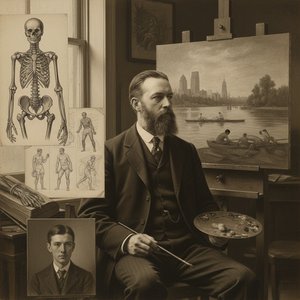 Thomas Eakins: Realism, Anatomy & the American Spirit – A Comprehensive Exploration of Life and LegacyExplore the life & legacy of Thomas Eakins, a pivotal American Realist painter. Discover his groundbreaking techniques, anatomical precisio…
 Romantic Realism's Finest: 10 Masterpieces for Your Home | OriginalUniqueArtExplore 10 defining masterpieces of Romantic Realism! Discover Courbet, Millet & Daumier's powerful paintings—capturing emotion and social …