Expressionism · 1915
Marching (Марк Шагал, 1915)
Марк Шагал (1887–1985) създаде Marching. Датира от 1915. Това произведение принадлежи към движението Expressionism. Изdelano е от Acrylic On Canvas.
- 1915
- Acrylic On Canvas

 Преглед в реален мащаб

 Ръчно изработена маслена картина
 Изпрати
 Сподели
 Ръководство


 Изтегляне
 Подобни артикули
 Рентгенова снимка
 Слайдшоу
 Въпроси и отговори

 Статистика
Marching: основните факти
- Заглавие
- Marching
- Художник
- Марк Шагал (1887–1985)
- Роден в
- Лйозна, Беларус
- Дата
- 1915
- Техника
- Acrylic On Canvas
- Движение
- Expressionism
- Предмет
- uniform, roof, sky, clock, figures, folklore
Какво е изобразено в Marching?
A Symphony of Color and Memory: Exploring Marc Chagall's "I Am Alone"
Marc Chagall’s “I Am Alone,” painted in 1915, isn’t merely a depiction of solitude; it’s an embodiment of existential angst rendered in the breathtaking language of Expressionism. Created during the turbulent years preceding World War I—a period marked by anxieties about national identity and impending conflict—the painting transcends its immediate historical context to speak to universal themes of isolation and longing. It's housed in the Musée d'Orsay, Paris, a testament to Chagall’s enduring influence on modern art.- Subject Matter: The canvas portrays a man standing alone on a rooftop amidst a swirling panorama of fantastical figures—a woman with outstretched arms, a child perched precariously on the edge of the roof, and several other stylized individuals drifting upwards into the heavens.
- Style: Chagall’s style is unmistakably Expressionist. Rejecting representational accuracy in favor of emotional intensity, he employs bold colors—primarily yellows, blues, and reds—to convey mood and feeling rather than to faithfully reproduce reality. The figures themselves are distorted and stylized, imbued with a dreamlike quality that defies logical interpretation.
Technique: Bold Brushstrokes and Layered Color
Chagall’s technique is characterized by thick, impasto brushstrokes—meaning the paint is applied in layers so thickly that it stands up prominently from the surface of the canvas. This textural approach contributes significantly to the painting's dramatic impact, creating a palpable sense of movement and conveying the artist’s emotional state directly onto the artwork. The colors are blended strategically to create luminous washes and vibrant accents, enhancing the overall visual richness.- Color Palette: The dominant hues—golden yellows symbolizing warmth and optimism juxtaposed with deep blues representing melancholy and uncertainty—are deliberately chosen to evoke specific emotions. Chagall’s masterful use of color underscores the painting's psychological depth.
- Composition: The rooftop setting serves as a focal point, anchoring the swirling figures and emphasizing the man’s isolation. The upward trajectory of the figures symbolizes aspiration but also hints at vulnerability—a yearning for connection amidst overwhelming circumstances.
Symbolism: Folklore and Existential Concerns
“I Am Alone” is replete with symbolic references drawn from Jewish folklore and Kabbalah—the mystical tradition of Judaism. The woman with outstretched arms represents compassion and maternal care, while the child symbolizes innocence and vulnerability. The swirling figures embody the chaotic forces of fate and the anxieties surrounding impending war. More broadly, the painting explores profound existential questions about human existence—questions concerning identity, purpose, and the inevitability of suffering.Ultimately, Chagall’s “I Am Alone” transcends its historical origins to resonate with viewers across generations. It's a hauntingly beautiful meditation on solitude, loss, and the enduring quest for meaning—a masterpiece that continues to inspire awe and provoke contemplation decades after its creation.
Marching в висока резолюция

Защитено от авторско право: изображението е показано само с информационна цел.
Други размери, кадриране и цитиране →Марк Шагал, Marching (1915).
Въпроси за Marching
Коя е датата на създаване на „Marching“ на Марк Шагал?
Създаването на „Marching“ на Марк Шагал датира от 1915.
Каква техника е използвана за „Marching“ на Марк Шагал?
"Marching" е изпълнено в Acrylic On Canvas.
Какви сюжети се появяват в „Marching“ на Марк Шагал?
„Marching“ на Марк Шагал изобразява: uniform, roof, sky, clock, figures, folklore, dreams.
Може ли изображението на „Marching“ на Марк Шагал да се репродуцира свободно?
Статусът на авторското право за „Marching“ на Марк Шагал: произведението е все още е защитено с авторско право. Това определя дали могат да се правят свободно репродукции на изображението.
Кой е създал "Marching"?
Художникът зад "Marching" е Марк Шагал. Произведението е каталогизирано под името на Марк Шагал.
Към кое художествено направление принадлежи „Marching“ на Марк Шагал?
Творческото направление, свързано с „Marching“ на Марк Шагал, е Expressionism. Тази класификация поставя произведението сред съответните автори и художествени творби.
Към кой период от кариерата на Марк Шагал принадлежи „Marching“?
„Marching“ принадлежи към Mature Period от кариерата на Марк Шагал. Тази класификация свързва творбата с развитието на художника.
На колко години е бил Марк Шагал, когато е създал „Marching“ през 1915?
Марк Шагал създава „Marching“ на възраст 28. Художникът е роден през 1887, а датировката на произведението е 1915.
Намира ли се произведението „Marching“ на Марк Шагал в общественото достояние и защо?
Статусът на авторското право върху "Marching" - все още е защитено с авторско право - се определя от годината на смъртта на художника – 1985.
За художника Марк Шагал
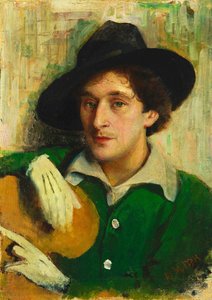
1887–1985, Беларус
Марк Шагал
Early Life, Family and Training Marc Chagall enters the world on July 7, 1887, in Vitebsk, Russian Empire, born Moishe Segal. He is the first of nine children in a modest Jewish family. Life is defined by the rhythms of labor and small-scale commerce. His father, Khatskel Segal, works as a herring pickler at a warehouse, while his mother, Feïga-Ita Tchernina, manages a small grocery store.
Други творби на Марк Шагал
 Аз и селото1911
 Бяло разпятие1938
 Рожден ден1915
 Над града1918
Есеи по темата Marching
 The Language of Brushstrokes: How Artistic Technique Expresses Emotion and EraExplore the profound connection between artistic technique and emotion. From the heavy impasto of Van Gogh to classical mastery, learn how …
 Dreaming in Color: The 25 Most Iconic Masterpieces by Marc ChagallStep into the dreamlike world of Marc Chagall. Explore 25 iconic masterpieces, from vibrant surrealist tales to soulful folklore. Find insp…
 Marc Chagall’s Masterpieces: Exploring the Magic, Color, and Surrealist Legacy of a Modernist IconEmbark on a journey through the dreamlike masterpieces of Marc Chagall. Explore the profound symbolism and vibrant colors of this Surrealis…