Realism
The Reader (Оноре Домие)
Оноре Домие (1808–1879) създаде The Reader. Това произведение принадлежи към движението Realism. Изdelano е от Oil On Panel. Размерите са 34 × 26 cm.
- Oil On Panel
- 34 × 26 cm

 Преглед в реален мащаб

 Ръчно изработена маслена картина
 Изпрати
 Сподели
 Ръководство


 Изтегляне
 Подобни артикули
 Рентгенова снимка
 Слайдшоу
 Въпроси и отговори

 Статистика
The Reader: основните факти
- Заглавие
- The Reader
- Художник
- Оноре Домие (1808–1879)
- Роден в
- Марсилия, Франция
- Техника
- Oil On Panel
- Размери
- 34 × 26 cm
- Движение
- Realism
- Епоха
- 19th Century
- Предмет
- man, book, reading, brown, ochre, red
Какво е изобразено в The Reader?
Identification of The Reader by Honoré Daumier
The quiet intensity of The Reader meets the viewer through the focused gaze of its subject. Painted by Honoré Daumier, this work captures a moment of profound stillness. The piece emerges from around c. 1857, a time when the artist's hand moved with a particular sense of purpose and weight. It exists as a painting, a physical presence that holds the light and shadow of a private, contemplative world.
Honoré Daumier brings a sense of lived experience to this study. The figure remains lost in the pages of a book, oblivious to the world outside the frame. There is a weight to the atmosphere, a feeling of solitude that settles over the scene. The work carries the mark of its creation, a tangible connection to the era of its origin.
This specific painting, The Reader, remains a significant part of the artist's visual language. It avoids the distractions of a grand setting to focus entirely on the human condition in a state of deep engagement. Through this work, the act of reading becomes a heavy, significant event, frozen in time for those who stop to look.
Composition and Visual Elements
The composition follows a vertical orientation, drawing the eye immediately to the man positioned slightly off-center. He sits in a moment of profound stillness, his gaze directed steadily downwards toward the open book held in his hands. This downward focus creates a tight, intimate space around his head and shoulders. Behind him, a blurred object, perhaps a cushion or a potted plant, rests in the background, providing a sense of depth without pulling attention away from the central figure.
Soft, diffused light falls from an unseen source above and to the left, casting gentle shadows across the man's face. This lighting emphasizes his features and the texture of the pages before him, while the shallow perspective keeps the viewer's focus firmly on the interaction between the reader and his text. The atmosphere feels quiet and heavy with contemplation.
The color palette relies on a somber arrangement of earthy tones. Deep browns, ochres, and muted reds dominate the scene, grounding the subject in a warm but melancholic environment. These colors wrap around the figure, reinforcing the sense of solitude and the weight of the thoughts contained within the book.
Technique and Physical Materials
The oil paint clings to the panel with a palpable, heavy presence. Each stroke carries the weight of the artist's hand, applied with a loose and expressive energy that refuses to settle into stillness. You can see the evidence of layering, where colors are built upon one another to create a sense of depth and substance. These layers blend into one another, creating soft transitions that suggest the subtle shifts of light across a surface.
A visible roughness defines the texture of the work. The brushstrokes remain unpolished and direct, leaving a tactile quality that speaks to the immediacy of the moment. This ruggedness gives the surface a physical life, where the paint does not merely sit upon the panel but seems to emerge from it. The interplay of these thick applications and the careful blending of tones creates a surface that feels both spontaneous and deeply considered.
The Reader в висока резолюция

Обществено достояние: художникът е починал през 1879 г.
Други размери, кадриране и цитиране →Оноре Домие, The Reader. Обществено достояние
Дигитален експерт проверява цветовете спрямо оригиналната картина и ретушира файла, съобразно мазките на художника.
Купете изображение с висока резолюцияВъпроси за The Reader
Къде мога да намеря статистика за „The Reader“ на Оноре Домие?
Статистиката за „The Reader“ на Оноре Домие се намира на страницата Статистика на произведението: месечни посещения на творбата, посещения на произведенията на художника, както и разпределение на последните посетители по държава и език.
Какво ниво на контраст притежава „The Reader“ на Оноре Домие?
Светло-тъмният контраст на „The Reader“ е определен като Serene. Контрастът описва доколко силно се различават светлите и тъмните зони.
Към кое художествено направление принадлежи „The Reader“ на Оноре Домие?
„The Reader“ е произведение от Realism. Това направление определя художествената традиция, към която принадлежи творбата.
Кой художник и кой стил стоят зад "The Reader"?
Оноре Домие създава „The Reader“ в рамките на движението Realism.
Мога ли да видя рентгенов образ на „The Reader“ на Оноре Домие?
Страницата Рентгенови лъчи на „The Reader“ на Оноре Домие е интерактивен визуализатор, който ви позволява да разгледате единадесет оптични слоя на произведението, включително и рентгенов вид.
Кой е доминиращият цвят на „The Reader“ на Оноре Домие?
Доминиращият цвят на „The Reader“ на Оноре Домие е Walnut (#714229).
Как се позиционира „The Reader“ сред често срещаните теми в творчеството на Оноре Домие?
"The Reader" изобразява man, book, reading, brown, ochre, red, shoulders, face, докато утвърдените теми на Оноре Домие са rubens' chiaroscuro, realism, social and political critique, lithography and painting, human condition. Сравнението между двете показва как произведението се свързва с обичайните сюжети на художника.
Има ли произведения, подобни на „The Reader“?
Произведения, подобни на „The Reader“, са изброени в страницата Подобни произведения на произведението.
Колко светлина изглежда, че отразяват цветовете на "The Reader"?
Записаната светлост за „The Reader“ на Оноре Домие е Dark.
За художника Оноре Домие

1808–1879, Франция
Оноре Домие
Honoré Daumier: A Voice of the People, a Master of Satire Honoré-Victorin Daumier, роден в Марсилия през 1808 г., е фигура от изключителна важност в историята на изкуството, чието творчество се отличава с остър социален коментар и революционен подход към графиката. Животът му е тясно преплетена с бурно време във Франция – от Революцията през 1830 г. до падането на Втората френска империя, което оформи неговата творческа визия и го направи глас за онези, които са били потиснати и забравени. Първоначално предназначен за юрист, Дамиер рано проявява интерес към изкуството, под влиянието на баща си – поет и майстор на дърворезбите, и на учителя си Александър Леноар, който го запознава с класическите влияния на Рубенс и Тициан.
Други творби на Оноре Домие
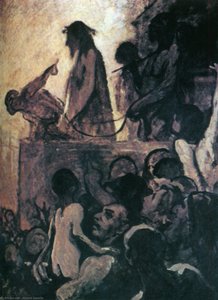 Ние искаме Барбас1852
 The Third-class Carriage1860
 Unknown, maybe Hippolyte Lucien-Joseph Lucas (1807-1878), a Journalist, maybe P.Mendez de Vigo (1790-1860) a Spanish General, but Most Probably the Count Pelet de la Lozere (1785-1871), a Politician1833
 Ratapoil (front view)1850

Есеи по темата The Reader
 The Art of the Gaze: A Collector's Guide to Mastering Portrait Composition and Emotional DepthMaster the nuances of portrait composition with our expert guide for collectors. Discover how light, gaze, and texture create emotional dep…
 Spontaneity and Matter: Distinguishing CoBrA from Art InformelMaster the differences between CoBrA and Art Informel with our expert guide. Learn to identify these post-war movements today.
 Ink and Light: How Impressionist Painters Captured the Act of ReadingExplore how masters like Renoir and Vermeer captured the intimacy of reading. Discover the profound link between literature and fine art.