Expressionism
Evening (Емил Нолде)
Емил Нолде (1867–1956) създаде Evening. Това произведение принадлежи към движението Expressionism.

 Преглед в реален мащаб

 Ръчно изработена маслена картина
 Изпрати
 Сподели
 Информационен лист


 Изтегляне
 Подобни артикули
 Рентгенова снимка
 Слайдшоу
 Въпроси и отговори

 Статистика
Evening накратко
- Заглавие
- Evening
- Художник
- Емил Нолде (1867–1956)
- Роден в
- Нолде, Дания
- Движение
- Expressionism
- Предмет
- landscape painting, cloudscape artwork, water reflection, dreamlike scene, abstract nature, evening glow”
Какво е изобразено в Evening?
A Symphony of Color: Experiencing Emil Nolde’s “Evening”
Emil Nolde's "Evening" is a captivating exploration of light and atmosphere, characteristic of his expressive landscape work. This piece doesn’t depict a literal evening scene, but rather an *emotional* response to one – a distillation of the feeling of twilight rendered in bold color and simplified forms. A dominant, luminous yellow cloud commands attention in the upper left quadrant, acting as a focal point that draws the eye down into the composition. Below, a gradient of blues transitions from deep indigo to lighter turquoise and verdant greens along the horizon line, suggesting water reflecting the celestial drama above.
Expressionism & The Power of Color
- Stylistic Roots: Nolde was a key figure in early 20th-century Expressionism, a movement that prioritized subjective experience and emotional impact over realistic representation. “Evening” exemplifies this approach through its non-naturalistic color palette and abstracted forms.
- Technique & Materials: The artwork appears to be executed in watercolor or gouache, evidenced by the fluidity of the washes and blending of colors. Nolde masterfully employs these techniques to create a sense of atmospheric depth despite the flattened perspective. Visible brushstrokes add texture and energy.
- Influences: While forging his own path, Nolde was influenced by artists like Vincent van Gogh and Paul Gauguin, particularly their use of intense color to convey emotion. He also drew inspiration from traditional folk art and primitive masks, evident in the bold outlines and simplified shapes.
Symbolism & Emotional Resonance
The symbolism within “Evening” is subtle yet potent. The large yellow cloud can be interpreted as a source of radiant energy or enlightenment – a beacon amidst the darkening sky. The winding body of water, reflecting the colors above, suggests a connection between the earthly and celestial realms. More broadly, Nolde’s landscapes often represent an attempt to connect with nature on a spiritual level.
The overall emotional impact is one of tranquility mixed with a hint of mystery. The stylized representation invites contemplation and allows viewers to project their own feelings onto the scene. Nolde's work frequently evokes a sense of longing or melancholy, reflecting his own complex relationship with the world around him.
Nolde’s Life & Legacy
Born in 1867 in Nordel, Germany, Emil Nolde dedicated himself to art after years working as a wood carver. Despite facing opposition from his family and later persecution under the Nazi regime (his work was deemed “degenerate”), he remained committed to his artistic vision. Nolde’s landscapes, seascapes, and portraits are celebrated for their raw emotional power and innovative use of color. His ability to capture the essence of a place or feeling – rather than simply its appearance – continues to resonate with audiences today.
Изображения с висока резолюция на Evening
Обществено достояние: художникът е починал през 1956 г.
Емил Нолде, Evening. Обществено достояние
Отговори на въпроси относно Evening
Каква е темата на "Evening"?
Обектите на "Evening" са landscape painting, cloudscape artwork, water reflection, dreamlike scene, abstract nature, evening glow”, “stylized landscape”.
Свободен ли е от авторско право "Evening"?
Що се отнася до авторското право, „Evening“ е в в обществено достояние – авторското право е изтекло.
Кой е художникът зад "Evening"?
Художникът зад "Evening" е Емил Нолде. Произведението е каталогизирано под името на Емил Нолде.
Към кое художествено направление принадлежи „Evening“ на Емил Нолде?
„Evening“ е произведение от Expressionism. Това направление определя художествената традиция, към която принадлежи творбата.
Коя е фазата от творческия път на Емил Нолде, която представлява „Evening“?
В рамките на кариерата на Емил Нолде, „Evening“ принадлежи към периода Mature Period. Тази фаза позволява да се направи сравнение с другите творби на художника.
Какво определя правния статус на „Evening“ на Емил Нолде по отношение на авторското право?
„Evening“ на Емил Нолде е в в обществено достояние – авторското право е изтекло. Срокът на авторското право се изчислява от годината на смъртта на художника, която е през 1956.
Как се вписва „Evening“ в цялостното творчество на Емил Нолде?
"Evening" принадлежи към творчеството на Емил Нолде в рамките на Expressionism, чиито утвърдени теми включват german romanticism influence, nature's ethereal beauty", "symbolic, spiritual themes", expressionist color theory, reflects coastal landscapes, nolde's personal visions.
Как се позиционира „Evening“ сред често срещаните теми в творчеството на Емил Нолде?
Сред утвърдените теми на Емил Нолде – german romanticism influence, nature's ethereal beauty", "symbolic, spiritual themes", expressionist color theory, reflects coastal landscapes, nolde's personal visions – „Evening“ привнося собствен фокус върху landscape painting, cloudscape artwork, water reflection, dreamlike scene, abstract nature, evening glow”, “stylized landscape”.
За художника Емил Нолде
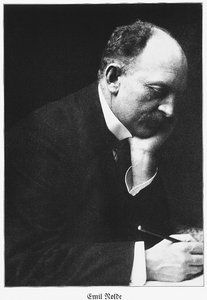
1867–1956, Дания
Емил Нолде
Животът и идентичността на Емил Нолде Роден като Ханс Емил Хансен на 7 август 1867 г., човекът, който по-късно ще стане известен като Емил Нолде, израства близо до село Нолде в херцогството Шлезвиг. Ранните му години са оформени от селския, аграрен начин на живот на неговото семейство. В крайна сметка той се отклонява от този път, избирайки вместо това да работи като дърворезбец и декоратор на мебели. Този тактилни, физически труд предхожда неговия преход към живописта и графиката.
Други творби на Емил Нолде
 Sunset
 Sea with Red Sky
 Couple on the beach1903
 Masks1911
Есеи по темата Evening
 Masterpieces of Emotion: The Top 25 Vincent van Gogh ArtworksImmerse yourself in the vibrant world of Vincent van Gogh. Explore 25 iconic Post-Impressionist masterpieces, from Starry Night to Sunflowe…
 Chasing Shadows: The Enchanting Beauty of Dim Light in Impressionist MasterpiecesDiscover the ethereal magic of Impressionist nightscapes. Explore how masters like Monet and Whistler captured the alchemy of moonlight, sh…
 Unveiling Inner Worlds: Exploring Psychological Depth in 20th & 21st Century ArtExplore the profound psychological themes within 20th & 21st-century art. Discover Expressionism, Surrealism & more – and learn how to coll…