

 Преглед в реален мащаб
 Сподели
 Сподели
 Подробности
 Ръководство

 Изтегляне
 Подобни артикули
 Рентгенова снимка
 Слайдшоу
 Статистика
Бракосъчетанието на Мария


 Разгърни целия текст
Ръчно изработена маслена репродукция
Ръчно рисувана маслена картина върху платно във вашия размер и рамка, изработена по поръчка от нашите художници. ( Избор на принт Превключване към дигитално изображение)




P118B $10

P118H $10

P118W $10

P438Z $10

P508JH $12

P508YH $12

P805H $10

P805Z $10

P919BZ $10

P919G $10

P919XJ $10

P959ZH $10

P968JZ $12

W106C $8

W218G $10

W218JH $8

W218Y $10

W307PJ $10

W316G $10

W316PJ $8

W316Y $10

W398PJ $8

W4111J $10

W500HY $15

W500JH $15

W692G $12

W849H $8

W940BG $15

W953PJ $8




Изберете от нашите предварително зададени размери, които съответстват на оригиналните пропорции на произведението.

Можете да въведете свои собствени размери, за да паснат на конкретна рамка или пространство. Ако избраният от вас размер не съответства на пропорциите на оригиналното изображение, ние ще изрежем произведението или ще разширим картината с допълнителни ръчно рисувани елементи. Дигитален макет ще бъде изпратен за ваше одобрение преди започване на производството.
Моля, обърнете внимание, че предпрогледа на екрана не отразява действителното изрязване или разширяване. Само макетът ще покаже точно финалната композиция.
Въпреки че са налични персонализирани размери, препоръчваме да изберете размер от предварително дефинирания списък, за да запазите оригиналните пропорции.
След получаване на поръчка, екипът на OriginalUniqueArt.com ще изпрати имейл до клиента с инструкции и ще предостави примерен макет за преглед.
Доставка по целия свят () в рамките на 3-4 седмици вместо стандартните 5 седмици. (25 Септември). Без компромис с качеството.

Безплатна експресна доставка по целия свят

Висококачествено ленено платно

Пълно застраховане на доставката

Гаранция за възстановяване на митнически такси

Гаранция за пълно съответствие на цветовете

Политика за връщане в рамките на 100 дни (само при дефекти)

100% Гаранция за връщане на сумата

Отстъпка при поръчка на повече произведения
 Опцията със стъкло е налична само за размери под 110 см

Бракосъчетанието на Мария
Техника на репродукция
Размер на репродукцията
-


Крайна цена
$ 300
Betrothal of Mary – A Fresco Masterpiece by Boccaccio Boccaccino
The fresco “Betrothal of Mary,” executed by Boccaccio Boccaccino in 1514, stands as a testament to the artistic fervor of Cremona during the High Renaissance. Located within the Cathedral of Cremona, this monumental artwork isn’t merely decoration; it's a carefully crafted narrative imbued with religious symbolism and reflecting the humanist ideals prevalent at the time. Examining its details unveils a profound understanding of both artistic innovation and cultural significance.A Vision of Regal Dignity: Composition and Style
Boccaccino’s masterful approach is immediately evident in the composition—a deliberate structuring of figures within arched pilasters that draws inspiration from Albrecht Dürer's celebrated woodcut series depicting the Life of the Virgin. Unlike a literal transcription, Boccaccino absorbed Dürer’s compositional principles – specifically the use of intersecting diagonals and balanced groupings – to create an image brimming with harmony and grandeur. The fresco adheres to traditional Italian artistic conventions while simultaneously embracing Renaissance ideals of clarity and elegance. This stylistic fusion speaks volumes about Boccaccino's engagement with contemporary artistic discourse.Technique and Color Palette: Craftsmanship and Atmosphere
The fresco’s execution showcases remarkable craftsmanship, utilizing tempera paint on plaster—a technique favored by Cremonese artists during this period. The artist meticulously layered pigments to achieve astonishing depth and luminosity, capturing the subtle nuances of light and shadow with exceptional precision. Dominating the color palette are earthy tones – ochre, umber, siennas – complemented by splashes of vibrant blues and reds that highlight key figures and architectural elements. These colors aren’t arbitrary; they contribute significantly to the fresco's emotive atmosphere, conveying a sense of solemn reverence and highlighting the importance of the depicted event—the betrothal between Mary and Joseph.Historical Context: Cremona Cathedral and Renaissance Ideals
The Cathedral of Cremona itself represents a pinnacle of Gothic architecture transformed by Renaissance sensibilities. Commissioned in the mid-15th century, its construction incorporated elements of both styles, reflecting the broader cultural landscape of Italy during this transformative era. Boccaccino’s fresco aligns perfectly with these prevailing ideals—a focus on human dignity, moral contemplation, and the glorification of Christian faith. It embodies the humanist conviction that art could elevate the soul and communicate profound truths about humanity's relationship with divinity.Symbolism: Narrative Depth and Religious Significance
The fresco’s narrative unfolds with meticulous detail, depicting scenes from Mary’s life preceding her marriage to Joseph. The central figure—representing a king or noble—holds a book symbolizing divine providence guiding the unfolding drama. Surrounding him are figures dressed in opulent attire, signifying social status and highlighting the solemnity of the occasion. Each element contributes to a larger symbolic tapestry, reinforcing the overarching theme of faith, hope, and love – virtues considered paramount by Renaissance thinkers. The archway framing the scene serves as a visual reminder of God’s omnipresence, emphasizing the sanctity of the depicted moment.Emotional Impact: Capturing Sacred Beauty
Ultimately, “Betrothal of Mary” transcends mere representation; it aspires to evoke emotion and inspire contemplation. Boccaccino's skillful rendering captures the tenderness of human connection alongside the grandeur of religious devotion. The fresco’s luminous colors and intricate detailing invite viewers into a realm of spiritual beauty—a legacy that continues to resonate with audiences centuries later. It remains an enduring masterpiece, demonstrating the transformative power of art to communicate profound truths about faith and humanity.Биография на художника
The Luminescent Legacy of Boccaccio Boccaccino
In the golden twilight of the Quattrocento, a period defined by the profound rebirth of classical ideals, Boccaccio Boccaccino emerged as a vital architect of the Emilian school's visual language. Born near Ferrara around 1460, Boccaccino’s life was woven into the very fabric of the Italian Renaissance, a time when the boundaries between sculpture and painting were fluid and the pursuit of naturalism was an all-consuming passion. While the historical record offers only fragmented glimpses into his early years, the sheer majesty of his surviving works allows us to reconstruct a narrative of immense talent and profound influence. His journey from the humanist traditions of Ferrara to the grander stages of Cremona and Venice represents more than just a personal career; it mirrors the expansion of an artistic movement that sought to harmonize the divine with the earthly through light, color, and meticulous detail.
The foundations of Boccaccino’s aesthetic were likely laid under the tutelage of Domenico Panetti, a master whose devotion to humanist precision instilled in the young artist a reverence for classical form. This early training provided the essential scaffolding upon which Boccaccino would build his later, more complex compositions. As he moved through the artistic landscapes of Northern Italy, his style began to coalesce into something uniquely distinctive—a blend of the delicate grace found in Venetian works and the structural rigor characteristic of the Emilian tradition. His ability to manipulate trompe l'oeil effects and master atmospheric perspective suggests an artist who was not merely a decorator of walls, but a storyteller capable of manipulating space to evoke deep spiritual resonance.
A Master of the Cremonese Fresco
The true zenith of Boccaccino’s career is inextricably linked to the Cathedral of Cremona. Between 1506 and 1519, he became a central figure in a prolific workshop alongside luminaries such as Pietro Parmeggiani and Andrea Altobello Melone. This period was marked by an extraordinary collaborative energy that transformed the cathedral into a sanctuary of Renaissance innovation. His frescoes are not merely religious illustrations; they are immersive environments where the boundaries between the viewer's world and the sacred realm begin to dissolve. Through the use of soft, luminous transitions and a sophisticated understanding of light, Boccaccino achieved a sense of sfumato that brought a breathing, organic quality to his figures.
His mastery extended far beyond the monumental scale of fresco painting into the intimate realm of devotional works. The artist possessed a singular gift for rendering the Virgin and Child with a tenderness that felt both timeless and profoundly human. In these compositions, one finds:
- A harmonious balance between landscape and figure, where nature serves as a silent participant in the divine narrative.
- An exquisite attention to the textures of fabric and the subtle glow of skin, achieved through layered glazes and careful pigment selection.
- The integration of classical motifs that reflect the humanist intellectual climate of his era.
Historical Significance and Enduring Influence
Though the passage of centuries has occasionally obscured the specific biographical milestones of Boccaccio Boccaccino, his impact on the trajectory of Italian art remains undeniable. As documented by Giorgio Vasari in his seminal Lives of Eminent Painters, Sculptors, and Architects, Boccaccino was a figure of significant repute whose technical prowess commanded respect across regional borders. His workshop served as a crucible for the next generation of artists, most notably influencing the development of Garofalo, who would go on to carry the torch of the Emilian style into the High Renaissance.
The historical significance of Boccaccino lies in his role as a bridge between the meticulous detail of the early Renaissance and the more fluid, emotive grandeur of the later period. He helped establish Cremona as a vital center of artistic production, proving that the periphery of the Italian peninsula could produce art of equal complexity and spiritual depth to the great centers of Florence or Rome. Today, when we gaze upon the remnants of his frescoes or the quiet dignity of his Madonnas, we are witnessing the enduring triumph of an artist who mastered the art of making the eternal visible.

Boccaccio Boccaccino
1460 - 1525 , Italy
Бързи факти
- Artistic Movement Or Style: Early Italian Renaissance; Emilian School
- Artists Or Movements Influenced By This Artist: ['Garofalo']
- Artists Who Influenced This Artist: ['Domenico Panetti']
- Date Of Birth: c. 1460
- Date Of Death: c. 1525
- Full Name: Boccaccio Boccaccino
- Nationality: Italian
- Notable Artworks:
- Virgin and Child
- Marriage of Saint Catherine
- Holy Family
- Place Of Birth: Ferrara, Italy
Свързани статии
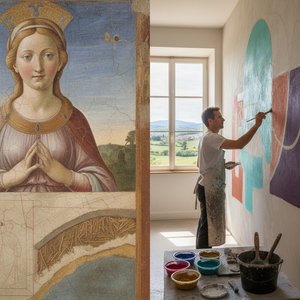
The Enduring Legacy of Fresco Painting: Techniques, History & Contemporary Relevance
Explore the rich history & enduring artistry of fresco painting – from Giotto to Michelangelo! Discover techniques, conservation efforts, & modern applications. Learn how OriginalUniqueArt brings this timeless art form to your home.

Фреската като Семейно Наследство: Пресъздайте Своята История по Стените
Създайте уникална семейна фреска с ! Експертни художници, висококачествени материали и персонализиран дизайн. Запазете спомените си за поколения наред!

The Enduring Legacy of Fresco: Technique, History & Artistic Expression Across Cultures
Explore the rich history & enduring legacy of fresco painting! Discover ancient techniques, Giotto's masterpieces, and modern applications. Expert insights for art lovers & professionals.

The Enduring Legacy of Fresco: Technique, History & Artistic Expression
Explore the rich history & enduring artistry of fresco painting. Discover techniques from Giotto to Michelangelo, conservation efforts, & modern applications. Learn how OriginalUniqueArt brings this timeless art form to your home.
Изкуството, което живее с нас: Емоционалната сила на персонализираната вътрешна фреска
Създайте уникална фреска с ! Ръчно рисувани стенописи по поръчка, персонализирани дизайни и експертни консултации. Инвестирайте в изкуство, което отразява вашата индивидуалност и преобразява пространството ви.
