Портрет на Kawanabe Kyōsai

72-те най-известни картини на Kawanabe Kyōsai, всяка от които е уникална

Обновено Ноември 2026 · класирано според нашия индекс на популярност (търсения, посещения и поръчки за всяко произведение) · 72 творби на Kawanabe Kyōsai в нашия каталог

Накратко

Three Kyōgen Dancers (801) е картината на Kawanabe Kyōsai, която привлича най-много погледи; оригиналът се намира в Метрополитън Музей на изкуствата, Ню Йорк. След това погледът се насочва към Sketches of East Asian Legendary Figures (801) и Yang Guifei Adjusting her Hair (1850). Сред 72 произведения на Kawanabe Kyōsai в нашия каталог, тези 72 са най-известните – всяко от тях е уникален оригинал, представен с годината на създаване, музея и причината за неговата вечност.

1831 – 1889, Koga Ukiyo-e Най-много творби: Метрополитън Музей на изкуствата

Топ 10 картини на Kawanabe Kyōsai, през погледа на галерията

1
Three Kyōgen Dancers (801) на Kawanabe Kyōsai

Three Kyōgen Dancers

A preliminary ink drawing captures three performers in the midst of a kyōgen dance. These figures, rendered with a fluid and spontaneous energy, embody the comedic essence of traditional Japanese theater. Each dancer is frozen in a distinct, expressive pose that suggests movement and rhythmic timing. One figure holds a drum, another a fan, and the third a bag, marking the specific roles and props essential to the performance. The…

2
Sketches of East Asian Legendary Figures (801) на Kawanabe Kyōsai

Sketches of East Asian Legendary Figures

The ink flows across the paper, capturing a moment of quietude and myth. In this black and white drawing, figures from the realm of legend emerge from the shadows of the everyday. We see Japanese figures like Daikoku and Urashima Tarō sharing space with Chinese immortals and the Twenty-Four Paragons of Filial Piety. There is a strange, casual intimacy to the scene, as if these divine and legendary beings have…

3
Yang Guifei Adjusting her Hair (1850) на Kawanabe Kyōsai

Yang Guifei Adjusting her Hair

1850 · Ink On Paper · Los Angeles County Museum of Art, Лос Анджелис

In "Yang Guifei Adjusting her Hair" by Kawanabe Kyōsai, the brush captures a moment of quiet preparation. The subject is Yang Guifei, a woman known to history as Lady Yang. She was the beloved consort of Emperor Xuanzong of Tang and remains celebrated as one of the Four Beauties of ancient China. Here, she is a figure of grace, focused on the delicate task of arranging her hair.

4
Yamauba and Kintarō (1850) на Kawanabe Kyōsai

Yamauba and Kintarō

1850 · Ink On Paper · Los Angeles County Museum of Art, Лос Анджелис

In this vertical composition, Kawanabe Kyōsai presents a dynamic encounter between two figures from Japanese folklore. The work, created about 1850, centers on the mountain hag Yamauba and the superhuman child Kintarō. A large, standing female figure dominates the space, her presence defined by the voluminous folds of her robes. Beside her, a smaller, crouching male figure provides a sense of scale and tension. The arrangement of these two bodies…

5
Hell Courtesan (1870) на Kawanabe Kyōsai

Hell Courtesan

1870 · Cleveland Museum of Art, Кливланд

The scene unfolds within the delicate confines of a hanging scroll, where the figure of the Hell Courtesan, known in Japanese as Jigoku Tayū, emerges from the silk. This work, titled Hell Courtesan, captures a moment of profound stillness and spiritual weight. The artist, Kawanabe Kyōsai, brings this legendary character to life through a composition that balances the elegance of a high-ranking courtesan with the unsettling imagery of the afterlife.…

6
Frolicking Figures and Animals (1870) на Kawanabe Kyōsai

Frolicking Figures and Animals

In this horizontal handscroll from 1870, we find a quiet, almost whispered dialogue between human presence and the natural world. The composition relies heavily on the use of negative space, a deliberate emptiness that allows the viewer to focus entirely on the gestural energy of the brushstrokes. It is a work of profound restraint, where the absence of color speaks more loudly than a full palette could. The monochromatic shades…

7
Calligraphy and Painting Party (1877) на Kawanabe Kyōsai

Calligraphy and Painting Party

1877 · Ink On Paper

Calligraphy and Painting Party is a hanging scroll created by the Japanese painter and caricaturist Kawanabe Kyōsai. Born in 1831 in Koga, Japan, the artist navigated the shifting tides of the Edo and Meiji periods. This work dates to 1880, a moment when his brush captured the restless energy of a changing nation. His hand moved with the precision of a trained scholar and the wit of a satirist.

8
Wisteria Maiden and Demon Priest (1872) на Kawanabe Kyōsai

Wisteria Maiden and Demon Priest

1872 · Ink · Minneapolis Institute of Art, Minneapolis

In this work, Wisteria Maiden and Demon Priest, Kawanabe Kyōsai presents a dramatic encounter between a maiden and a demon priest. The composition is centered on a woman dressed in an ornate, multi-colored kimono featuring red, blue, and white patterns. She appears to dance or float gracefully above a crouching, monstrous figure. This figure, the demon priest, is depicted with a weathered, muscular, and grotesque face, wearing dark, heavy robes…

9
Painting Party (1880) на Kawanabe Kyōsai

Painting Party

1880 · Woodblock Print · Cleveland Museum of Art, Кливланд

Painting Party is a traditional Japanese ukiyo-e woodblock print by Kawanabe Kyōsai. The artist, born in 1831 in Koga, Japan, lived until 1889. This work emerged from a life defined by the shifting currents of the Meiji era. It captures a specific moment of social gathering through the precision of the woodblock medium.

10
Night Procession of One Hundred Demons (1880) на Kawanabe Kyōsai

Night Procession of One Hundred Demons

1880 · Ink

Kawanabe Kyōsai painted Night Procession of One Hundred Demons about 1880. The work captures a Hyakki Yagyō, a traditional Japanese Night Parade of One Hundred Demons. This supernatural event brings a chaotic procession of various yokai into the light of the viewer's gaze. It is a rhythmic movement of spirits passing through the dark.

Знаменитите картини на Kawanabe Kyōsai, номера от 11 до 72

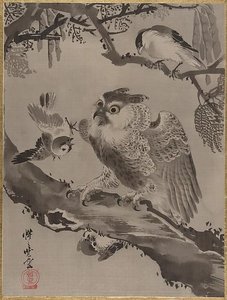
11Hell Courtesan (1880) на Kawanabe KyōsaiHell Courtesan1880 12Jurōjin [center of a triptych] (1884) на Kawanabe KyōsaiJurōjin [center of a triptych]1884 · Minneapolis Institute of Art 13Theatre Curtain of Shintomi-za, with an Impromputu Sketch Monster (1880) на Kawanabe KyōsaiTheatre Curtain of Shintomi-za, with an Impromputu Sketch Monster1880 14Squirrels Eating Chestnuts (1886) на Kawanabe KyōsaiSquirrels Eating Chestnuts1886 · Los Angeles County Museum of Art 15A Beauty in Front of King Enma's Mirror (1887) на Kawanabe KyōsaiA Beauty in Front of King Enma's Mirror1887 16Urashima Tarō Riding on a Tortoise (1888) на Kawanabe KyōsaiUrashima Tarō Riding on a Tortoise1888 · Метрополитън Музей на изкуствата 17Two Children Playing with Goldfish (1887) на Kawanabe KyōsaiTwo Children Playing with Goldfish1887 · Метрополитън Музей на изкуствата 18Two Birds on a Branch (1887) на Kawanabe KyōsaiTwo Birds on a Branch1887 · Метрополитън Музей на изкуствата 19Singing Bird on a Branch (1887) на Kawanabe KyōsaiSinging Bird on a Branch1887 · Метрополитън Музей на изкуствата 20滝に燕図 Swallows by a Waterfall (1887) на Kawanabe Kyōsai滝に燕図 Swallows by a Waterfall1887 · Метрополитън Музей на изкуствата 21Tale of the Tongue-cut Sparrow (1800) на Kawanabe KyōsaiTale of the Tongue-cut Sparrow1800 · Los Angeles County Museum of Art 22Sketches of Birds and Animals (1870) на Kawanabe KyōsaiSketches of Birds and Animals1870 · Метрополитън Музей на изкуствата 23Three Crossbills on a Leafless Tree (1878) на Kawanabe KyōsaiThree Crossbills on a Leafless Tree1878 · Minneapolis Institute of Art 24Chinese-style Landscape with Man Fishing from a Boat by Moonlight [right of a triptych] (1884) на Kawanabe KyōsaiChinese-style Landscape with Man Fishing from a Boat by Moonlight [right of a triptych]1884 · Minneapolis Institute of Art 25Landscape with River in Mountainous Country [left of a triptych] (1884) на Kawanabe KyōsaiLandscape with River in Mountainous Country [left of a triptych]1884 · Minneapolis Institute of Art 26猿を襲う鷲図 Eagle Attacking a Monkey (1885) на Kawanabe Kyōsai猿を襲う鷲図 Eagle Attacking a Monkey1885 · Метрополитън Музей на изкуствата 27兎を追う鷲図 Eagle Pursuing Rabbit (1885) на Kawanabe Kyōsai兎を追う鷲図 Eagle Pursuing Rabbit1885 · Метрополитън Музей на изкуствата 28Eagle Attacking a Mountain Lion (1885) на Kawanabe KyōsaiEagle Attacking a Mountain Lion1885 · Метрополитън Музей на изкуствата 29White Eagle Eyeing a Mountain Lion (1885) на Kawanabe KyōsaiWhite Eagle Eyeing a Mountain Lion1885 · Метрополитън Музей на изкуствата 30Rocky Landscape (1887) на Kawanabe KyōsaiRocky Landscape1887 · Метрополитън Музей на изкуствата 31Crow on a Branch (1887) на Kawanabe KyōsaiCrow on a Branch1887 · Метрополитън Музей на изкуствата 32Untitled (D2X7KF) (1887) на Kawanabe KyōsaiUntitled (D2X7KF)1887 · Метрополитън Музей на изкуствата 33Fox Catching Bird (1887) на Kawanabe KyōsaiFox Catching Bird1887 · Метрополитън Музей на изкуствата 34Bird and Frog (1887) на Kawanabe KyōsaiBird and Frog1887 · Метрополитън Музей на изкуствата 35松に鴉図 Two Crows on a Pine Branch (1887) на Kawanabe Kyōsai松に鴉図 Two Crows on a Pine Branch1887 · Метрополитън Музей на изкуствата 36Cranes in Marsh (1887) на Kawanabe KyōsaiCranes in Marsh1887 · Метрополитън Музей на изкуствата 37Buffalo and Herdsman (1887) на Kawanabe KyōsaiBuffalo and Herdsman1887 · Метрополитън Музей на изкуствата 38柳に鴉図 Crow and Willow Tree (1887) на Kawanabe Kyōsai柳に鴉図 Crow and Willow Tree1887 · Метрополитън Музей на изкуствата 39岩に鴉図 Crow on a Rock (1887) на Kawanabe Kyōsai岩に鴉図 Crow on a Rock1887 · Метрополитън Музей на изкуствата 40Owl Mocked by Small Birds (1887) на Kawanabe KyōsaiOwl Mocked by Small Birds1887 · Метрополитън Музей на изкуствата 41木に鴉図 Crow on a Branch (1887) на Kawanabe Kyōsai木に鴉図 Crow on a Branch1887 · Метрополитън Музей на изкуствата 42竹に鴉図 Crow on a Bamboo Branch (1887) на Kawanabe Kyōsai竹に鴉図 Crow on a Bamboo Branch1887 · Метрополитън Музей на изкуствата 43旭に群鴉図 Flock of Crows at Dawn (1887) на Kawanabe Kyōsai旭に群鴉図 Flock of Crows at Dawn1887 · Метрополитън Музей на изкуствата 44ムクドリ図 Starlings on a Branch (1887) на Kawanabe Kyōsaiムクドリ図 Starlings on a Branch1887 · Метрополитън Музей на изкуствата 45Fish in a Whirlpool (1887) на Kawanabe KyōsaiFish in a Whirlpool1887 · Метрополитън Музей на изкуствата 46富士図 Mount Fuji (1887) на Kawanabe Kyōsai富士図 Mount Fuji1887 · Метрополитън Музей на изкуствата 47Rocky Landscape (1887) на Kawanabe KyōsaiRocky Landscape1887 · Метрополитън Музей на изкуствата 48瓜に鼠図 Mice in a Melon (1887) на Kawanabe Kyōsai瓜に鼠図 Mice in a Melon1887 49Eagle Attacking Fish (1887) на Kawanabe KyōsaiEagle Attacking Fish1887 · Метрополитън Музей на изкуствата 50Squirrels Gathering Chestnuts (1887) на Kawanabe KyōsaiSquirrels Gathering Chestnuts1887 · Метрополитън Музей на изкуствата 51Monkey Hanging from Grapevines (1887) на Kawanabe KyōsaiMonkey Hanging from Grapevines1887 · Метрополитън Музей на изкуствата 52雪中鴉図 Crow Flying in the Snow (1887) на Kawanabe Kyōsai雪中鴉図 Crow Flying in the Snow1887 · Метрополитън Музей на изкуствата 53Waterfall, Eagle and Monkey (1887) на Kawanabe KyōsaiWaterfall, Eagle and Monkey1887 · Метрополитън Музей на изкуствата 54月に鴉図 Crow and the Moon (1887) на Kawanabe Kyōsai月に鴉図 Crow and the Moon1887 · Метрополитън Музей на изкуствата 55Pheasant Caught by a Snake (1887) на Kawanabe KyōsaiPheasant Caught by a Snake1887 · Метрополитън Музей на изкуствата 56Shakyamuni Conquering the Demons (Shaka Gōma zu) (1888) на Kawanabe KyōsaiShakyamuni Conquering the Demons (Shaka Gōma zu)1888 · Метрополитън Музей на изкуствата 57Eagle Holding Small Bird (1887) на Kawanabe KyōsaiEagle Holding Small Bird1887 · Метрополитън Музей на изкуствата 58Monkeys (1888) на Kawanabe KyōsaiMonkeys1888 · Метрополитън Музей на изкуствата 59Deer and Monkeys (1887) на Kawanabe KyōsaiDeer and Monkeys1887 · Метрополитън Музей на изкуствата 60Rabbits (1887) на Kawanabe KyōsaiRabbits1887 · Метрополитън Музей на изкуствата 61Cat Catching a Frog (1887) на Kawanabe KyōsaiCat Catching a Frog1887 · Метрополитън Музей на изкуствата 62水辺に鴉図 Crow and Reeds by a Stream (1887) на Kawanabe Kyōsai水辺に鴉図 Crow and Reeds by a Stream1887 · Метрополитън Музей на изкуствата 63白衣観音図 White Robed Kannon (1887) на Kawanabe Kyōsai白衣観音図 White Robed Kannon1887 · Метрополитън Музей на изкуствата 64Playful Demon на Kawanabe KyōsaiPlayful DemonХудожествена галерия на Йейлския университет 65Frolicking Animals, Nekomata and Tanuki Badger на Kawanabe KyōsaiFrolicking Animals, Nekomata and Tanuki Badger 66Long Arms [right of a pair of Long Legs and Long Arms] на Kawanabe KyōsaiLong Arms [right of a pair of Long Legs and Long Arms]Minneapolis Institute of Art 67Long Legs [left of a pair of Long Legs and Long Arms] на Kawanabe KyōsaiLong Legs [left of a pair of Long Legs and Long Arms]Minneapolis Institute of Art 68Seven Otafukus на Kawanabe KyōsaiSeven OtafukusMinneapolis Institute of Art 69Tanuki (Racoon Dog) Viewing Its Reflection in Water (801) на Kawanabe KyōsaiTanuki (Racoon Dog) Viewing Its Reflection in Water801 · Метрополитън Музей на изкуствата 70Boy’s Day Carp Streamer and Shōki Banner (1870) на Kawanabe KyōsaiBoy’s Day Carp Streamer and Shōki Banner1870 · Метрополитън Музей на изкуствата 71Figure Sketches на Kawanabe KyōsaiFigure Sketches 72Frolicking Figures and Animals на Kawanabe KyōsaiFrolicking Figures and Animals

Знаменитите картини на Kawanabe Kyōsai, период по период

Темите, които привличат погледа на Kawanabe Kyōsai

Четирите найчесто срещани теми в тези оригинални творби, всяка с най-добрия си пример.

Музеите, в които се съхраняват оригиналите на Kawanabe Kyōsai

5 музея, които притежават най-голям брой от картините на тази страница.

Музеи Град Творения на Kawanabe Kyōsai Картини от този списък
Метрополитън Музей на изкуствата, Ню ЙоркМетрополитън Музей на изкуствата Ню Йорк 48 Three Kyōgen Dancers, Sketches of East Asian Legendary Figures, Frolicking Figures and Animals
Minneapolis Institute of Art, MinneapolisMinneapolis Institute of Art Minneapolis 8 Wisteria Maiden and Demon Priest, Jurōjin [center of a triptych], Three Crossbills on a Leafless Tree
Los Angeles County Museum of Art, Лос АнджелисLos Angeles County Museum of Art Лос Анджелис 4 Yang Guifei Adjusting her Hair, Yamauba and Kintarō, Squirrels Eating Chestnuts
Cleveland Museum of Art, КливландCleveland Museum of Art Кливланд 2 Hell Courtesan, Painting Party
Художествена галерия на Йейлския университет, Ню ХейвънХудожествена галерия на Йейлския университет Ню Хейвън 1 Playful Demon

Kawanabe Kyōsai през десетилетията: един уникален оригинал за всяко

Произведения по десетилетия

Изберете десетилетие, за да видите оригиналната творба, която го определя.

Картини на Kawanabe Kyōsai: въпроси към галерията

Кое е най-известното произведение на Kawanabe Kyōsai?Разкрийте отговора

Three Kyōgen Dancers (801), Метрополитън Музей на изкуствата, Ню Йорк. Следват Sketches of East Asian Legendary Figures (801) и Yang Guifei Adjusting her Hair (1850).

Кои са десетте най-известни картини на Kawanabe Kyōsai?Разкрийте отговора

Three Kyōgen Dancers, Sketches of East Asian Legendary Figures, Yang Guifei Adjusting her Hair, Yamauba and Kintarō, Hell Courtesan, Frolicking Figures and Animals, Calligraphy and Painting Party, Wisteria Maiden and Demon Priest, Painting Party и Night Procession of One Hundred Demons. Класацията по-горе показва годината и музея за всяко от тях.

Колко са известните творби на Kawanabe Kyōsai?Разкрийте отговора

В нашия каталог са представени 72 произведения на Kawanabe Kyōsai, датирани от 1850 до 1888.

Къде могат да се видят най-известните оригинали на Kawanabe Kyōsai?Разкрийте отговора

Предимно в Метрополитън Музей на изкуствата (Ню Йорк), Minneapolis Institute of Art (Minneapolis) и Los Angeles County Museum of Art (Лос Анджелис). В горната таблица с музеи са изброени всички тях.

През кой период Kawanabe Kyōsai създава най-известните си картини?Разкрийте отговора

В 1880s: 52 от 72 произведенията на тази страница са създадени тогава, като Painting Party са сред тях.

Коя е най-ранната и коя е най-късната известна картина на Kawanabe Kyōsai?Разкрийте отговора

На тази страница най-старата е Yang Guifei Adjusting her Hair (1850), а най-новата е Urashima Tarō Riding on a Tortoise (1888).

Какви теми предпочиташе Kawanabe Kyōsai?Разкрийте отговора

Animals (8), Woman (6) и Black ink (6), разпределени в 72 произведения на тази страница.

С какви материали най-често е живописувал Kawanabe Kyōsai?Разкрийте отговора

Ink, за 8 от 72 произведения на тази страница.

Към кое художествено направление принадлежи творчеството на Kawanabe Kyōsai?Разкрийте отговора

Ukiyo-e, судейки по оригиналите на тази страница.

Какви оригинални творби на Kawanabe Kyōsai мога да видя в Метрополитън Музей на изкуствата?Разкрийте отговора

Three Kyōgen Dancers, Sketches of East Asian Legendary Figures и Frolicking Figures and Animals: Метрополитън Музей на изкуствата, Ню Йорк притежава 48 от произведенията на тази страница.

Kawanabe Kyōsai: портрет на художника

A Life of Ink and Rebellion

Kawanabe Kyōsai entered the world in 1831 in Koga, born into a samurai family. His early years were marked by a sudden, visceral encounter with mortality when, at age nine, he discovered a human head separated from a corpse in the Kanda river. This early shock preceded a formal education under the masters of the Kanō school and Utagawa Kuniyoshi. While he mastered the precise brushwork required by tradition, his spirit gravitated toward the more liberated styles of the popular schools. He moved to Edo, where his father joined the official firefighters of the Shogunate, and there, Kyōsai began to develop a persona that would define his career.

His path was never one of quiet conformity. During the political shifts from the Edo period to the Meiji era, he became a figure of both fascination and friction. He was arrested three times by the authorities of the Shogunate, often for the satirical nature of his work which mocked government officials and criticized prevailing policies. These brushes with the law did not dampen his output; instead, they reinforced his reputation as an independent thinker. His art reflected the chaos of a nation transforming from a feudal state into a modern power.

The Demon of the Brush

Kyōsai’s technical skill was matched by a wild, undisciplined energy. He earned the nickname Shuchu gaki, or "the Painting Demon," a title he embraced through his use of various seals in his work. His subject matter was vast and often strange, ranging from the religious to the grotesque. He populated his canvases with demons, skeletons, frogs, and animals, often imbuing them with human-like humor or political significance. One notable long painting on a handscroll, The battle of the farts, captured the political ferment of his era through sheer caricature.

His creative process was as legendary as his subjects. It was said that he could paint after an entire night of drinking, entering a state where the brush moved with instinctive speed. This spontaneous style, sometimes referred to as kyōga or "crazy pictures," allowed for a fluid draughtsmanship that felt alive. While he possessed the technical foundations of the Kanō school, his work leaned into chaos and comedy rather than quiet reverence. He was a skilled woodblock print artist, producing works like Kyōsai hyakuzu and various namazu-e prints that resonated with the public.

A Legacy in Lines

Beyond his individual paintings, Kyōsai contributed to the evolution of visual storytelling. In 1874, he helped create what is considered the first manga magazine, Eshinbun Nipponchi, alongside Kanagaki Robun. Though the publication lasted only three issues, it represented an early attempt at a new form of graphic media. His influence reached far beyond Japan, as his works found their way into collections such as the British Museum and the Guimet Museum in Paris. Even Western visitors, including architects like Josiah Conder, documented his extraordinary abilities.

The artist passed away in 1889 due to gastric cancer. He left behind an immense body of work, estimated at over 10,000 pieces, spanning prints, sketches, and albums. His life was a mirror of the era he inhabited—turbulent, transitioning, and deeply complex. Through his ink, the transition from the Middle Ages to a modern industrialized society found its most expressive voice.