Портрет на Джоузеф Ноел Патън

45-те най-известни картини на Джоузеф Ноел Патън, селекция от галерията

Обновено Ноември 2026 · класирано според нашия индекс на популярност (търсения, посещения и поръчки за всяко произведение) · 46 творби на Джоузеф Ноел Патън в нашия каталог

Накратко

От всички оригинални произведения, оставени от Джоузеф Ноел Патън, най-известната е Hesperus, the Evening Star, Sacred to Lovers (1857). След тях непосредствено следват Puck and Fairies, from "A Midsummer Night's Dream" (1850) и Michelangelo's dream. Нашият каталог съдържа 46 произведения на Джоузеф Ноел Патън; галерията е съхранила 45-те най-обожавани от света, всяко от тях представен с неговата дата, неговия музей и неговата история.

1821 – 1901, Дънфърмлин Pre-raphaelite Най-много творби: Национална галерия на Шотландия

Топ 10-те картини на Джоузеф Ноел Патън: изборът на галерията

1
Hesperus, the Evening Star, Sacred to Lovers (1857) на Джоузеф Ноел Патън

Hesperus, the Evening Star, Sacred to Lovers

1857 · Oil On Board

A man kneels before a woman in a secluded natural setting, their figures framed by the dense foliage of trees. He holds her hands in a gesture of devotion, his gaze fixed upon her as she looks down at him. The scene is quiet, set within a clearing where the soft light of the evening begins to settle. A single star hangs in the sky above them, casting a subtle…

2
Puck and Fairies, from "A Midsummer Night's Dream" (1850) на Джоузеф Ноел Патън

Puck and Fairies, from "A Midsummer Night's Dream"

1850 · Oil On Board · Yale Center for British Art, Ню Хейвън

The forest breathes with a secret life as the moonlight filters through a dense canopy of tangled vegetation. In this intimate clearing, the air feels heavy with the scent of damp earth and the hum of unseen magic. Puck leans over the scene from the upper right, his large, rounded form casting a watchful presence over the delicate gathering below. The sprites move with a fluid, organic grace, their soft…

3
Michelangelo's dream на Джоузеф Ноел Патън

Michelangelo's dream

Oil On Canvas

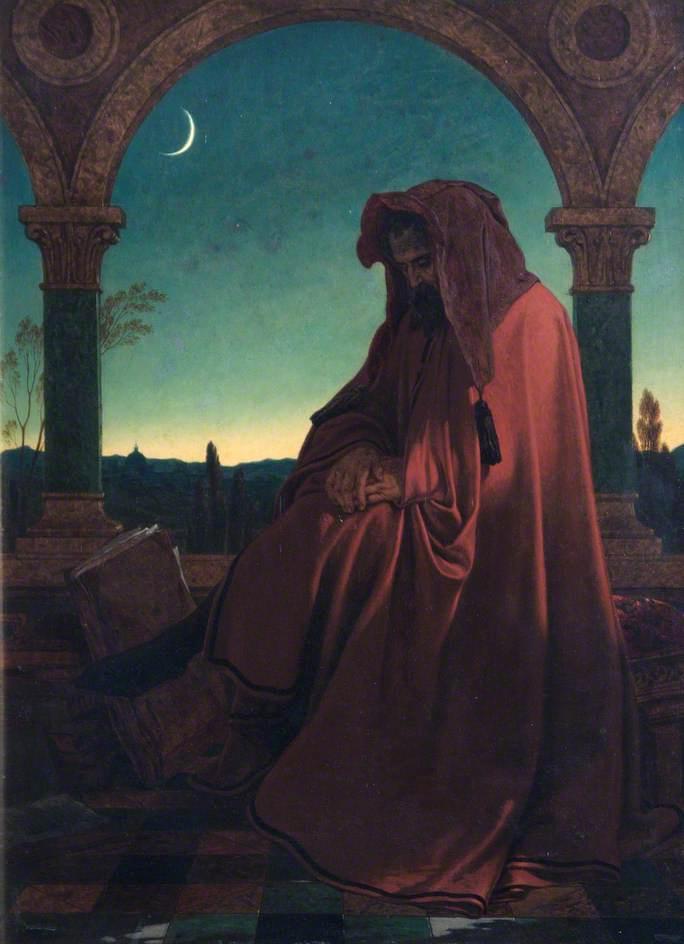
The artwork presents a dramatic portrait of a figure draped in a deep red robe, positioned within an archway formed by classical columns. This central figure dominates the vertically oriented composition, creating a sense of enclosure. Through the arch, a landscape is visible, featuring a crescent moon and a distant horizon line suggesting twilight or dawn. The scene is characterized by a strong use of chiaroscuro, with a single light…

4
In Memoriam (1863) на Джоузеф Ноел Патън

In Memoriam

1863 · Watercolor · Кралска колекция, Лондон

The scene unfolds within the delicate, translucent layers of In Memoriam, a poignant watercolor or gouache study by the Scottish artist Joseph Noel Paton. Created in 1863, this work captures a quiet, spectral moment where the boundaries between the physical and the spiritual begin to dissolve. The paper holds a vision of memory, rendered with a softness that suggests the fleeting nature of life itself.

5
The Man with the Muck Rake (study) (1872) на Джоузеф Ноел Патън

The Man with the Muck Rake (study)

1872 · Oil

The Man with the Muck Rake (study) emerges from the brush of Joseph Noel Paton, a man whose hands were shaped by the intricate patterns of the Scottish textile industry. Born in 1821 in Dunfermline, United Kingdom, Paton carries the precision of a weaver into his work as an artist, illustrator, and sculptor. This particular piece, dating to 1872, captures a moment of intense spiritual or moral focus. It exists…

7
The choice на Джоузеф Ноел Патън

The choice

In "The choice" by Joseph Noel Paton, a heavy tension hangs in the air, freezing a moment of profound conflict. Three figures dressed in medieval clothing occupy the center of the scene, their bodies angled toward one another in a struggle of words or wills. On the left, a man clad in armor stands as a rigid presence, his metallic attire catching the light amidst the unfolding drama. The others…

8
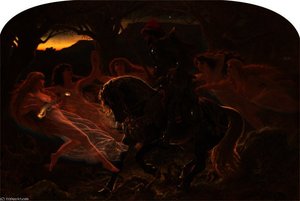
Oskold and the Elle Maids на Джоузеф Ноел Патън

Oskold and the Elle Maids

Oil

A man sits atop a horse, a solitary figure amidst a sudden surge of movement. Around him, the forest breathes with the presence of the Elle Maids. These women, appearing as nymphs or fairies, drift through the shadows and the light, their forms scattered like fallen petals across the woodland floor. Some linger in the foreground, their presence felt in the immediate air, while others recede into the deep green…

9
The Reconciliation of Oberon and Titania на Джоузеф Ноел Патън

The Reconciliation of Oberon and Titania

The Reconciliation of Oberon and Titania emerges from the shadows of a Scottish forest, a scene where magic and emotion collide. Painted in 1847, this oil on canvas work by Sir Joseph Noel Paton captures a moment of profound transition. The air feels heavy with the aftermath of a great dispute, as the fairy rulers move toward a delicate peace. It is a sequel to a previous quarrel, a continuation…

Изборът на Джоузеф Ноел Патън продължава, от 11 до 45

Темите, които привличат погледа на Джоузеф Ноел Патън

Четирите найчесто срещани теми в тези оригинални творби, всяка с най-добрия си пример.

Музеите, в които се съхраняват оригиналите на Джоузеф Ноел Патън

6 музея, които притежават най-голям брой от картините на тази страница.

Музеи Град Творения на Джоузеф Ноел Патън Картини от този списък
Национална галерия на Шотландия, ЕдинбургНационална галерия на Шотландия Единбург 3 The Reconciliation of Oberon and Titania, Dawn - Luther at Erfurt, The Quarrel of Oberon and Titania
Кралска колекция, ЛондонКралска колекция Лондон 2 In Memoriam, 'Home': The Return from the Crimea
Yale Center for British Art, Ню ХейвънYale Center for British Art Ню Хейвън 1 Puck and Fairies, from "A Midsummer Night's Dream"
Laing Art Gallery, New South WalesLaing Art Gallery New South Wales 1 The Man of Sorrows
Sheffield City Art Galleries, SheffieldSheffield City Art Galleries Sheffield 1 The Fairy Queen
Musée de Grenoble, ГренобълMusée de Grenoble Гренобъл 1 Beati mundo corde

Джоузеф Ноел Патън десетилетие по десетилетие: оригиналът, който дефинира всяко от тях

Произведения по десетилетия

Изберете десетилетие, за да видите оригиналната творба, която го определя.

Въпроси на колекционерите относно картините на Джоузеф Ноел Патън

С кое произведение е най-известен Джоузеф Ноел Патън?Разкрийте отговора

Hesperus, the Evening Star, Sacred to Lovers (1857). Следващите са Puck and Fairies, from "A Midsummer Night's Dream" (1850) и Michelangelo's dream.

На каква възраст е бил Джоузеф Ноел Патън, когато е създадена Hesperus, the Evening Star, Sacred to Lovers?Разкрийте отговора

36 години: Hesperus, the Evening Star, Sacred to Lovers е от 1857 г., а Джоузеф Ноел Патън е роден/а в 1821.

Кои са десетте най-известни картини на Джоузеф Ноел Патън?Разкрийте отговора

Hesperus, the Evening Star, Sacred to Lovers, Puck and Fairies, from "A Midsummer Night's Dream", Michelangelo's dream, In Memoriam, The Man with the Muck Rake (study), Michelangelo Sculpting the Statue of 'Night', The choice, Oskold and the Elle Maids, The Reconciliation of Oberon and Titania и Michelangelo's Dream. Класацията по-горе показва годината и музея за всяко от тях.

Колко картини е оставил Джоузеф Ноел Патън?Разкрийте отговора

В нашия каталог са представени 46 произведения на Джоузеф Ноел Патън, датирани от 1849 до 1875.

В кои музеи са изложени шедьоврите на Джоузеф Ноел Патън?Разкрийте отговора

Предимно в Национална галерия на Шотландия (Единбург), Кралска колекция (Лондон) и Yale Center for British Art (Ню Хейвън). В горната таблица с музеи са изброени всички тях.

В кои години Джоузеф Ноел Патън е създал най-известните си произведения?Разкрийте отговора

В 1850s: 4 от 45 произведенията на тази страница са създадени тогава, като Hesperus, the Evening Star, Sacred to Lovers са сред тях.

Кои са първата и последната известни оригинални творби на Джоузеф Ноел Патън?Разкрийте отговора

На тази страница най-старата е The Quarrel of Oberon and Titania (1849), а най-новата е The Man of Sorrows (1875).

Кои теми избира най-често Джоузеф Ноел Патън?Разкрийте отговора

Man (6), Forest (6) и Woman (5), разпределени в 45 произведения на тази страница.

Коя техника използва най-често Джоузеф Ноел Патън?Разкрийте отговора

Oil On Canvas, за 4 от 45 произведения на тази страница.

Към коهoто художествено направление принадлежи Джоузеф Ноел Патън?Разкрийте отговора

Pre-raphaelite и Romanticism, судейки по оригиналите на тази страница.

Кои произведения на Джоузеф Ноел Патън се съхраняват в Национална галерия на Шотландия?Разкрийте отговора

The Reconciliation of Oberon and Titania, Dawn - Luther at Erfurt и The Quarrel of Oberon and Titania: Национална галерия на Шотландия, Единбург притежава 3 от произведенията на тази страница.

Джоузеф Ноел Патън: живот и творчество

A Scottish Visionary: The Life and Art of Sir Joseph Noel Paton

Sir Joseph Noel Paton, a name synonymous with evocative fairy paintings, allegorical scenes brimming with symbolism, and deeply resonant religious depictions—all rooted in the rich soil of Scottish folklore and Pre-Raphaelite influences—was born on December 13th, 1821, in Dunfermline, a textile town steeped in tradition. His early life was inextricably linked to the intricate designs of damask weaving; his parents were skilled designers and weavers themselves, an environment that instilled within him from a young age an unparalleled appreciation for detail, pattern, and the power of visual storytelling. While initially involved in the family business, directing design at a muslin factory, Paton’s true passion lay elsewhere—a yearning to capture the magic and mystery of the world around him through art. This desire led him to Dunfermline Art Academy, where he laid the foundation for a career that would ultimately transcend regional boundaries and establish him as one of Scotland's most distinctive artistic voices.

Early Influences and the Pre-Raphaelite Connection

Paton’s artistic journey was profoundly shaped by his upbringing and early exposure to art. The meticulous craftsmanship inherent in damask weaving—the precise placement of threads, the careful blending of colors—served as a potent metaphor for his own approach to painting. He developed an exceptional eye for detail, meticulously rendering textures, light, and shadow with remarkable accuracy. A brief period of study at the Royal Academy in London in 1843 exposed him to the prevailing artistic currents of the time, but it was through his friendship with John Everett Millais that Paton truly found his artistic bearings. Millais, a key figure within the Pre-Raphaelite Brotherhood—a movement dedicated to reviving the ideals of medieval art and rejecting the conventions of academic painting—invited Paton to join their ranks. While Paton ultimately declined formal membership, he remained deeply influenced by the Brotherhood’s emphasis on truth to nature, detailed observation, and a rejection of idealized beauty. This connection is evident in his early works, such as “The Quarrel of Oberon and Titania” (1847), now a cornerstone of the National Gallery of Scotland's collection—a fantastical scene brimming with vibrant colors, intricate costumes, and a palpable sense of drama.

Weaving Myth and Morality: The Development of a Unique Style

Paton’s artistic journey was characterized by an extraordinary synthesis of diverse influences. He wasn’t merely illustrating tales; he was breathing life into them with meticulous detail and emotional depth. His early works, such as “The Quarrel of Oberon and Titania,” immediately established his reputation for capturing fantastical scenes with remarkable realism. This painting, inspired by Shakespeare's *A Midsummer Night's Dream*, showcases not only technical skill but also Paton’s ability to imbue mythological subjects with psychological complexity. He didn’t simply depict fairies; he portrayed their passions, conflicts, and vulnerabilities—a level of emotional depth rarely seen in contemporary fairy paintings. Beyond the realm of folklore, Paton explored religious themes with equal fervor, as evidenced in works like “Luther discovering justification by faith,” revealing a deep engagement with theological concepts. His ability to seamlessly blend these seemingly disparate subjects—mythology, religion, and everyday life—created a uniquely personal and compelling artistic vision.

Major Works and Royal Recognition

Throughout his career, Paton produced a remarkable body of work that reflects the breadth of his artistic interests and technical skill. “Puck and Fairies” (1857), another iconic image now housed in the National Gallery of Scotland, exemplifies his mastery of capturing the ethereal beauty and mischievous spirit of the fairy world. The painting is filled with intricate details—the shimmering light filtering through the trees, the delicate costumes of the fairies, the expressions of wonder and delight on the faces of the human figures—creating a truly immersive experience for the viewer. “Luther discovering justification by faith” (1875) demonstrates his ability to convey complex theological ideas through powerful visual imagery. These works were not merely aesthetically pleasing; they were imbued with symbolic meaning, inviting viewers to contemplate profound questions about faith, morality, and the human condition. In 1866, Queen Victoria recognized Paton’s exceptional talent by appointing him Her Majesty's Linmer for Scotland—a prestigious honor that solidified his position as the foremost artist in the country. Two years later, he was knighted, a testament to his significant contributions to Scottish art and culture.

Themes, Symbolism, and Lasting Legacy

Paton’s work is deeply imbued with symbolism, reflecting both personal beliefs and the broader cultural anxieties of the Victorian era. His fascination with Celtic legends speaks to a growing interest in national identity and folklore during this period—a desire to reconnect with Scotland's rich heritage. The fairy paintings, while seemingly whimsical, often carry underlying moral messages about temptation, innocence, and the dangers of unchecked desire. Religious works, such as those depicting scenes from the life of Martin Luther, explore themes of faith, redemption, and the struggle against oppression. His meticulous attention to detail—evident in the intricate costumes, landscapes, and facial expressions—adds layers of meaning to his compositions. The use of dramatic lighting and rich color palettes enhances the emotional impact of his paintings. Paton’s works often feature allegorical figures representing abstract concepts like love, death, and justice. He wasn't simply recreating stories; he was using them as vehicles for exploring universal human experiences. Sir Joseph Noel Paton passed away on December 26, 1901, leaving behind a rich artistic legacy that continues to captivate audiences today. His works can be found in prominent museums and collections, ensuring his art remains accessible for generations to come. He stands as a testament to the power of art to transport us to other worlds, explore profound truths, and celebrate the rich cultural heritage of Scotland.