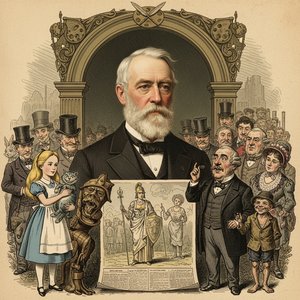
Born: 1846, Bellefontaine, United States of America
Early Life and American Career
Born: July 7, 1846, Bellefontaine, Ohio, USA
Died: August 21, 1927, Mosman, New South Wales, Australia
Parents: Daniel Hopkins and Sarah (née Carter)
Early life was spent on a farm in Ohio. His family had Puritan roots and migrated from the New England region.
He briefly served in the 130th Ohio Volunteer Regiment during the American Civil War.
From 1870 to 1882, Hopkins worked as a freelance cartoonist and illustrator in New York City.
He contributed to various periodicals and specialty publications.
Notable work included *A Comic History of the United States* (1876), which received mixed reception.
Move to Australia and Career with The Bulletin
In 1882, William Traill from The Bulletin in Sydney invited Hopkins to join their staff.
He relocated to Sydney with his family in February 1883.
Hopkins became a central figure at The Bulletin for over thirty years.
He worked under the pseudonym "Hop" and produced thousands of cartoons.
His work satirized political figures, social issues, and events like the Sudan War and the Federation movement.
He established Sydney’s first artists' camp at Balmoral, attracting prominent Australian artists.
Became a part-owner of The Bulletin.
Artistic Style and Influences
Style: Cartoonist and caricaturist with a focus on political satire and humorous commentary.
His draftsmanship was considered less refined than that of Phil May, another prominent cartoonist at The Bulletin.
Despite this, his work was immensely popular due to its accessible humor and relatable observations.
Influences likely included contemporary American cartoonists and illustrators of the period.
His cartoons often featured symbolic figures and allegorical animals, contributing to a broader cultural understanding of political issues.
Major Achievements and Historical Significance
Prolific Output: Produced over 19,000 drawings throughout his career, primarily for The Bulletin.
Cultural Impact: His cartoons played a significant role in shaping public opinion during the lead-up to Federation of Australia.
Popularity with Readers: He was consistently the most popular cartoonist at The Bulletin, contributing significantly to its success and influence.
Establishment of Artists' Camp: His creation of the Balmoral artists’ camp fostered a vibrant artistic community in Sydney.
Contribution to Australian Cartooning: Hopkins is considered a key figure in the development of Australian cartooning and political satire.
Later Life and Legacy
Retired from full-time work at The Bulletin in 1913, though he continued occasional contributions until 1921.
Pursued hobbies including violin making, whittling, and gardening.
Died on August 21, 1927, in Mosman, New South Wales.
His work remains a valuable historical record of late 19th and early 20th century Australia, offering insights into the political climate and social attitudes of the time.
بقلم فريق تحرير OriginalUniqueArt.com
اختبار المعلومات الفنية
لكل سؤال إجابة صحيحة واحدة فقط.
سؤال 1:
Where was Livingston Hopkins born?
سؤال 2:
What publication did Livingston Hopkins work for extensively in Australia?
سؤال 3:
What was Livingston Hopkins' pen name?
سؤال 4:
Before moving to Australia, where did Hopkins work as a cartoonist and illustrator?
سؤال 5:
What was one of Livingston Hopkins' hobbies besides cartooning?
Explore the life & work of Sir John Tenniel, Victorian England's master illustrator & political cartoonist. Discover his iconic 'Alice in Wonderland' art and lasting impact on satire & visual culture.