The Romantic Titan of Napoleonic History
Antoine-Jean Gros, known to many through the evocative lens of his landscapes as Gros Achille, stands as a monumental figure in the transition between the rigid discipline of Neoclassicism and the emotional turbulence of the Romantic movement. Born on March 16, 1771, in Paris, his early life was steeped in the meticulous traditions of fine art, having received his initial training from his father, a skilled miniature painter. This early exposure to delicate craftsmanship instilled in him a lifelong appreciation for precision and detail. However, as he matured, Gros began to seek a more profound expression than the small-scale portraits of his youth could provide. His journey led him into the studio of the legendary Jacques-Louis David, the master of Neoclassicism. While David provided the foundational structure of his technique, a creative friction soon emerged; Gros found himself increasingly drawn toward a more dynamic, Rubensian energy and a vibrant Venetian color palette that defied the austere linearity of his mentor.
The trajectory of Gros’s career was irrevocably altered by the meteoric rise of Napoleon Bonaparte. As the French Empire expanded, so too did the scale of Gros’s ambition. He became the preeminent visual chronicler of the Napoleonic era, possessing a unique ability to translate military conquest into high art. His canvases did not merely document historical facts; they breathed life into the legend of the Emperor. In masterpieces such as Napoleon Visiting the Pesthouse at Jaffa and Napoleon on the Battlefield at Eylau, Gros utilized dramatic lighting and complex compositions to capture the psychological weight of war and the charismatic authority of leadership. Through his brush, the battlefield became a stage for epic human drama, blending the heroic ideals of the past with the visceral, often harrowing realities of contemporary conflict.
A Legacy of Light and Emotion
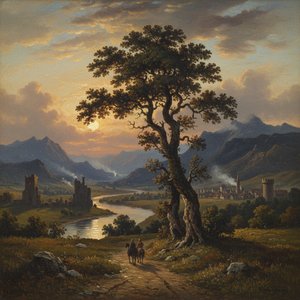
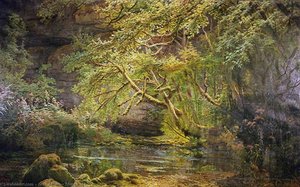
Beyond the grand historical narratives, Gros’s artistic evolution revealed a profound sensitivity to the natural world. His later works, which include serene landscapes such as Lac de Saint Point (bord du lac) and Source et mousses, demonstrate a departure from the structured battlefield toward an exploration of atmosphere and light. In these pieces, one can observe a loosening of the brushstroke and an embrace of impressionistic qualities that foreshadowed the next generation of French painters. His landscapes often evoke a sense of tranquil solitude, using muted colors and soft textures to invite the viewer into a contemplative state. This duality—the ability to command both the chaotic energy of war and the quietude of nature—is what defines his singular contribution to 19th-century art.
The historical significance of Antoine-Jean Gros cannot be overstated, as he served as a vital bridge between eras. His influence rippled through the art world, impacting luminaries such as Eugène Delacroix and providing a foundation for the development of Romanticism in France. By integrating the technical rigor of his Neoclassical training with a new, emotive vocabulary, he helped liberate art from the constraints of strict imitation. His life, which ended in Paris on June 26, 1835, left behind an oeuvre that remains a testament to a period of unparalleled historical transformation, capturing both the glory of an empire and the enduring beauty of the natural landscape.