The Veronese Visionary: The Life and Legacy of Giovanni Francesco Caroto
In the vibrant tapestry of the Italian Renaissance, few threads are as intricately woven as those left by Giovanni Francesco Caroto. Born in Verona around 1480, Caroto emerged from a landscape deeply influenced by the rigorous classical traditions of Mantegna. His early years were shaped by the mentorship of Liberale da Verona, a period that instilled in him a profound respect for anatomical precision and a restrained, monumental grandeur. This foundational training provided the technical scaffolding upon which he would later build a style far more fluid, expressive, and experimental than the rigid structures of his predecessors.
As Caroto’s journey took him beyond the borders of Verona, his artistic soul underwent a transformative evolution. His time in Milan proved to be a watershed moment, placing him in the presence of the era's most formidable intellects and creators. The subtle shadows and atmospheric depth of Leonardo da Vinci, combined with the harmonious grace of Raphael, acted as catalysts for change. Through these encounters, Caroto began to move away from the static perfection of the early Renaissance, embracing instead the burgeoning complexities of Mannerism. This transition was marked by a newfound interest in compositional tension, elongated forms, and a more emotive use of light and color that would define his mature period.
Mastery of Form and the Mannerist Shift
The brilliance of Caroto’s oeuvre lies in his ability to balance the naturalism of his training with the stylized elegance of the Mannerist movement. His works often serve as a bridge between two eras, capturing the divine beauty of the High Renaissance while hinting at the dramatic distortions of the later sixteenth century. In masterpieces such as Madonna and Child, one can observe a breathtaking synthesis of rich, Venetian color palettes and a profound sense of spiritual intimacy. He possessed a unique talent for rendering the human figure with both physical weight and an ethereal, almost otherworldly, grace.
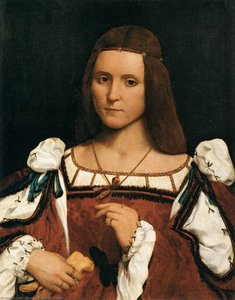
Caroto’s technical prowess extended into the realm of portraiture, where he captured the psychological depth of his subjects with remarkable sensitivity. His Portrait of a Woman stands as a testament to his ability to use texture, light, and subtle facial expressions to convey character and status. This mastery of detail was not merely decorative; it was an exploration of humanist ideals, seeking to find the eternal within the individual. Whether depicting sacred figures or contemporary nobility, Caroto infused his canvases with a sense of movement and life that resonated far beyond the frame.
A Lasting Influence on the Venetian School
Beyond his individual achievements, Caroto’s historical significance is cemented by his role as a vital conduit for artistic innovation. He was not merely a practitioner of art but a custodian of its future. Alongside Antonio Badile, Caroto played a crucial role in nurturing the next generation of masters. Most notably, he served as a teacher to Paolo Veronese, one of the most celebrated painters of the Venetian school. By passing on his refined techniques and his experimental spirit, Caroto ensured that the stylistic advancements he helped pioneer would flourish in the works of the great Mannerist successors.
The legacy of Giovanni Francesco Caroto is found in the enduring vitality of the Venetian Renaissance. His life’s work represents a period of intense intellectual and aesthetic ferment, where the boundaries of tradition were tested and expanded. Through his ability to absorb the influences of giants like Da Vinci and Raphael while forging his own path, he helped shape the visual language of an entire epoch. Today, as we gaze upon his surviving works in museums across the globe, we witness the enduring power of a master who dared to embrace change, leaving behind a trail of beauty that continues to inspire awe.