The Soul of the Cap-Haïtien Streets
Etienne Chavannes, a visionary whose brush captured the very heartbeat of Haiti, emerged from the vibrant cultural landscape of the Caribbean to leave an indelible mark on art history. Born in 1939 in the historic city of Cap-Haïtien, his formative years were steeped in the rich traditions of Creole culture and marked by a profound engagement with the social realities of his homeland. Growing up as the eldest of eight children in a family connected to the rhythms of trade and craftsmanship, Chavannes developed an acute eye for the storytelling inherent in everyday life. His early education in the storied halls of Collège Marius Levy and Colliente Oswald Durand provided him with a foundation that would later allow him to translate the bustling energy of Haitian society into a visual language that was both deeply personal and universally resonant.
His artistic journey, which truly took flight in the 1960s, was fueled by an intense inspiration drawn from the landscapes and social tapestries of Haiti. While his roots were firmly planted in the traditions of the Ecole du Cap, Chavannes’s vision extended far beyond mere documentation. He possessed a rare ability to look past the surface, famously stating, “I don’t paint things as I see them with my eyes, but as I see them with my mind.” This philosophy guided his transition from simple observation to a complex, structural approach to painting. Influenced by the principles of Proto-Cubism and Fauvism, he embraced the power of simplified geometric forms and an expressive, almost visceral color palette. By adopting a technique reminiscent of Cézanne’s emphasis on structural reduction, Chavannes meticulously rendered volume and space through bold brushstrokes and vibrant hues, creating canvases that felt less like static images and more like living, breathing entities.
A Symphony of Movement and Celebration
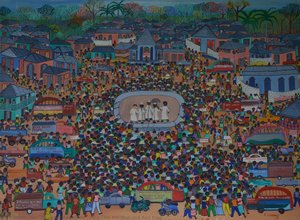
The true magic of Chavannes’s oeuvre lies in his unparalleled ability to convey atmosphere and narrative through the depiction of the crowd. He was a master of the communal experience, finding profound beauty in the organized chaos of religious celebrations, funerals, weddings, and sporting events. His paintings are characterized by a sense of dynamism; the viewer does not merely look at a scene but is swept up in it. In his celebrated work, “Military Parade,” one can feel the palpable fervor of Haiti's independence day celebrations. The canvas pulsates with the grandeur of the ceremonial march and the collective joy of the spectators, serving as a monumental testament to his command over composition and color.
Beyond the celebratory, Chavannes’s work carries a significant sociological weight. His canvases often serve as historical chronicles, capturing the "great and small" histories of a people. Whether depicting the political shifts of the Duvalier era or the quiet dignity of rural life in Petit-Goave, his art functions as a vital record of Haitian identity. This depth of meaning elevated his work above the labels of "naive art," positioning him instead as a painter of profound historical and sociological importance. His ability to weave together the following elements defined his legacy:
- The Pulse of the Crowd: Transforming mass gatherings into rhythmic, energetic compositions.
- Structural Mastery: Utilizing bold, simplified forms to create a sense of lasting permanence within fleeting moments.
- Chromatic Vitality: Using a vibrant palette to mirror the intense emotional landscape of Caribbean life.
- Historical Narrative: Documenting the evolution of Haitian society through both celebratory and somber lenses.
Legacy and Global Resonance
The reach of Etienne Chavannes’s talent extended well beyond the borders of Haiti, finding resonance in prestigious international venues. His works have graced the halls of the Brooklyn Museum in New York and the Musée d’art et d’histoire de Cholet in France, proving that the specificities of Haitian life could speak to a global audience. Through his mastery of movement and his dedication to capturing the essence of his culture, Chavannes ensured that the spirit of Cap-Haïtien would endure. He remains a cornerstone of Caribbean art, an artist who did not just paint scenes, but who breathed life into the very fabric of history, leaving behind a legacy of color, motion, and unyielding celebration.