A Swedish Master Across Borders: The Life and Art of Carl Frederik von Breda
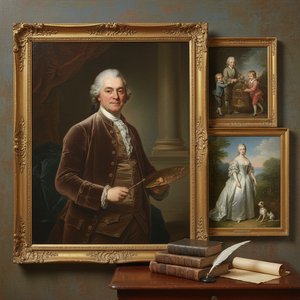
Carl Frederik von Breda occupies a fascinating, somewhat unique position in the history of European portraiture. Born in Stockholm in 1759, his artistic journey wasn’t confined by national boundaries but rather flourished through an intriguing interplay between Swedish tradition and British innovation. Descended from Pieter von Breda, a Dutch emigrant who settled in Sweden around 1670, Carl inherited not only an artistic lineage—his grandfather Lucas was a painter, and his father, Lucas the younger, an art collector and arbitrator—but also a cosmopolitan sensibility that would shape his career. This upbringing fostered within him a deep appreciation for aesthetics and laid the groundwork for his future success. From a young age, Breda demonstrated exceptional talent, enrolling at the Royal Swedish Academy of Arts at nineteen where he studied historical and portrait painting under Lorens Pasch the Younger. Early recognition came swiftly; prizes accumulated, and by 1784, he was already exhibiting nineteen paintings and receiving commissions for royal portraits—including those of Duchess Hedvig Elisabeth Charlotte, Crown Prince Gustavus Adolphus, and King Gustavus III himself. These early works reveal a nascent talent, grounded in the established Swedish style but hinting at an ambition that extended beyond its borders.London Calling: The Influence of Reynolds and British Portraiture
A pivotal moment arrived when Breda faced a difficult choice after losing a competition at the Academy. Rather than following the conventional path to Paris and Rome, he made the bold decision to relocate to London with his family in 1786. This move proved transformative. In London, Breda sought out and secured tutelage under the esteemed portraitist Sir Joshua Reynolds. While Reynolds wasn’t known for intensive instruction, his influence on Breda was profound, instigating what has been described as a “revolutionary change” in the young artist's style. Breda quickly established a successful studio on St James's Street, attracting a clientele drawn from London’s intellectual and social elite—the "learned men and literati," as they were known. He became sought after for his ability to capture not just likeness but also character and intellect. His portraits during this period include prominent figures such as abolitionists Thomas Clarkson and James Ramsay, engineers James Watt and Matthew Boulton of the famed Lunar Society, botanist William Withering, and Mary Priestley. These weren’t merely commissions; they were engagements with some of the most forward-thinking minds of the era. A testament to his growing reputation was his portrait of Reynolds himself, completed as a diploma piece for admission to the Stockholm Academy of Arts in 1791—a symbolic acknowledgement of his artistic debt and achievement.Return to Sweden and Artistic Maturity
In 1796, Breda returned to Stockholm, accepting a professorship at the Academy of Arts. This marked a new phase in his career, one characterized by artistic maturity and a distinctive style honed during his years in England. He was immediately inundated with portrait commissions, quickly becoming a leading figure in the Swedish art scene. His brushwork became bolder and more spirited, reflecting the energy and dynamism he had absorbed in London. The late 1790s are often considered to be among his finest years, with works exhibiting an early embrace of Romantic sensibilities. Notable portraits from this period include those of his father Lucas, two of his nephews, the scholar Nils von Rosenstein, and perhaps most celebrated of all, Teresa Vandoni, a renowned Italian singer performing at the Royal Swedish Opera. The portrait of Vandoni is particularly striking, capturing her dramatic presence and vocal artistry with remarkable sensitivity. These works demonstrate Breda’s ability to synthesize classical training with a modern sensibility, creating portraits that were both technically accomplished and emotionally resonant.Legacy and Historical Significance
Carl Frederik von Breda's impact on Swedish art extended far beyond his own prolific output. His exposure to British artistic trends—particularly the influence of Reynolds—helped modernize portraiture in Sweden, inspiring subsequent generations of artists to embrace new techniques and stylistic approaches. He wasn’t simply a painter of faces; he was a chronicler of his time, creating a visual record of some of the leading scientific, intellectual, and cultural figures of the late 18th and early 19th centuries. His portraits of members of the Lunar Society, for example, offer invaluable insights into this influential group of innovators. The artistic legacy continued within his family; his son, Johan Fredrik von Breda, followed in his father’s footsteps, receiving tutelage from him and continuing the family tradition. While some critics noted a perceived decline in consistency in his later works—a tendency towards monotony—Breda remained an important figure in Swedish art history until his death in Stockholm in 1818. He is remembered today as “the Van Dyck of Sweden,” a testament to his skill, elegance, and enduring contribution to the world of portraiture.Key Works & Collections
- James Watt: A compelling portrait of the renowned engineer, held in the National Portrait Gallery, London.
- Matthew Boulton: Another significant work depicting a member of the Lunar Society, residing in Birmingham Museum and Art Gallery.
- Teresa Vandoni: Often considered his most celebrated piece, capturing the essence of the Italian opera singer.
- Portrait of Joshua Reynolds: A testament to Breda’s admiration for his mentor and a key work in establishing his own artistic credentials.
- Mrs. William Hartigan: An example of his skill in capturing the elegance and refinement of society figures.
الأسئلة والأجوبة
أين يمكنني العثور على أعمال Carl Fredrik von Breda الفنية المصنفة حسب اللون؟
يمكن استكشاف أعمال Carl Fredrik von Breda حسب اللون عبر صفحة مؤشر الألوان الخاصة بالفنان.
كيف يمكنني متابعة أعمال Carl Fredrik von Breda عاماً بعد عام؟
يوجد جدول زمني لأعمال Carl Fredrik von Breda: حيث ترتب صفحة الخط الزمني للأعمال الفنية الخاصة بالفنان الأعمال الفنية حسب تاريخ إنشائها.
هل يوجد سجل زمني لمسيرة Carl Fredrik von Breda؟
تتجلى المسيرة المهنية لـ Carl Fredrik von Breda مرحلة تلو الأخرى في صفحة سجل زمني: وهي عبارة عن خط زمني أفقي للأعمال الفنية، مُصنفة ضمن فصول تمثل كل حقبة من مسيرته.