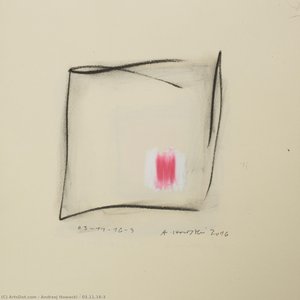
A Life Shaped by Geometry: The World of Andrzej Nowacki
Andrzej Nowacki, born in 1953 in the tranquil spa town of Raków-Zdrój, Poland, is an artist whose life has been a dedicated exploration of
geometric abstraction. His journey began not within the hallowed halls of art school, but through practical experience – a formative period spent immersed in
interior design and the delicate craft of art restoration in Kraków. This early exposure instilled in him a profound understanding of form, structure, and the subtle interplay between space and object, laying the groundwork for his future artistic endeavors. A restless spirit led him to pursue higher education abroad, initially studying Scandinavian languages at the University of Gothenburg before shifting his focus to
Art History at the University of Innsbruck, Austria. This intellectual curiosity, coupled with a growing fascination with visual language, would prove pivotal in shaping his unique artistic vision.
The Polish Constructivist Spark and European Dialogue
The 1980s marked a turning point for Nowacki, as he discovered the powerful aesthetic of Polish
Constructivism. The work of Henryk Stazewski resonated deeply, offering a compelling framework for his own explorations into pure abstraction. Stazewski’s commitment to
geometric form and harmonious composition became a guiding principle, influencing Nowacki's early works and instilling in him a belief in the power of reduction and clarity. This period wasn’t one of isolated study, however. A crucial collaboration with Heinz Teufel, a prominent collector and owner of a leading
concrete art gallery in Cologne and Berlin, broadened Nowacki’s horizons immeasurably. Teufel provided not only invaluable mentorship but also vital exposure within the
European art scene, connecting him to a network of artists and thinkers who shared his passion for
geometric abstraction. This dialogue with the wider artistic community helped refine Nowacki's vision and solidify his place within the evolving landscape of
contemporary art.
Op Art Principles and the Expansion of Scale
Nowacki’s mature work is characterized by a steadfast dedication to the principles of
Op Art and
Concrete Art. He primarily creates dynamic geometric reliefs that delve into the complexities of optical perception and
color theory. These are not merely static compositions; they are carefully orchestrated arrangements of shapes and colors designed to create visual vibrations, illusions of movement, and a heightened awareness of spatial relationships. A defining aspect of his style is the exploration of multi-part and large-format works, pushing the boundaries of scale and challenging viewers to engage with the artwork on a physical as well as intellectual level. He meticulously crafts each element, understanding that even subtle shifts in color or form can dramatically alter the overall impact of the piece. The artist himself describes colour as being more than just an addition to light; it is a language unto itself, capable of evoking profound emotional responses and sparking imaginative thought.
Recognition and Continued Evolution
Throughout his career, Andrzej Nowacki has received significant recognition for his contributions to
abstract art. He was awarded a private scholarship in West Orange, New Jersey, in 1994, providing him with the opportunity to further develop his artistic practice. Participation in workshops “Under the Sign of Geometry” organized by Bozena Kowalska in Okuninka, Poland between 1997 and 2001, fostered a collaborative spirit and deepened his understanding of geometric principles. In 2001, he received a prestigious scholarship from the
New York Pollock-Krasner Foundation, affirming his standing within the international art community. His work has been exhibited globally, including a significant showing in Osaka, Japan, in 2005, and a period of focused creation at Anna Maria Island, Florida, USA, leading to exhibitions with Seth Jason Beitler Gallery in Miami. In 2015, he established a large-scale studio in the former industrial area of Ostrava Lower Vítkovice, Czech Republic, providing him with the space and resources to pursue increasingly ambitious projects. Currently residing and working in Berlin, Germany, Nowacki continues to push the boundaries of his artistic practice, creating compelling and visually stimulating artworks that challenge perceptions and invite contemplation. His dedication to
geometric abstraction ensures his continued relevance as a significant figure in the ongoing dialogue surrounding
abstract art.
A Legacy of Order and Vibration
Andrzej Nowacki’s work represents not merely a continuation but an evolution of Constructivist principles within a contemporary context. He stands as a testament to the enduring power of
geometric abstraction, demonstrating its capacity to evoke emotion, stimulate intellect, and challenge our understanding of visual space. His dedication to exploring optical effects and his masterful manipulation of color and form position him as a vital voice in the world of
abstract art – an artist who invites us to look beyond the surface and discover the hidden harmonies within seemingly simple shapes.
His reliefs are not just objects to be seen, but experiences to be felt. They whisper of order amidst chaos, of stillness within movement, and of the profound beauty that can be found in the fundamental elements of form and color.