The Twilight of Tradition: From Impressionism to Post-Impressionist Foundations
 Breaking Tradition: A Definitive Guide to the Evolution of Early Modernism and the Avant-Garde
The Twilight of Tradition: From Impressionism to Post-Impressionist Foundations Post-Impressionism Post-Impressionism (also spelled Postimpressionism) was a predominantly French art movement which developed roughly between 1886 and 1905, from the las...
However, as the century drew to a close, a profound dissatisfaction began to stir within the artistic community. While the Impressionists had mastered the depiction of light, they had left behind the structural integrity of the subject. This tension birtized Post-Impressionism, a period roughly spanning from 1886 to 1905, which acted as a vital bridge between sensory observations and conceptual abstractions. Artists began to move beyond mere naturalism, seeking instead to imbue their canvases with symbolic content and more permanent, structured forms. They were no longer content to simply record what the eye saw; they sought to express what the soul felt and what the mind understood about the underlying architecture of reality. For the discerning collector, these works represent the very foundation of modern thought, a period where the transition from the observable to the felt began in earnest.
Shattering Perspective: The Geometric Revolution of Cubism
 The Avant-Garde Revolution: Transforming Luxury Spaces with Bold, Boundary-Breaking Masterpieces
The Great Disruption: How the Avant-Garde Shattered the Renaissance Perspective Cubism Explained: How Picasso and Braque Shattered Reality to Redefine Modern Art The Genesis of Fragmentation: Breaking from Renaissance Perspective Cubism Unveiled: How...
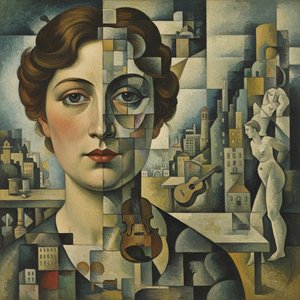
This movement replaced the single-point perspective of the Renaissance with a complex, fragmented reality. It was not merely an aesthetic choice but a profound intellectual shift that mirrored the accelerating pace of modern life. To stand before a Cubist masterpiece is to witness the genesis of fragmentation. At OriginalUniqueArt.com, our artists approach these works with the same reverence for structure, utilizing 100% cotton canvas and meticulous layering to recreate the tactile depth and complex planes that define this era. Our hand-painted oil reproductions capture the essential tension between form and space, ensuring that the visible brushstrokes and tonal range of the original revolution are preserved in every custom commission.
Chromatic Intensity: Fauvism and the Power of Pure Color
As Cubism explored the architecture of form, another group of radicals sought to explore the architecture of emotion through color. The Fauves, or "wild beasts," emerged with a palette so vibrant and uninhibably bold that it initially scandalized the established art world. Moving far beyond the soft, light-drenched palettes of the Impressionists, Fauvist artists used color as an independent language, detached from the descriptive requirements of reality.In these works, a tree might be rendered in brilliant crimson, or a face in shocking green, not because the subject demanded it, but because the emotional resonance of the hue required it. This movement emphasized the autonomy of the medium itself—the idea that color could exist purely for its own sake. This era of intense chromatic experimentation paved the way for much of the abstraction to follow. For those looking to transform a contemporary space with this level of energy, we offer the ability to "remix" history, allowing you to request your own subjects be painted in the light-drenched or color-saturated styles of these legendary masters.
The Russian Vanguard: Rayonism, Suprematism, and the Search for New Forms
 Mikhail Larionov: Rayonism, Primitivism & the Dawn of Russian Avant-Garde Painting
The Precursors: Russian Art Before the Avant-Garde Wikipedia: Russian avant-garde The Russian avant-garde was a large, influential wave of avant-garde modern art that flourished in the Russian Empire and the Soviet Union, approximately from 1890 to 1...
A seminal work like Ekster's Color Construction (1912) stands as a breathtaking testament to this era, where representation began to dissolve into an exhilarating exploration of geometric form and pure color. This was art stripped of narrative, inviting the viewer to engage with the "pure feeling" of the composition. The legacy of this movement is found in the works of artists like Lazar Khidekel, whose vision bridged the gap between painting and the very blueprints of human existence. Our studio honors this tradition of precision by providing museum-grade reproductions that respect the sharp angles and vibrant, vibrating color relationships central to the Suprematist vision.
Dreams and Distortions: The Emergence of Surrealist Vision
 Untitled
A Fragment of Surrealist Vision: Exploring Amadeo de Souza-Cardoso’s “Untitled” The painting "Untitled," created by Portuguese modernist Amadeo de Souza-Cardoso in 1915, stands as a testament to the burgeoning surrealist movement and Cardoso's singul...
One can see this beautifully distilled in the works of Portuguese modernist Amadeo de Souza-Cardoso, whose 1915 Untitled utilizes the delicate fluidity of watercolor to create a sense of unsettling, ethereal beauty. Here, recognizable elements are subtly warped against muted backdrops, mirroring the fragility of memory and the complexity of the dream state.
At OriginalUniqueArt.com, we believe that art is a lasting memory. Whether you are seeking to commemorate a personal milestone through a custom portrait or wish to bring the haunting beauty of a Surrealist masterpiece into your home, our process ensures excellence:
- Hand-Painted Excellence: Every piece is 100% hand-painted on cotton canvas, ensuring the physical texture and depth that digital prints simply cannot replicate.
- Bespoke Customization: Through our Professional Digital Mockup Service, you can see your composition before the first brushstroke touches the canvas, allowing for unlimited revisions to ensure perfection.
- Global Preservation: Using specialized oils and a protective Damar varnish, we ensure that these historical echoes remain vibrant and protected from the elements for generations.